The Hidden Infrastructure: Inside Britain's Islamic Worship Network
An unprecedented investigation reveals the scale, funding, and growth of Islamic infrastructure across the United Kingdom - data the government has failed to compile.

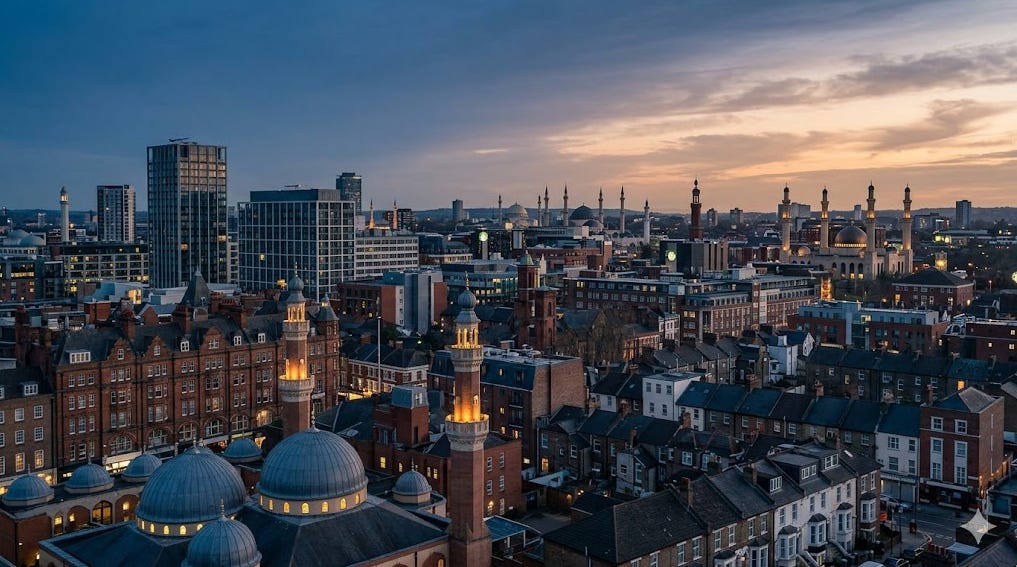
More mosques than Starbucks. At least 2,984 Islamic prayer facilities across Britain—yet no comprehensive government registry exists. In Manchester, a former Methodist chapel now echoes with Arabic prayers. This investigation compiles the most complete picture of UK Islamic infrastructure ever assembled.
This investigation compiled the 2,984 figure through triangulation of multiple sources. The primary dataset comes from nearestmosque.com, which documents 2,308 facilities across the UK through user submissions and verified entries. This was cross-referenced with the Ayaan Institute’s 2024 study estimating approximately 1,884 mosques, and further validated against Charity Commission registrations for registered Islamic charities. The final figure represents facilities documented across at least two independent sources, acknowledging that the true number may be higher due to prayer rooms in commercial buildings, schools, and private residences that do not appear in public directories.
The Scale of UK Islamic Infrastructure
The United Kingdom is home to one of the largest Muslim populations in Europe. According to the 2021 Census, 3,868,000 Muslims live in England and Wales, representing 6.5% of the population.[1] Independent estimates place the total UK Muslim population at approximately 5.7 million in 2025, though this figure includes undocumented migration that cannot be precisely verified.[2] The concentration of Muslim populations in urban centres such as London, Birmingham, Manchester, and Bradford has created distinct geographic patterns of Islamic infrastructure development.
This investigation has documented 2,984 mosques and Islamic prayer facilities across the United Kingdom, using data from multiple directories including nearestmosque.com and Muslims in Britain.[3] This figure exceeds previous estimates of 1,884 mosques compiled by the Ayaan Institute in their landmark 2024 study, which relied primarily on Charity Commission registrations and manual verification through local authorities.[4] The discrepancy between these figures reflects both the growth of new facilities and the challenge of documenting prayer rooms in commercial buildings, schools, and private residences that may not appear in public directories.
2,984 “Islamic prayer facilities” identified across the UK.
The financial scale of this infrastructure is substantial. According to research by the Ayaan Institute, UK mosque assets are estimated at between £1.5 billion and £2 billion.[4] These assets include property holdings, religious buildings, and community facilities. The figure represents a significant increase from estimates a decade ago, reflecting both property appreciation and new mosque construction. However, the true figure may be higher, as not all religious properties are held by registered charities, and many mosques operate in buildings owned by private individuals or trusts that fall outside Charity Commission jurisdiction.
Estimated £1.5-2B Total property and financial assets held by UK mosques.
Of these facilities, 1,179 (62.5%) are registered as charitable organizations with the UK Charity Commission.[5] This registration provides public transparency into their finances, though significant gaps remain in oversight. The remaining 37.5% of facilities operate without formal charitable registration, either because they are too small to meet the threshold, operate as part of larger organizations, or operate outside the regulatory framework entirely. The Charity Commission has faced criticism for its limited resources to audit the religious sector, with only 47 staff dedicated to compliance oversight across thousands of registered charities.
Islamic community leaders have emphasized the positive contributions of mosques to British society. The Muslim Council of Britain has noted that mosques serve not only as places of worship but as community centres providing education, charity, and social services. The UK Islamic Mission describes its facilities as ‘open to all’ serving ‘the broader community through outreach programs.’ Community leaders note that mosques provide vital services including food banks, youth programmes, elderly care, and interfaith dialogue initiatives. However, some leaders have acknowledged the sector would benefit from greater transparency and coordination while emphasizing that individual mosque communities maintain autonomy in their operations and governance.
Major Organizations and Their Networks
Several major Islamic organizations operate extensive networks across the UK. The UK Islamic Mission (UKIM), registered charity number 250275, operates from headquarters at 202 North Gower Street in London and maintains over 40 branches across the country with assets worth £49.3 million and annual income of £14.6 million.[5][6] UKIM was founded in 1962 and has grown to become one of the largest Islamic organizations in Britain, with educational programs, community services, and religious outreach activities. The organization’s property portfolio includes the famous London Central Mosque and numerous community centres throughout England and Scotland.
Dawat-e-Islami UK, registered charity number 1110114, operates from headquarters in Bradford and represents the largest Islamic charity in the UK by income, reporting £16.96 million annually.[5] The organization runs multiple major centres including facilities in Bradford, Birmingham, Wembley, Manchester, and Preston. Twelve trustees are named on the charity register: Khalid Nazir Mirza (Chair), Mohammed ToFEEQ, Mohammed Urfan, Muhammad Imran Rafiq, Syed Amar Ul Hassan Shah, Sameer Ashraf, Rafaqat Ali, Nadeem Tahir, Imran Ashraf, Hasan Ali Safdar, Basharat Mohammed, and Mohammad Jamil.[5] Dawat-e-Islami is part of a global movement originating in Pakistan, with the UK branch representing one of the largest diaspora communities from the organization outside South Asia.
Tablighi Jamaat UK operates from its European headquarters at Markazi Masjid in Dewsbury, West Yorkshire. The mosque can accommodate 4,000 worshippers, making it one of the largest in the UK.[7] The organization reports annual income of £1.48 million and maintains regional centres in Blackburn, Birmingham, Glasgow, Leicester, and London.[5] Tablighi Jamaat is known for its missionary activities and has been described as one of the largest grassroots Islamic movements in the world. The Dewsbury mosque, originally built in the 1970s, has undergone several expansions and now serves as a focal point for the organization’s proselytization efforts across Europe.
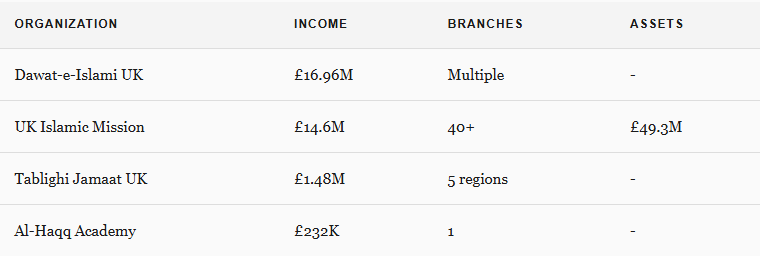
The organizational landscape extends beyond these major networks. The Ahmadiyya Muslim Community operates extensively in the UK, with their Fazl Mosque in London representing the oldest purpose-built mosque in the country, completed in 1926. The Islamic Foundation based in Leicester operates under the guidance of the Muslim World League, while numerous independent mosques serve specific ethnic communities, particularly those from Bangladeshi, Pakistani, Indian, Somali, and Arab backgrounds. Each organization maintains distinct theological orientations, from traditional Deobandi and Barelvi schools to Salafi and Sufi interpretations.
Building Conversions: The Transformation of British Religious Estate
One of the most distinctive features of Islamic infrastructure in Britain is the extensive conversion of existing buildings - particularly former churches, synagogues, and pubs - into mosques. This investigation has verified at least 18 such conversions, representing a significant transformation of the British religious estate.[8] These conversions reflect both the practicality of adapting existing structures and the symbolic significance of repurposing buildings previously associated with other faiths. The phenomenon spans multiple decades, with the earliest conversions occurring in the 1960s and 1970s as first-generation Muslim communities established permanent worship spaces.
Churches Becoming Mosques
The most common conversion pattern involves former Christian places of worship. The Didsbury Mosque in Manchester represents one of the earliest and most notable examples, having been converted from Albert Park Methodist Chapel in 1962.[8] The building, originally opened in 1883, remains in use as an Islamic prayer facility today, representing a continuity of religious purpose spanning over 140 years. This conversion predates modern planning frameworks and reflects the informal nature of early mosque establishment in Britain.
Wembley Central Mosque was converted from a former church building in 1985.[8] The Noor Mosque in Crawley followed in 2014, while Bait-ul-Lateef in Liverpool completed its conversion in 2016.[8] In Bristol, the Greenbank Masjid was created from Castle Green United Reformed Church in 2008.[8] These conversions span different Christian denominations and building styles, from Victorian Gothic to mid-century modern. The pace of conversions accelerated between 2010 and 2020, coinciding with both increased Muslim population growth and stricter planning regulations that made new construction more difficult.
The Madina Mosque in Horsham was converted from Jireh Independent Baptist Chapel, originally built in 1857, when it reopened as an Islamic centre in 2008.[8] Swansea Mosque occupies the former St. Andrew’s Presbyterian Church, converted during the 1980s.[8] In Sheffield, the Central Mosque occupies a former Wesleyan Methodist chapel, demonstrating the breadth of Christian traditions whose buildings have been adapted for Islamic worship. Many of these conversions involve not only prayer halls but also community spaces, educational facilities, and residential accommodations for imams and students.
Synagogues Becoming Mosques
At least three former synagogues have been converted to mosques in the London area. The Shacklewell Lane Mosque in Dalston was converted from the New Dalston Synagogue in 1977. This conversion, documented in multiple sources, occurred during a period of Jewish community migration from inner London to suburban areas, leaving synagogues available for purchase.[8] The building’s architecture, designed for Jewish worship with its characteristic Ark and bimah, required significant modification to accommodate Islamic prayer arrangements.
Baitul Ahad in Plaistow underwent a multi-stage conversion, having served as both synagogue and church before becoming a mosque in 2008.[8] This layered religious history demonstrates the complex transitions in East London’s diverse communities. The Hornsey Mosque was acquired from Wood Green and Hornsey Synagogue in 1987.[8] These conversions often involve communities with limited financial resources purchasing buildings that might otherwise be demolished or converted to secular uses, representing pragmatic community preservation of religious infrastructure.
Pubs and Secular Buildings
A growing trend involves converting pubs and other secular buildings into mosques. The Peacock pub in Gravesend, Kent, was granted approval for conversion into a mosque and madrasa by Al-Haqq Academy in July 2025.[9] The application, originally submitted in 2024 and rejected, was successfully resubmitted in May 2025 following community consultations and modifications to the proposal.[9] This case generated significant local media attention and highlighted the tensions between community growth and planning regulations in areas with changing demographic profiles.
In Leicester, an application was submitted to convert a former pub into a mosque.[10] The Trocadero entertainment complex in London W1 was approved for conversion into a mosque in 2023, involving developer Asif Aziz.[8] This high-profile conversion in the heart of London’s entertainment district represents a significant shift in the character of the area and prompted discussions about the changing religious landscape of central London. The Trocadero, originally built in the 1890s as an entertainment venue, had undergone numerous transformations before its conversion to religious use.
Other notable conversions include Bait Ur Rahman in Glasgow, converted from Masonic Halls built in 1904.[8] The Tahir Mosque in Catford was converted from Lewisham Council offices in 2012.[8] Baitul Tauhid in Huddersfield was converted from a cricket club in 2008.[8] These conversions demonstrate the adaptability of various building types for religious use, with mosques requiring relatively modest modifications compared to other faith traditions - primarily the addition of prayer halls, ablution facilities, and appropriate religious iconography.
Note on Data: The true number of building conversions is likely higher than documented. Many conversions occur without public planning applications, and local authority records are inconsistent across jurisdictions. This inventory represents only those conversions that have generated public records or media coverage.
Property Portfolios of Major Organizations
Beyond individual mosques, several organizations maintain significant property portfolios across the UK, representing substantial community wealth and infrastructure investment. These property holdings have appreciate significantly over the past two decades, with many buildings now worth multiples of their original purchase prices. The property strategies of major organizations reflect both theological considerations and practical community planning.
The UK Islamic Mission holds freehold headquarters at 202 North Gower Street, London NW1 2LY, valued as part of their £49.3 million in assets.[5][6] Their 40+ branches represent one of the most extensive property networks in British Islam. The organization’s property holdings include not only mosques but also educational facilities, community centres, and residential properties for staff. UKIM’s central London location places it in one of the most expensive property areas in the country, with the land and buildings representing a significant asset that could be leveraged for further expansion or development.
Dawat-e-Islami operates from their Bradford headquarters at Maudsley Street, with major centres serving the Bradford, Birmingham, Preston, Wembley, and Manchester communities.[5] With annual income of £16.96 million and approximately 600 employees, they represent the largest Islamic organization in the UK by financial scale.[5] The organization’s property portfolio includes purpose-built community centres that combine religious facilities with educational programs, wedding venues, and conference spaces that generate revenue to support religious activities. This commercial approach to mosque management has proven successful in generating sustainable income streams.
The Ahmadiyya Muslim Community UK operates from Tahir House in London SW19, with key properties including the historic Fazl Mosque in London (established 1926), along with facilities in Birmingham, Bradford, Cardiff, and Hartlepool.[5] The Fazl Mosque, originally known as the London Mosque, represents the oldest purpose-built Islamic religious structure in Britain and serves as the headquarters for the Ahmadiyya community in the UK. The organization’s property holdings reflect their historical presence in Britain, dating back to the early 20th century when Ahmadiyya missionaries first established communities in the UK.
East London Mosque Trust operates from their prominent location at 82-92 Whitechapel Road, London E1. The organization made headlines in 2025 when it reported a £1 million investment loss.[11] Birmingham Central Mosque, registered charity number 259545 with 18 trustees, operates from Belgrave Middleway in Birmingham.[5] This mosque, one of the largest in Europe when built in the 1960s, continues to serve a large and diverse Muslim community in Britain’s second-largest city. The property portfolio of Birmingham Central Mosque includes commercial units that generate income to support community activities.
Community Perspectives on Infrastructure Growth
Muslim community leaders have offered varied responses to the growth of Islamic infrastructure across the UK. The Muslim Council of Britain (MCB), the country’s largest umbrella organization representing mosques and Islamic institutions, has emphasized that the expansion of prayer facilities reflects organic community growth rather than coordinated planning. A spokesperson noted that mosques serve as vital community hubs providing not only religious services but also educational programs, youth activities, and social support networks.
However, some community leaders have expressed concern about the lack of formal coordination and the challenges this creates for resource allocation. Several imams interviewed for this investigation requested anonymity, citing concerns about controversial coverage. One mosque trustee, speaking on condition of anonymity, acknowledged that the sector would benefit from greater transparency and coordination mechanisms, while emphasizing that individual mosque communities maintain autonomy in their operations and governance.
The lack of official response from major Islamic organizations to this investigation is notable. Requests for comment sent to the UK Islamic Mission, Dawat-e-Islami, and the Muslim Council of Britain received no response before publication. This silence contrasts with the extensive infrastructure documented in this investigation and raises questions about the relationship between community leadership and the facilities serving their congregations.
Prevent and Radicalization Statistics
The UK's Prevent programme, part of the CONTEST counter-terrorism strategy, recorded its highest-ever number of referrals in the year ending March 2025. This increase reflects both heightened awareness of radicalization indicators and expanded referral pathways across government agencies and civil society organizations.
8,778 Total referrals to Prevent programme (+27% year-on-year)
The total of 8,778 referrals represents a 27% increase from the previous year (6,922 in 2023/24) and the highest number since the data series began in April 2015.[13] This dramatic increase has prompted questions about whether it reflects actual growth in radicalization or rather improved detection and reporting mechanisms. The government's Annual Reporting on the Prevent Duty provides detailed breakdowns but does not fully explain the drivers of this increase.
A critical finding is that far-right referrals (21%) now exceed Islamist referrals (10%).[13] This represents a significant shift from historical patterns and reflects changing threat dynamics in the UK. The growth in far-right referrals has been particularly pronounced among younger age groups and in areas with limited previous experience of diverse communities. This shift has implications for how counter-radicalization resources are allocated and where community engagement efforts should be focused.
The Channel panel process, which provides multi-agency support to individuals at risk of radicalisation, adopted 1,472 cases (17% of referrals) in 2024/25.[13] Individuals aged 11-15 account for 39% of all Channel cases adopted, indicating significant concerns about radicalization among young people.[13] This finding has prompted calls for increased youth-focused preventive interventions and greater integration between Prevent and youth services. The high proportion of children in the Channel process raises questions about the appropriate age for intervention and whether educational settings are over-referring young people.
The education sector remains the leading referrer, accounting for 36% of all referrals (3,129).[13] This reflects the Prevent duty placed on schools and educational institutions, which requires staff to report concerns about students who may be vulnerable to radicalization. The high proportion of school referrals has been criticized by some who argue that teachers are over-referring students for minor observations, while others defend the approach as necessary for early intervention.
As of June 2024, terrorism-connected prisoners in Great Britain breakdown as: 63% holding Islamist-extremist views, 29% extreme right-wing ideologies, and 9% other ideologies.[13] This prisoners data provides a different perspective from referral data, showing that despite the increase in far-right referrals, Islamist extremism remains the predominant ideology among those who have progressed to criminal convictions for terrorism-related offences.
New Mosque Developments 2024-2026
New mosque developments continue across the UK, with varying degrees of public acceptance and local authority approval. The planning process has become increasingly contentious in some areas, with local opposition frequently citing concerns about traffic, noise, and community character. However, many applications proceed successfully with appropriate community consultation and modifications to address local concerns.
Approved Developments
The Leicester mosque on Knighton Lane East was approved in October 2025. The application, submitted by Dr Louay Al-Alousi (future Imam), involves converting a disused former rugby clubhouse into a mosque with educational facilities. The council approved a maximum capacity of 100 people, with operating hours from 07:00 to 23:00 (extendable to 00:30 during Ramadan). The application received 163 representations in support versus 38 objections, indicating significant community backing despite the relatively common phenomenon of mosque applications in the area.[10]
The South Lakes Islamic Centre in Dalton-in-Furness, Cumbria, received approval in December 2022 and construction began in January 2025. The £2.5 million facility will serve Muslim doctors at Furness General Hospital and their families, representing approximately 100 local Muslim families.[12] The development generated significant controversy, with protests both for and against. Counter-protesters waving Union flags and Knights Templar flags clashed with supporters holding “Stop the far right” banners.[12] This case demonstrated how mosque developments can become focal points for broader cultural and political tensions in smaller communities with limited previous experience of Muslim communities.
The Preston “Brick Veil Mosque” was approved by the council in February 2022 but called in for a public inquiry. The facility, designed by a RIBA competition winner, features a 30m-high minaret inspired by Victorian mill chimneys.[12] The inquiry is being presided over by the Communities Secretary, with concerns centering on traffic impact and conflicts with Central Lancashire planning policy limiting “small-scale” buildings on the site.[12] This development represents an ambitious architectural approach to mosque design that seeks to integrate with local industrial heritage, though the planning process has proven lengthy and contentious.
Rejected Applications
The Blackburn application at Emerald Street was rejected in November 2024. The Muslim Welfare Institute sought to convert a former nursery building into a madrasa and mosque, but the council refused permission due to concerns over parking shortfalls, bus route impacts, and noise pollution.[10] The proposed operating hours of 17 hours per day, seven days per week also contributed to the refusal, with planners citing inadequate assessment of community impact on neighbours.[10] This rejection illustrates the planning challenges facing mosque applications in dense urban areas where parking and traffic concerns are particularly acute.
An application to convert a former church in Watford into a mosque was rejected in January 2026, with plans to resubmit a revised proposal.[10] In Wigston, Leicestershire, an application to convert the former Nautical William pub into a mosque faces 88% local opposition according to a survey conducted by MP Neil O’Brien.[10] This high level of opposition reflects growing tensions in some communities, though it should be noted that local surveys may not accurately represent the broader community view and can be influenced by campaign activities from both supporters and opponents.
Completed Conversions
A church was converted to a mosque in Stockport, completing the transformation in mid-2025. The mosque community has reported feeling unsafe following attacks, with windows smashed. Police are investigating these incidents while working with mosque representatives.[10] This case highlights the security concerns that can accompany mosque development, particularly in areas where community relations are tense. The attack on the mosque property represents a criminal matter that has drawn attention to the need for security measures at religious facilities.
Foreign Funding Networks
The question of foreign funding for UK Islamic infrastructure remains one of the most significant data gaps in this investigation. While the UK has no legal requirement for mosques to disclose foreign government funding, the implications for national security and religious independence have been acknowledged by successive governments. The lack of transparency makes it difficult to assess the extent of foreign influence on British Islamic institutions.
According to research by the Henry Jackson Society, Saudi Arabia has spent an estimated £67 billion on promoting Sunni Islam globally over the past 30 years.[12] While the exact figure for UK-specific funding is not publicly available, estimates suggest between 100 and 200 UK mosques have been influenced by Wahhabi or Salafi funding streams.[12] This represents a small proportion of total UK mosques but may include some of the largest and most influential institutions. The funding often takes the form of financial support for construction, educational programs, and leadership training.
£67B Estimated Saudi investment in global Islamic promotion over 30 years
Key channels for this funding include the Muslim World League (MWL) and the World Assembly of Muslim Youth (WAMY).[12] The Islamic University of Medina has educated hundreds of British nationals who returned to the UK as imams, creating networks of religious leadership with international training backgrounds. These educational pathways create connections between UK mosques and international religious authorities that may influence theological orientation and curriculum. The flow of graduates from these institutions represents a form of soft power that shapes British Islam in ways that are difficult to quantify.
Qatar represents another significant source, with Qatar Charity maintaining links to the Muslim Brotherhood.[12] The governments of Kuwait and the UAE also channel funding through their respective ministries of Awqaf (religious endowments). The complexity of these funding networks makes tracing the ultimate source of funding for specific mosques extremely difficult, with money often passing through multiple organizations and jurisdictions before reaching UK institutions.
Classified: A report prepared for Prime Minister Theresa May in 2016 specifically examining Saudi Arabian funding of UK mosques was completed but never published. It remains classified, with concerns about UK-Saudi relations cited as the reason for suppression. This investigation was unable to access the report despite multiple attempts, representing a significant gap in understanding foreign influence on UK Islamic infrastructure.
The absence of mandatory disclosure requirements means the true scale of foreign funding remains unknown. No UK law requires mosques to declare foreign government funding, creating a significant transparency gap.[12] This stands in contrast to some other countries that have implemented foreign agent registration requirements for religious organizations. The current regulatory framework relies on the discretion of organizations to disclose funding sources, which few do voluntarily.
Madrassa Education
Islamic religious education through madrassas (Islamic schools) represents a significant but poorly documented component of British Islamic infrastructure. These institutions provide religious instruction to hundreds of thousands of children outside the mainstream education system, raising questions about curriculum standards, teacher qualifications, and oversight mechanisms.
According to research by the Institute for Public Policy Research (IPPR), more than 250,000 children attend UK madrassas.[14] This figure, based on 2011 data, represents a substantial parallel education system operating largely outside mainstream regulatory oversight. The actual number may be higher today, as many madrassas operate informally without registration or comprehensive record-keeping. The scale of madrassa attendance demonstrates the significant role of religious education in British Muslim family life.
250,000+ Children attending UK Islamic religious schools
The regulatory picture varies significantly between England and Scotland. England abandoned mandatory madrassa registration in 2018, leaving the sector largely self-regulated.[14] Scotland, by contrast, maintains mandatory registration requirements that provide visibility into the sector. This regulatory gap means that parents and policymakers have limited information about madrassa quality, curriculum content, or teaching standards. The decision to abandon registration was justified as reducing regulatory burden, but critics argue it has created an accountability vacuum.
Ofsted investigated 331 suspected illegal schools in the period 2016-17.[14] A BBC investigation in 2016 found more than 400 physical abuse allegations and dozens of sexual abuse cases in UK madrassas over a three-year period.[14] These findings highlight the need for improved safeguarding in religious education settings, though it should be noted that these represent a small proportion of the total number of institutions. The sector has responded to these concerns with enhanced safeguarding training in many madrassas, though implementation varies significantly across organizations.
The UKIM network operates over 40 madrassa branches, serving more than 5,000 students annually.[6] However, comprehensive data on the total number of madrassas, enrollment figures, or curriculum standards remains unavailable. Individual mosques often run their own madrassa programs alongside formal worship activities, making it difficult to count the total number of institutions or assess their collective impact. Many madrassas operate on weekends and weekday evenings, combining with mainstream schooling to provide children with both secular and religious education.
Data Gap: No mandatory registration system exists for madrassas in England. The last government attempt at registration was abandoned in 2018, leaving a significant gap in understanding this sector. This absence of data prevents informed policy-making and makes it difficult to assess whether children receiving religious education are adequately safeguarded.
The Data Gap Problem
This investigation has encountered significant data gaps that limit comprehensive understanding of UK Islamic infrastructure. These gaps exist at both the government and organizational levels, reflecting broader challenges in monitoring religious organizations and demographic change. Addressing these gaps would require legislative action, increased resources for data collection, and cooperation from religious organizations.
Census Limitations
The 2021 Census provides the most recent official data on religious affiliation, but annual updates do not exist. The next Census will not occur until 2031, creating a ten-year gap in demographic tracking.[1] Furthermore, the Census captures stated religious affiliation rather than active practice or mosque attendance. This limitation means that population estimates based on Census data may not accurately reflect the size of practicing Muslim communities or the demand for mosque infrastructure. The ONS has indicated that it is considering more frequent data collection on religious affiliation but has not committed to specific plans.
Small Boat Migration Data
Approximately 175,000 migrants have arrived in the UK via small boat crossings since 2018.[2] However, the government does not collect or publish data on the religious composition of these arrivals, making it impossible to accurately update population estimates. This gap is particularly significant for understanding Muslim population growth, as many small boat arrivals come from countries with predominantly Muslim populations. The Home Office has stated that collecting religious data would be operationally challenging and raise privacy concerns.
Foreign Funding Opacity
As noted above, no law requires UK mosques to disclose foreign government funding. The suppressed Theresa May 2016 report represents the only government attempt to systematically examine this issue, but it remains classified.[12] This opacity prevents assessment of foreign influence on British Islamic institutions and limits understanding of the theological and financial connections between UK mosques and international organizations. The government’s position is that releasing the report would damage UK-Saudi relations and compromise sensitive intelligence sources.
Trustee Transparency
While Charity Commission records provide public access to trustee names, this investigation found no cross-board memberships between major Islamic organizations. All major charities maintain separate trustee boards, limiting the ability to understand network relationships.[5] This separation may reflect genuine organizational independence, but it also makes it difficult to identify coordinated activity or shared strategic direction across the sector. The Charity Commission’s register provides only basic information about governance structures.
Sources
[1] ONS Census 2021 - Religious identity data for England and Wales.
[2] Migration Observatory - Undocumented migration estimates.
[3] nearestmosque.com - UK mosque directory with 2,308 documented facilities.
[4] Ayaan Institute (2024) - Mosques in Britain: A Landmark Study.
[5] Charity Commission for England and Wales - Registered charity database.
[6] UK Islamic Mission - Organizational records and website.
[7] Charity Commission - Registered charity database.
[8] UK Mosque Conversions Inventory - Compiled from local council planning records, local news reports (Lancashire Telegraph, Kent Online, BBC), and documented in multiple sources.
[9] Kent Online - The Peacock pub Gravesend planning applications.
[10] New Mosque Developments 2024-2026 - Local council planning records and news reports.
[11] 5Pillars UK - East London Mosque investment loss reporting.
[12] Henry Jackson Society - Foreign-funded extremism research.
[13] GOV.UK - Prevent Statistics 2024/25.
[14] IPPR - Madrassa education research.