
In April 2025, the United States brought into force an unusual kind of export-control regime. Its subject was not advanced semiconductors, weapons technology or cryptographic equipment, but information about people.
The Department of Justice’s Data Security Program restricts transactions capable of giving designated countries of concern access to sufficiently large collections of Americans’ genomic, biometric, geolocation, financial and health information. The government’s justification is explicitly strategic. Such data, the department says, can be exploited not only for surveillance, espionage and counter-intelligence, but to “develop AI and military capabilities”. The threshold at which personal health information becomes sufficiently important to attract these controls is data relating to 10,000 Americans; for human genomic data, it is just 100.
The policy originated under President Biden, through Executive Order 14117, but the Trump administration retained and implemented it. Announcing enforcement of the programme in April 2025, the Justice Department described the problem as an urgent national-security threat. Its underlying final rule went further, warning that artificial intelligence makes large datasets more strategically useful because unrelated information can increasingly be combined to identify people, infer relationships and develop capabilities that would previously have been much more difficult to construct. Even anonymisation is not necessarily sufficient: the department’s final-rule guidance treats data above its thresholds as bulk sensitive information whether anonymised, pseudonymised, de-identified or encrypted.
This is not an irrational concern. Large-scale genomic and medical databases have legitimate research value precisely because information becomes more useful when assembled, compared and analysed at scale. The same property makes such collections attractive to intelligence services, commercial actors and increasingly sophisticated machine-learning systems.
Yet another arm of the American government has been moving in the opposite direction.
Under the State Department’s America First Global Health Strategy, Washington has negotiated a rapidly expanding network of bilateral health agreements, particularly with African governments. These arrangements commit billions of dollars to health systems, laboratories, surveillance, disease prevention, medicines and digital infrastructure. They also require, in differing forms, the sharing of health information with the United States.
On 12 August, eight Democratic senators led by Raphael Warnock wrote to Secretary of State Marco Rubio because they believed the arrangements had crossed an important boundary. Their letter to the State Department states that some of the accompanying data-sharing agreements require American officials to receive direct login credentials to nationally owned health-information systems. Uganda, the senators said, had been asked to provide direct, real-time American access to nine systems for seven years, including systems containing electronic medical records and laboratory information.
There is an obvious tension between those two positions. The United States has concluded that foreign access to Americans’ bulk health and genomic information can constitute a national-security risk magnified by artificial intelligence, while simultaneously negotiating access to sensitive health infrastructure belonging to other nations.
The explanation may be entirely legitimate: the Justice Department’s restrictions are aimed principally at adversarial states and entities under their jurisdiction, whereas the health agreements are negotiated government-to-government with partners receiving substantial American assistance. Public-health programmes have also depended on epidemiological data for decades. Detecting an Ebola outbreak in Uganda or drug-resistant tuberculosis in Kenya is plainly relevant to American health security as well as African health.
But the resemblance is sufficiently striking that the senators themselves raised it. They told Rubio that the new agreements appeared “at odds with U.S. policy concerning the data of American citizens”, and asked why a government determined to prevent sensitive American information being accessible abroad was creating precedents involving American credentials to foreign national systems.
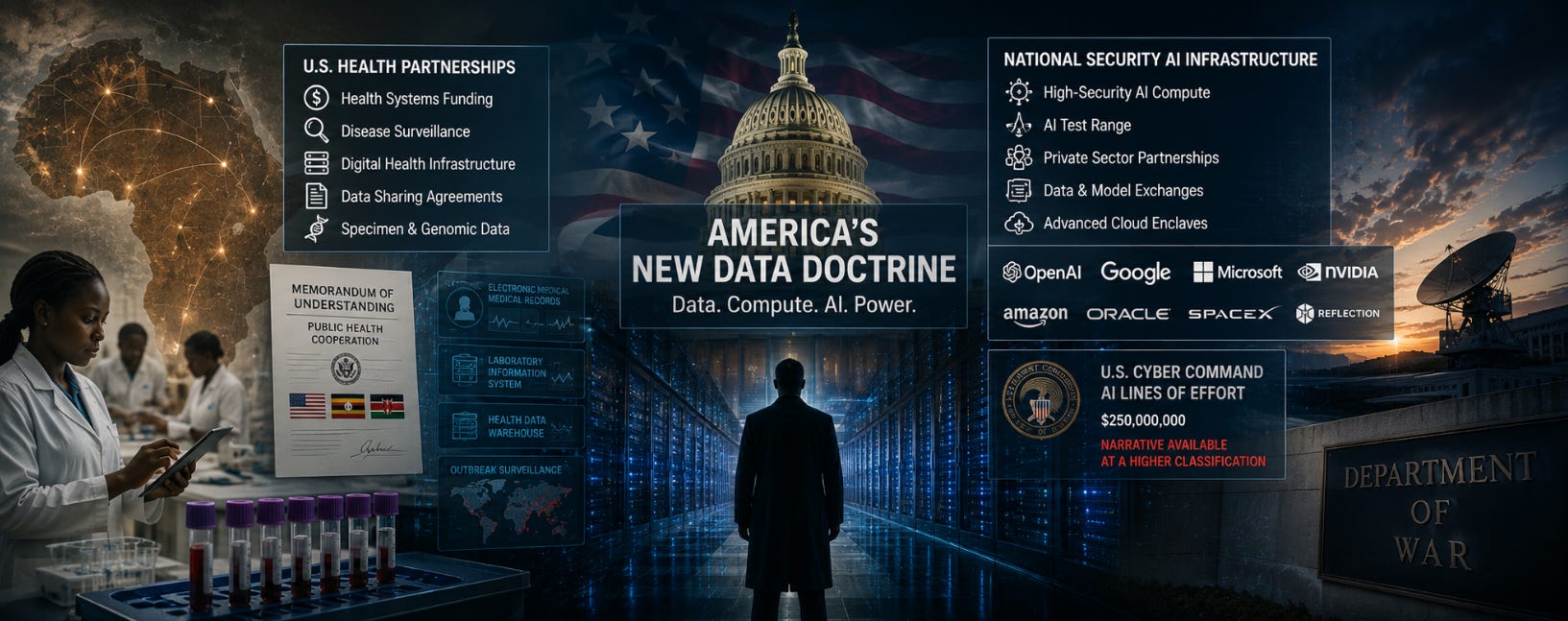
The question becomes more consequential when a wider set of documents is read alongside the health agreements. Congress is financing AI-enabled tools as part of the same global-health transition. The White House is separately ordering the construction of high-security AI computing facilities and a national-security AI test range. The Pentagon has opened classified networks to eight leading technology companies. A quarter of a billion dollars has been allocated to artificial intelligence work at US Cyber Command, the details of which are classified.
There is no documentary evidence that the African health information is being funnelled into those military systems. Nothing examined for this investigation establishes such a pipeline, and the existence of the two programmes should not be used to insinuate one.
What the records reveal instead is something broader and arguably more significant: across diplomacy, public health, justice, defence and intelligence, the American state is reorganising itself around the proposition that data, compute and artificial intelligence are strategic assets, and that access to each of them increasingly belongs inside national policy rather than merely commercial technology.
WHAT THE AGREEMENTS ACTUALLY SAY
The strongest way of assessing the health controversy is not through the rhetoric surrounding it, but through the agreements themselves.
Uganda signed its 32-page memorandum with the United States in December 2025. It is considerably more nuanced than descriptions of a straightforward surrender of African medical records suggest.
The United States intends to provide Uganda with more than $113 million specifically for health-data systems between 2026 and 2030. The money covers developers, product managers, systems engineers, cloud computing and associated digital infrastructure. The programme contemplates the expansion and integration of Uganda’s electronic medical records, laboratory systems, logistics platforms, community-health systems and national health-data warehouse.
The agreement also contains substantial safeguards. Uganda is designated as the data owner. Its government is to determine and approve its national health-information architecture before investment takes place. Data sharing requires prior written authorisation under a separate agreement, and activities are expected to comply with Uganda’s Data Protection and Privacy Act and National Data Governance Framework. Uganda’s own Health Data Access, Sharing and Use Guidelines require data-sharing agreements to specify intended use, duration, security and what will happen to information after that use is complete.
Those protections matter. They demonstrate that this is not simply a document transferring ownership of Ugandans’ medical records to Washington.
But other provisions explain the controversy.
For as long as American funding continues, Uganda commits to provide the United States with “any data access, on-site access, or other information needed” to audit specified programme metrics. Washington may conduct spot checks without notice at up to five per cent of health facilities, clinics, laboratories or programmes selected by the United States. Similar access exists for supply-chain auditing and monitoring compliance with American funding restrictions.
The agreement separately anticipates a data-sharing arrangement lasting up to seven years and a specimen-sharing agreement covering physical samples and related information, including genetic-sequence data from high-consequence pathogens with transnational epidemic potential.
These are not incidental appendices to an ordinary development grant. Digital information systems are among the central infrastructure being funded.
Kenya’s arrangement demonstrates the same model at larger scale. Its Health Cooperation Framework provides for $175 million in American support specifically for data systems. Washington intends to finance enhancements to Kenya’s Taifa Care health-management platform, electronic medical records, a comprehensive laboratory-information system, outbreak-surveillance infrastructure, logistics systems and national and county health-data repositories.
A separately negotiated Kenya-US Data Sharing Agreement specifies the handling of information generated through these programmes. The Kenyan Ministry of Health now hosts a page providing both the Cooperation Framework and Data Sharing Agreement, making Kenya one of the comparatively rare cases in which both components can be examined publicly.
The arrangement immediately encountered constitutional objections. On 19 December 2025, Kenya’s High Court restrained the government from implementing the entire framework while a petition challenging its legality proceeded. The court’s published ruling recorded allegations concerning privacy, public participation, spending commitments and foreign access to sensitive health information without determining those substantive questions finally.
That was not, however, the end of the matter. On 12 May 2026, Kenya’s Court of Appeal temporarily stayed the High Court restraint, clearing the government to proceed while the appeal continues. Later that month, Kenya’s Ministry of Health was publicly convening the joint steering committee to discuss the “next phase of implementation”, according to its 28 May departmental newsletter.
The legal challenge therefore remains important, but claims that the Kenya framework is simply frozen are now outdated.
Nor have all African governments accepted the American model unchanged. Different states have negotiated different provisions; some have resisted entirely. The variation itself undermines any simple claim that Washington has imposed an identical continental contract.
It does, however, make the lack of systematic disclosure more difficult to justify.
THE AGREEMENTS THAT APPEARED, THEN DISAPPEARED
By the time of the senators’ August letter, 34 countries had signed health memoranda, according to the lawmakers. Yet they said only eight memoranda and one associated data-sharing agreement had been made publicly available by either the State Department or partner governments.
Part of this obscurity is particularly peculiar.
Human Rights Watch records that agreements involving Ethiopia, Kenya, Mozambique, Nigeria and Uganda were uploaded to the State Department’s Freedom of Information Act library on 13 March 2026, apparently as disclosures under the Case-Zablocki Act, the federal mechanism governing reporting and publication of international agreements.
They subsequently disappeared.
The sequence has been independently reconstructed by Public Citizen’s archive of the bilateral agreements, which preserves links to documents originally published by the State Department alongside agreements recovered from governments and other sources.
There may be an administrative explanation for their removal. What is presently known does not establish why the files vanished. But their disappearance is now part of a congressional inquiry precisely because federal law generally requires qualifying international agreements and their accompanying materials to be transmitted and made public.
Warnock and his colleagues have given the State Department until 31 August to explain why the memoranda and associated annexes have not all been published, whether State believes it possesses legal authority to withhold them, which countries were required to sign data-sharing agreements, which were exempted, and what safeguards govern American access.
That deadline is still ahead.
The missing annexes matter because the public memoranda frequently anticipate subsequent agreements whose operative terms are not contained in the headline document.
Human Rights Watch’s comparison of seven available African agreements found significant differences in privacy protections and audit provisions. Uganda expressly invokes its domestic data law; other agreements contain narrower or less explicit guarantees. Six of the seven reviewed agreements permitted American access to information and facilities for programme auditing at up to five per cent of selected facilities, with Mozambique using a four per cent threshold.
A second documentary trail concerns biological material rather than ordinary health records.
Uganda’s memorandum provides for a future agreement covering physical specimens and genetic-sequence information from high-consequence pathogens. Similar arrangements appear across several of the bilateral partnerships. An American model specimen agreement that circulated during the negotiations, marked “NOT FOR PUBLIC DISCLOSURE” and subsequently published by Health Policy Watch, proposed that requested samples and related sequencing data be provided to the US government within five days.
More unusually, the template authorises Washington to share that material with as many as ten non-government American entities capable of developing diagnostics or medical countermeasures.
That does not mean every final bilateral agreement adopted those terms unchanged. Some did not, and negotiated versions must be examined country by country. Public Citizen’s comparison of completed specimen agreements documents those variations.
Nevertheless, the template illuminates what Washington initially sought: not merely epidemiological reports, but a structure through which physical biological material, sequencing information and associated data could move into a wider American research and medical-development ecosystem.
The strategic significance of such datasets need not be invented. The American government describes it itself.
Support This Work
Bitcoin (BTC) - bc1qevvy4y7ph5nxhsux0j6llfjepn239r52rakgcy
Ethereum (ETH) - 0x26F16D2D4d3dE1ab332deeE9d7DECA6B90654717
XRP - r4UDiUq5U8cQv5gq2zBdimtoMVxxjqzcYH
Solana (SOL) - 22SruEARKvXAKn8TzZZ1dBogQXRYyWkuYA4KYZWa4vAS
Dogecoin (DOGE) - DBjnCWtW1r7bnTorAocE5ypsgA1h7kQ1PD
Cardano (ADA) - addr1q8u5ld73yzv0ep9vguaz2zepdlv3ldpdr23ytukpk7lt9r8ef7mazgycljz2c3e6y59jzm7er76z6x4zghevrda7k2xq43ad8d
WHAT AMERICA THINKS DATA CAN DO
When the Justice Department constructed its programme restricting foreign access to American data, it explained at unusual length why health and genomic information had become a matter of national security.
Its rulemaking documents cite the ability of AI to extract, re-identify, connect and infer information from datasets that might appear innocuous when considered separately. Large collections of health information can contribute to AI and big-data analytical capabilities; genomic information can help construct detailed profiles; multiple databases can be combined to expose relationships that one dataset alone would not reveal.
The final rule therefore applies at remarkably low thresholds in some categories: more than 100 Americans for genomic information and 10,000 for health information. The rule can apply even where the records have been de-identified.
There is a crucial distinction, again, between what the United States fears from a foreign adversary and what it seeks from a cooperating health ministry. China obtaining commercially traded American genomic data is not equivalent to Uganda sharing epidemiological information with a government providing more than a billion dollars of health assistance. Motive, legal framework, reciprocity, security and geopolitical relationship all matter.
But the American policy documents make one proposition difficult to dispute: modern AI has increased the strategic value of large human datasets.
Congress has already carried that proposition into the global-health programme itself.
Buried in the January 2026 Congressional Record, appropriators provided money for the America First Global Health Strategy to use data and emerging technologies, expressly including “data-driven early warning systems and AI-enabled tools” for tailoring interventions to countries’ epidemiological conditions.
In the same legislation, Congress required a plan to safeguard personally identifiable patient information contained within electronic medical records, laboratory systems and surveillance systems required by the new country agreements.
These provisions are worth reading together. Congress plainly understands that the new agreements are creating or integrating consequential health-data infrastructure; it is financing AI-enabled analysis within the same global-health programme; and it has simultaneously recognised the need for explicit privacy safeguards around the systems involved.
That still does not connect those health records to American military AI.
The distinction becomes particularly important because, elsewhere in Washington, an entirely different AI infrastructure is being assembled at extraordinary speed.
THE OTHER DATA ARCHITECTURE
On 5 June, President Trump signed National Security Presidential Memorandum 11, ordering the national-security establishment to accelerate its adoption of frontier artificial intelligence.
The memorandum reaches far beyond the acquisition of commercial chatbots. Within 90 days, the White House science adviser and Office of Management and Budget, working with the Departments of War and Energy, the intelligence community and National Security Agency, must produce a roadmap ensuring the national-security enterprise has access to advanced computing resources.
The roadmap is specifically instructed to contemplate advanced AI computing facilities with appropriate high-security requirements and the establishment of an AI test range for national-security use cases.
Within 120 days, the same national-security institutions, working through the AI Security Center, must develop partnerships with private companies. The permitted activities include shared threat intelligence, joint red-teaming, personnel vetting, security research that private companies cannot undertake independently and enhancement of the physical and cyber security of American data centres.
The memorandum also orders government agencies to prepare joint AI data and model exchanges operating across multiple security enclaves.
A week later, the administration issued NSPM-12, restructuring cybersecurity policy for National Security Systems. One of its less-noticed provisions requires a report on cloud capabilities and secure configurations stretching from Secret through Top Secret, TS/SCI and Special Access Program environments. That work is expressly required to be coordinated with NSPM-11’s advanced-compute roadmap.
The documents therefore describe something considerably larger than a government software purchase. Washington is designing the compute, cloud, security, testing and data-exchange substrate on which classified artificial intelligence can operate.
Some of the private companies entering that architecture are already known.
On 1 May, before NSPM-11 was issued, the Department of War announced classified-network AI agreements with SpaceX, OpenAI, Google, Nvidia, Reflection, Microsoft, Amazon Web Services and Oracle. Their systems are intended for deployment at the department’s Impact Level 6 and Impact Level 7 environments, enabling artificial intelligence to operate against classified information for data synthesis, situational understanding and military decision-making.
This materially changes the question of who is building America’s military AI infrastructure. The first corporate layer is no longer secret.
OpenAI had already joined the department’s unclassified enterprise platform. In February the company announced that a customised ChatGPT deployment would be added to GenAI.mil, the department-wide platform accessible to roughly three million military and civilian personnel. OpenAI says information handled there remains isolated inside government infrastructure and is not used to improve its commercial models.
The May agreements move the frontier companies beyond that environment and into classified networks.
What remains substantially less visible is what comes next: which companies will build or host the advanced high-security computing facilities required by NSPM-11, how the AI test range will be constituted, what the private-sector security partnerships will cost, and how data and models will move between the security enclaves ordered by the memorandum.
The budget contains another clue.
The Department of War’s FY2026 Mandatory Funding Allocation Plan assigns $250 million to the department’s broader artificial-intelligence ecosystem. Of that, $123 million is earmarked for GenAI.mil and $127 million for agentic-AI pilots addressing warfighting and business processes.
Immediately beneath that entry appears another:
“Expansion of Cyber Command artificial intelligence lines of effort, $250,000,000.”
The explanation consists of a single sentence.
“This narrative is available at a higher classification.”
A quarter of a billion dollars has therefore been allocated to an artificial-intelligence programme at US Cyber Command whose substantive description is withheld from the public version of the funding plan.
That does not make the expenditure suspicious. Cyber Command necessarily conducts classified work. It does, however, establish the scale and opacity of the AI infrastructure now being constructed alongside the more visible commercial partnerships.
TWO SYSTEMS, NOT ONE PIPELINE
At this point the evidentiary boundary must be drawn very clearly.
The documents reviewed for this investigation do not show that health information obtained from Uganda, Kenya or any other partner country is being supplied to the Pentagon, US Cyber Command, the intelligence community, GenAI.mil, the classified AI companies or the future national-security AI test range.
No contract, memorandum, budget document or government statement examined by Thom Aster establishes such a transfer.
The global-health architecture and the national-security AI architecture should therefore not be represented as a single technical system.
What links them is policy rather than plumbing.
The State Department is restructuring foreign health assistance around direct bilateral relationships containing extensive data-system, surveillance and specimen-sharing provisions. Congress is financing AI-enabled epidemiological tools within that programme. The Justice Department has meanwhile determined that sufficiently large collections of American health and genomic information constitute strategic assets whose foreign exploitation can enhance AI and military capabilities. The White House is ordering the national-security establishment to construct high-security AI compute and data-exchange environments. The Department of War is bringing eight private technology companies onto classified networks and allocating hundreds of millions of dollars to AI programmes whose most sensitive details are withheld.
Taken independently, each development has a conventional bureaucratic explanation.
Taken together, they describe a changing conception of state power.
In that conception, computational capacity is strategic infrastructure; private AI laboratories are national-security partners; datasets are resources whose value can change according to who possesses them and what analytical machinery is applied to them; public-health information contributes to early warning and increasingly AI-assisted decision-making; and control over the movement of sensitive information becomes an instrument of foreign and domestic policy.
That is not a conspiracy. It is increasingly explicit government policy.
THE QUESTION OF RECIPROCITY
The strongest defence of the American health arrangements is straightforward. Washington is spending very large sums of money to strengthen health systems that have historically depended upon foreign assistance. It reasonably expects evidence that its money is producing results, that commodities are not disappearing through corruption, that infectious diseases capable of crossing borders are rapidly reported, and that American funds comply with American law.
Uganda’s agreement, for example, is not merely an access instrument. It finances digital systems that Uganda itself will own; envisages local technical capacity; requires compliance with domestic privacy law; seeks greater integration rather than maintenance of parallel donor databases; and gradually transfers responsibility to Ugandan institutions. Those are features of a serious state-building programme, not merely data extraction.
There is also a powerful public-health argument for international pathogen sharing. An emerging virus does not respect sovereign borders, and rapid movement of samples and sequence information can allow diagnostics and vaccines to be developed before an outbreak becomes a pandemic.
The difficulty is that such arguments make governance, reciprocity and transparency more important rather than less.
If the agreements are mutually beneficial, publication should strengthen their legitimacy. If direct American credentials to national systems are necessary, the exact technical safeguards can be explained without disclosing passwords or compromising security. If private American organisations may receive pathogens or sequence data, the rules governing their use and the benefits returned to the source country can be made clear. If different countries have been subjected to different data requirements, the rationale for those differences can be articulated.
At present, much of that architecture remains fragmented among memoranda, unpublished annexes, court proceedings and agreements recovered after government copies disappeared from public view.
The imbalance is made more conspicuous by the extraordinary care Washington takes over American information.
Under the Justice Department’s own rules, American health data belonging to 10,001 people can become a national-security concern if a transaction exposes it to an adversarial jurisdiction.
The State Department, meanwhile, is negotiating access to national systems containing information concerning populations measured in millions.
That comparison does not prove equivalent risk, because the recipients, purposes and legal relationships are profoundly different. It does reveal something about the value the United States attaches to data when it considers who should control it.
THE NEXT DOCUMENTS
This investigation arrives at an unusually useful moment because several of the unresolved questions now have deadlines.
The senators demanding answers about the health agreements have asked the State Department to respond by 31 August. Among other things, they want to know why the full agreements and annexes have not been published, which countries have been required to sign data-access arrangements, the purpose and scope of direct login credentials and what protections prevent misuse.
Days later, the 90-day deadline created by NSPM-11 falls due. The administration is supposed to have completed its roadmap for national-security access to advanced computing, including high-security AI facilities and an AI test range.
NSPM-12 creates a similar September deadline for the government’s architecture governing cloud systems at Secret, Top Secret, TS/SCI and Special Access Program levels.
By early October, NSPM-11’s private-sector partnership provisions and updated frontier-model procurement processes are also due.
The most important parts of those outputs may never become public. Some are inevitably classified. But procurement notices, corporate disclosures, appropriations, contract modifications and implementation documents should make parts of the architecture visible.
The same principle applies overseas. Thirty-four health memoranda cannot be properly understood from eight publicly available examples. The data-sharing and specimen-sharing arrangements sitting beneath them are, in many respects, more consequential than the ceremonial agreements ministers sign in front of cameras.
There is therefore a larger question behind the individual controversies over Uganda, Kenya or classified military AI.
The United States is entering an era in which information itself is being governed increasingly like a strategic commodity. It is restricting its export, bargaining over its access, subsidising the infrastructure that produces it, financing artificial intelligence capable of exploiting it, and constructing classified environments in which data and models can be combined for national-security purposes.
The relevant safeguards have not developed at the same speed.
For Americans, Washington has already decided that some collections of health and genomic information are sufficiently sensitive to warrant a national-security control regime.
For the citizens of countries entering its new health partnerships, the answer depends on agreements that in many cases remain difficult to inspect.
That discrepancy does not establish abuse.
It establishes the question that now deserves an answer:
If data has become valuable enough for the United States to protect as a matter of national security, what obligations follow when the United States asks other nations to share theirs?
SOURCES
U.S. Department of Justice, National Security Division — Data Security Program. Official overview of restrictions governing foreign access to Americans’ genomic, health, biometric, financial and other sensitive information, including the stated AI and military risks.
Data Security ProgramU.S. Department of Justice — Implementation of the Data Security Program, 11 April 2025. Explains the national-security rationale and implementation under the Trump administration.
Justice Department implementation announcementU.S. Department of Justice — Final Rule addressing foreign-adversary access to sensitive American data, 27 December 2024. Includes the relationship between bulk data, AI capabilities and national security.
DOJ Final Rule announcementU.S. Department of Justice — Final Rule fact sheet. Provides the bulk thresholds for genomic, health and other sensitive data and confirms that anonymised or de-identified data can remain covered.
Data Security Final Rule fact sheetU.S. Department of Justice — Data Security Advance Notice of Proposed Rulemaking. Discusses AI-assisted re-identification and the strategic utility of combined health and genomic datasets.
ANPRMSenator Raphael Warnock and seven Senate colleagues — Letter to Secretary of State Marco Rubio, 12 August 2026. Raises concerns about direct American credentials to partner-country health systems, states that 34 countries have signed MoUs and requests answers by 31 August.
Senate inquiry and full letterUnited States–Uganda Memorandum of Understanding Regarding Public Health, December 2025. Provides the data-system funding, Ugandan ownership provisions, audit access, pathogen-sharing commitments and planned seven-year data-sharing arrangement.
Uganda-US MOUUganda Ministry of Health — Health Data Access, Sharing and Use Guidelines. Domestic rules governing health-data ownership, access, cross-border transfer, privacy and data-sharing agreements.
Ugandan health-data guidelinesKenya–United States Health Cooperation Framework, 4 December 2025. Contains the $175 million data-system programme and planned support for electronic medical records, laboratories, surveillance, logistics and health-data infrastructure.
Kenya-US Cooperation FrameworkKenya–United States Data Sharing Agreement. Signed agreement governing information exchanged beneath the Health Cooperation Framework.
Kenya-US Data Sharing AgreementKenya Ministry of Health — Cooperation Framework and Data Sharing Agreement portal. Kenyan government publication page for the two agreements.
Kenyan Ministry of Health documentsHigh Court of Kenya — Okoiti v Prime Cabinet Secretary et al., 19 December 2025. Conservatory ruling initially restraining implementation of the Kenya-US framework pending the constitutional challenge.
Full High Court rulingKenya Ministry of Health — 28 May 2026 newsletter. Records the Joint Kenya-US Health Cooperation Framework Steering Committee discussing continuing implementation following the May appellate intervention.
Ministry newsletterHuman Rights Watch — Human Rights Assessment of the 2025–2026 US Bilateral Health Agreements, 8 June 2026. Comparative analysis of seven agreements and reconstruction of the State Department documents that were briefly published and subsequently removed.
HRW assessmentPublic Citizen — US Bilateral Health Agreements: Texts and Related Information. Archive preserving State Department agreement texts and documents released elsewhere after State removed several files.
Bilateral agreement archiveModel Specimen Sharing Agreement between the United States and partner countries. Negotiating template marked “NOT FOR PUBLIC DISCLOSURE”, providing for rapid specimen and sequence sharing and onward sharing with up to ten non-government US entities.
Model Specimen Sharing AgreementPublic Citizen — Trump Pathogen Agreements and Global Equity Proposals. Comparison of final specimen-sharing agreements against the original American template.
Specimen-agreement comparisonCongressional Record, 14 January 2026 — Global Health Activities. Provides for data-driven early-warning systems and AI-enabled public-health tools and requires safeguards for patient information in electronic records, laboratory systems and surveillance systems under new country agreements.
Congressional RecordWhite House — National Security Presidential Memorandum 11, Artificial Intelligence in the National Security Enterprise, 5 June 2026. Orders high-security AI compute, an AI test range, private-sector security partnerships, procurement reform and AI data/model exchanges.
NSPM-11The White House/GovInfo — National Security Presidential Memorandum 12, 12 June 2026. Orders secure cloud architecture across Secret, Top Secret, TS/SCI and Special Access Program environments and coordinates it with NSPM-11’s advanced-compute roadmap.
NSPM-12U.S. Department of War — Classified Networks AI Agreements, 1 May 2026. Announces agreements with SpaceX, OpenAI, Google, Nvidia, Reflection, Microsoft, AWS and Oracle for AI deployment at IL6 and IL7.
Classified Networks AI AgreementsOpenAI — Bringing ChatGPT to GenAI.mil, 9 February 2026. Details OpenAI’s deployment on the War Department enterprise-AI platform and the isolation of government data from commercial model training.
OpenAI GenAI.mil announcementU.S. Department of War — FY2026 Mandatory Funding Allocation Plan. Allocates $250 million to the broader AI ecosystem, including GenAI.mil and agentic warfighting pilots, plus a separate $250 million Cyber Command AI programme whose narrative is classified.
FY2026 Mandatory Funding Allocation PlanProPublica — “Digital Colonialism”, 17 June 2026. Independent investigation into the State Department’s direct-access requirements, including the reported Uganda DSA and nine health-information systems.
ProPublica investigation
In the end, my personal health data is not subject to ANY government collection or scrutiny. But we all know big brother wants every speck of health data for every human in the US (at least) along with all personal data and lifestyle data. They have been collecting this for a few decades.
The purpose? To be used against us at some point for some nefarious reason...otherwise why do they need it? It's not as if these tyrannical clowns will ever make a difference in anybody's health unless it is to murder them.