Rupert Lowe Has Offered Farage a Way Back — But This Is Not a Peace Deal
Restore’s unity proposal could change Britain’s electoral map. It could also expose whether the insurgent right wants power badly enough to share it.

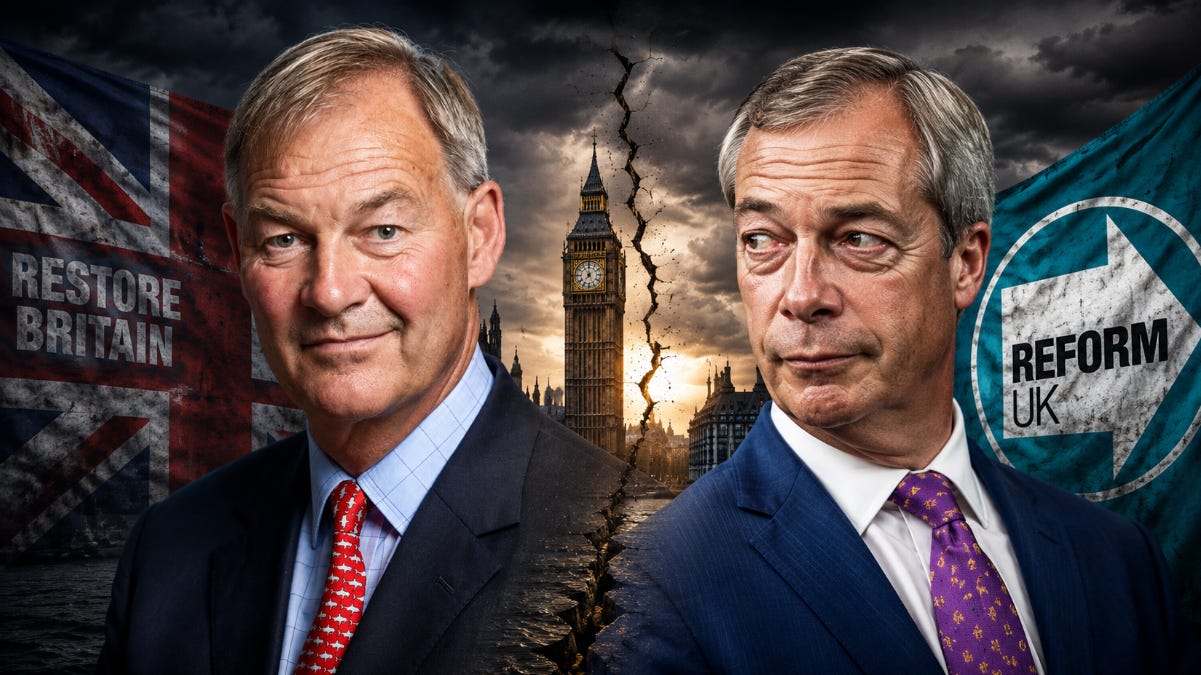
Rupert Lowe has done something unusual in British politics. He has offered an opponent a route towards cooperation without pretending that the argument between them has been settled. There has been no sentimental reconciliation, no carefully staged handshake and no declaration that the old wounds have healed. Instead, Lowe has placed five demands in front of Nigel Farage and asked whether Reform UK is prepared to meet them.
The proposal has been described as an olive branch. It is closer to a public examination. Lowe is asking Farage to demonstrate that the two parties share enough substance to justify cooperation: the removal of every person living in Britain without lawful status, what Lowe calls “demographic security”, a referendum on capital punishment, severe restraint in public spending and the exclusion of failed former Conservative ministers from a future cabinet. Reform had not formally accepted the offer at the time of writing and had declined to comment when approached by the Financial Times.
The reaction among politically engaged voters has been immediate. TalkTV’s phone lines were reported on air as being inundated by callers demanding that Farage take the deal. That is a useful measure of intensity, but not of national opinion. A phone-in audience is self-selecting, no public call log or weighted sample has been released, and callers cannot be treated as a representative poll of Reform voters. The pressure is real; the percentage is unknowable.
What can be measured is the electoral threat that produced the offer. Restore Britain is no longer merely an internet pressure group orbiting one Westminster personality. It is polling at a level capable of changing close contests, and it has now demonstrated that support in actual elections. Britain’s first-past-the-post system does not require a small party to win many seats before it becomes powerful. It only has to remove enough votes from a larger rival in the places that matter.
The offer is not “forget the past and unite”. It is “prove what you are prepared to do, then we can discuss how not to destroy each other”.
The Five Tests Hidden Inside the Offer
In the video setting out his conditions, Lowe began with the border. Ending high immigration was not enough, he argued; previous migration had to be reversed and every person without lawful status removed. His second condition concerned “demographic security” and a programme to reverse what he describes as the Islamification of Britain. The measures named included prohibitions on the burqa, cousin marriage, halal and kosher slaughter, unofficial Sharia tribunals and dominating public Islamic prayer.
The third condition was a referendum on restoring the death penalty. The fourth demanded a self-sufficient Britain built through spending controls, welfare reductions and decisions Lowe conceded would be unpopular. The fifth was aimed directly at the personnel Farage has recruited to make Reform appear ready for office: former Conservative ministers who had already failed in government, Lowe said, should not be admitted into a future cabinet.
Each demand operates on two levels. There is the policy itself, then there is the question of who decides the policy. Farage could accept stricter immigration enforcement without accepting Lowe as an equal. He could endorse a referendum without promising to campaign for capital punishment. He could promise fiscal discipline without allowing Restore to dictate the cabinet. The exact form of cooperation therefore matters more than the broad word “unity”. A merger, coalition, non-aggression pact and constituency-by-constituency arrangement are four different political objects.
That distinction becomes especially important on immigration, because the public argument has obscured an inconvenient fact: Reform UK already has a mass-removal policy.
Reform Already Promises Mass Deportation
Reform’s published Operation Restoring Justice describes a five-year emergency programme to identify, detain and remove people without extant leave to remain. It proposes leaving the European Convention on Human Rights, repealing the Human Rights Act, disapplying the Refugee Convention and Convention Against Torture for the purposes of the programme, creating a legal duty on the Home Secretary to remove people, building detention capacity for 24,000, operating five deportation flights a day and establishing a UK Deportation Command backed by data-sharing among the Home Office, police, HMRC, DVLA, banks and the NHS.
Reform estimates that more than one million people are in Britain without lawful status and claims its programme would cost about £10 billion over five years while generating net savings. Restore’s own 113-page blueprint assumes a larger unauthorised population of between 1.8 million and two million, seeks between 150,000 and 200,000 forced removals a year and relies on at least half a million voluntary departures annually. Its direct five-year cost estimate is between £49 billion and £57.6 billion.
The disagreement is therefore not whether the state should attempt mass removal. Both parties have placed that objective in writing. The disputes concern the estimated population, the legal architecture, the pace, the price, the broader cultural programme and — above all — whether voters trust Farage to carry through what Reform has already promised.
This helps explain why Lowe’s offer is politically shrewd. If Farage says the deportation condition is too extreme, Restore can point to Reform’s own document. If he says it is already Reform policy, Lowe can ask why cooperation is impossible. If he accepts the entire package, he allows a rival polling at four per cent to set the test of seriousness for a party polling above twenty.
The Arithmetic That Has Forced the Conversation
The latest YouGov Westminster poll placed Reform and Labour on 22 per cent, the Conservatives on 21, the Greens on 13, the Liberal Democrats on 11 and Restore on four. Reform’s figure was its lowest in that tracker since March 2025. In a proportional system, a four-point party might remain an independent minor force. Under first-past-the-post, those four points can deny another party dozens of marginal seats without electing a single Restore MP.
Restore’s supporters cannot simply be added to Reform’s column. YouGov found that 90 per cent of Restore voters considered immigration one of the country’s most important issues, while 97 per cent held a favourable view of Lowe. Yet only 30 per cent viewed Farage positively, 67 per cent viewed him unfavourably and just 36 per cent said they would consider voting Reform. The parties overlap heavily in policy but not necessarily in trust. A merger controlled by Farage could recover far less than Restore’s full national share.
The traffic can also move in the other direction. Forty-three per cent of current Reform voters told YouGov they would consider Restore. Immigration was a leading concern for 86 per cent of Reform supporters, while 44 per cent viewed Lowe positively. Farage remains personally popular within his own coalition, but Lowe is not attempting to recruit from an alien electorate. He is operating inside Reform’s pressure chamber.
The recent elections show both the significance and the limit of that threat. In the Makerfield by-election, Labour won 24,927 votes, Reform 15,696 and Restore 3,111. Even if every Restore vote had transferred to Reform, Labour would still have won by 6,120. Restore split the right; it did not decide the result.
The Greater Manchester mayoral contest produced the same lesson on a larger scale. Labour’s Bev Craig received 251,449 first-preference votes, Reform’s Sian Astley 111,928 and Restore’s Marlon West 46,289. Reform and Restore together would still have trailed Labour by more than 93,000 first preferences. Restore’s 8.7 per cent was impressive for a new party and exceeded the Conservative vote, but it was not enough to explain away Reform’s defeat.
Those results should restrain both camps. Reform cannot dismiss Restore as irrelevant, because tens of thousands of voters have now used a real ballot to support it. Restore cannot claim that unity alone would have delivered victory, because the published totals prove otherwise. The strategic value lies in future marginals, not retrospective mythology.
What Unity Could Actually Deliver
The most recent More in Common MRP model, based on fieldwork conducted before the full Burnham polling bounce, projected Reform as the largest party with 293 seats on 27 per cent of the vote — 33 seats short of a majority. The Conservatives were projected to finish second in 161 of those Reform seats and in 209 constituencies overall. The exercise is a model, not a prophecy, and its authors explicitly noted that it did not incorporate recent by-election results. It nevertheless exposes how sensitive the map is to modest shifts on the right.
A full merger is not required to exploit that sensitivity. The most efficient arrangement would probably be a written electoral pact under which only one Reform-or-Restore candidate contests selected seats, with the choice made using local polling, membership strength and previous results. The parties could preserve separate organisations, postpone the leadership dispute and agree a minimum programme for a future parliament.
That would produce most of the tactical benefit while avoiding the immediate destruction of either brand. It would also be easier for Farage to present as pragmatism rather than capitulation. Lowe could claim he had secured policy commitments without dissolving Restore into the movement he left. The difficulty would begin the moment both sides tried to decide who stands where. Candidate selection is where abstract unity becomes the surrender of jobs, money, influence and future parliamentary careers.
A broader alliance involving the Conservatives would be more electorally powerful and much harder to construct. Lowe’s ban on failed former ministers conflicts directly with Reform’s recruitment of former Conservative cabinet figures. Farage has used those defections to suggest Reform now possesses governing experience. Accepting Lowe’s fifth condition would turn that strategy into evidence against itself.
How Fast Could a Government Begin Removals?
A pact between opposition parties would not itself remove anyone. It would first have to win a general election and secure enough parliamentary support to pass the necessary legislation. Even then, ministers would inherit the Home Office, detention estate, courts, contracts, records and diplomatic agreements that exist — not the ones described in a manifesto.
The latest Home Office figures recorded 39,000 returns in the year ending March 2026. Of those, 9,700 were enforced and 29,300 were voluntary. Restore’s target of 150,000 to 200,000 forced removals a year is therefore approximately 15.5 to 20.6 times the current enforced rate.
That is not a tougher version of the existing system. It is a different state capacity.
During the same period, about 23,000 people entered immigration detention and roughly 2,000 were being held at the end of March. Fifty-one per cent of people leaving detention were released on immigration bail, while 44 per cent left to be returned. Two-thirds had been detained for less than a month. Some releases occurred because claims remained unresolved or there was no immediate prospect of removal.
A new government could accelerate the easiest cases quickly: foreign national offenders whose litigation had concluded, failed claimants from countries that issue documents and accept returns, and people already willing to take assisted departure. More charter capacity, larger caseworking teams and better coordination could lift removals within months. No credible operational pathway takes the enforced figure from 9,700 to 150,000 during a government’s first year without an extraordinary mobilisation that begins before the election.
Detention facilities must be acquired or built. Officers, escorts, caseworkers, interpreters and medical staff must be recruited and trained. Nationality must be established. Travel documents have to be issued. Aircraft must be contracted, insured and given landing permission. Destination states have to accept their nationals. New legislation will be litigated. The first hundred days could change the direction of policy; they could not manufacture the completed apparatus.
The Two-Year Claim and the Assumption Carrying It
Restore’s timetable is mathematically coherent on its own terms. Its policy paper models 150,000 forced removals with three voluntary departures for each forced removal. That would mean 600,000 total exits a year and would clear an assumed population of 1.8 million in three years. With four voluntary departures for every forced removal, the annual total rises to 750,000 and the timetable falls to about two years and five months. Its most ambitious scenario assumes 185,000 forced removals, a four-to-one voluntary ratio and a 95 per cent detention-to-deportation conversion rate, producing a claimed completion time of one year and eleven months.
The calculation is not the problem. The assumptions are.
Without the voluntary multiplier, 1.8 million forced removals would take twelve years at 150,000 a year or nine years at 200,000. The headline timetable therefore depends less on aircraft than on behaviour: hundreds of thousands of people must conclude that remaining in Britain is impossible and depart without being physically removed.
Restore proposes to create that pressure through employment enforcement, landlord and banking restrictions, data matching, reduced access to services, financial incentives for departure and a public campaign advertising removal. Some people would undoubtedly leave. What has not been demonstrated is that Britain could sustain a nationwide ratio of three or four voluntary exits for every enforced removal while simultaneously identifying the relevant population, avoiding administrative errors and preventing new unlawful residence from replacing those departures.
There is also no definitive count of the population being modelled. Reform says the number is above one million; Restore assumes 1.8 to two million. People without lawful status are difficult to enumerate by definition, and estimates depend on assumptions about overstayers, failed claimants, clandestine entrants, departures and regularisations. A timetable built on an uncertain denominator should be presented as a scenario, not a countdown clock.
Who Could Be Removed — and Who Could Not Simply Be Put on a Flight
The political language often collapses several distinct populations into the word “migrants”. That is too imprecise for a serious assessment. British citizens cannot ordinarily be deported. Lawful visa holders, people with indefinite leave to remain, recognised refugees and people protected by settled status are not interchangeable with those who have no lawful right to remain. Mixed-status families create additional questions that neither slogan nor spreadsheet resolves.
Even among people without current status, removal is not merely a British decision. A destination country must accept the person, usually after nationality and identity have been established. Some governments delay or refuse travel documents. Some countries are unsafe, lack functioning authorities or will not accept charter flights. A person may raise an asylum, trafficking, torture, age or family-life claim. A future parliament can narrow legal remedies and change domestic law, but it cannot compel every sovereign government to receive a passenger on Britain’s preferred timetable.
Leaving the ECHR would remove important legal constraints, but it would not delete every obligation. The House of Commons Library notes that comparable protections exist in United Nations treaties and customary international law. Withdrawal would also have consequences for the Belfast/Good Friday Agreement, the UK–EU Trade and Cooperation Agreement and the devolution settlements. Parliament remains sovereign in domestic law; sovereignty does not mean freedom from external consequences.
Reform’s policy goes further by proposing to disapply the Refugee Convention, Convention Against Torture and anti-trafficking obligations during its emergency programme. Whether the claimed doctrine of necessity could lawfully justify that internationally would be fiercely contested. Passing an Act of Parliament can instruct British officials and courts. It cannot force treaty partners to accept Britain’s interpretation or prevent diplomatic, commercial and security repercussions.
The Price of the Machine
Restore’s blueprint estimates direct costs of between £49 billion and £57.6 billion across a pessimistic five-year period. Its largest line is £30 billion for immigration enforcement, followed by detention, estate management, enforced and voluntary returns and arrangements with third countries. The paper claims eventual savings of at least £12.5 billion a year, combining estimated public-service costs with the abolition of the existing asylum system.
Those figures deserve scrutiny rather than automatic dismissal or acceptance. The cost estimate is produced by the party advocating the programme and has not been audited by the Office for Budget Responsibility or National Audit Office. The savings depend on assumptions about the number and composition of the population, service use, tax receipts, children, labour-market effects and how much theoretical expenditure can actually be removed from departmental budgets.
Reform publishes a markedly cheaper model: approximately £10 billion gross over five years, with claimed net savings above £7 billion during that period. The gap between two parties pursuing broadly the same objective is itself a warning. One plan may be overbuilt, the other undercosted, or both may be counting different populations and consequences. Before any unity agreement could be treated as a programme for government, the parties would have to reconcile those numbers in public.
Lowe’s demand for enormous spending cuts sharpens the contradiction. Mass enforcement requires large expenditure early: facilities, staff, digital systems, litigation, transport and foreign agreements all have to be funded before long-term savings appear. A government simultaneously promising severe fiscal retrenchment and a rapid expansion of coercive state capacity must name what it will cut, what it will borrow and what it will tax. “Waste” is not a budget line large enough to answer every question.
The Constitutional Programme Behind the Border Programme
Restore does not regard immigration enforcement as a discrete Home Office reform. Its document proposes repealing the Human Rights Act and Equality Act, leaving the ECHR, replacing the current asylum system, restricting judicial review, changing judicial appointments and passing a “Great Clarification Act” intended to let a parliamentary majority rapidly override court decisions.
The proposal rests on a defensible constitutional premise and a dangerous temptation. The premise is that elected Parliament, not the courts, possesses ultimate legislative authority. The temptation is to treat every legal obstacle as illegitimate merely because it obstructs the government’s preferred outcome. British courts cannot normally strike down an Act of Parliament under the Human Rights Act; they can interpret legislation, review executive action and issue declarations of incompatibility. A government that fails to distinguish adverse judgment from judicial usurpation risks replacing one alleged imbalance with another.
Capital punishment would open a separate constitutional battle. Lowe is asking for a referendum, not promising that a single vote would instantly restore executions. Parliament would still need to legislate, determine eligible offences and procedures, address miscarriages of justice and confront Britain’s ratification of Protocol No. 13 to the ECHR, which abolishes the death penalty in all circumstances. Extradition partners would demand assurances, while Scotland and Northern Ireland would become central to the argument over territorial application.
The cultural conditions would be no less disruptive. Restrictions on religious dress, slaughter and public worship would provoke litigation, protests and resistance from Muslim and Jewish communities. Prohibiting forced marriage or sham tribunals is not the same legal proposition as banning a form of clothing or a religious method of slaughter. Packaging them together may be politically effective, but it conceals different questions of evidence, proportionality and enforceability.
Why Farage May Engage
Farage has several reasons to avoid an outright rejection. Reform’s national lead has narrowed, Restore has established a measurable base and the number of Reform voters willing to consider Lowe’s party is too large to ignore. A limited pact could protect Reform in marginal seats without requiring an institutional merger. Farage also has precedent for tactical withdrawal: during the 2019 general election, the Brexit Party stood down candidates in Conservative-held seats to avoid splitting the Leave vote.
Engagement would also give Farage a chance to regain ownership of the immigration issue. He could point to Operation Restoring Justice, invite Restore to negotiate on implementation and frame the talks as evidence that Reform is the only vehicle capable of converting policy into national power. A clever response would not accept Lowe’s five demands word for word; it would propose a broader conference or written framework in which Reform remains the senior partner.
The political cost of silence will rise if Reform loses additional close contests while Restore polls between three and five per cent. Every defeat will be presented as proof that personality defeated country. Lowe has designed the offer so that refusal can be used as campaign material.
Why a Full Merger Remains Unlikely
The personal rupture is severe. Lowe accused Farage of presiding over a protest party centred on a single personality and later said he must never become prime minister. Reform reported Lowe to police over alleged threats, which Lowe denied; prosecutors concluded there was insufficient evidence to charge him. The quarrel was not a routine disagreement over one policy. It involved trust, party governance, personal loyalty and public allegations.
A merger would force an immediate answer to the question both men are avoiding: who commands? Farage will not dissolve the most successful insurgent party in Britain into a four-per-cent rival. Lowe cannot fold Restore into Reform without risking the very support produced by distrust of Farage. YouGov’s finding that two-thirds of Restore voters view Farage unfavourably makes absorption particularly difficult.
The conditions also challenge Reform’s existing coalition. Former Labour voters inside Reform care more about the cost of living and NHS than its ex-Conservative wing and are more likely to worry about extremism. Lowe’s complete package may excite Reform’s hardest immigration voters while repelling softer supporters needed for a parliamentary majority. A party can win an argument on social media and still lose the constituency required to govern.
For those reasons, the most plausible path is staged cooperation: private talks, public agreement on several shared principles, selective candidate withdrawals and no immediate merger. Both sides would retain the ability to leave if the arrangement became electorally expensive.
What the Deal Would Mean for Britain
At its narrowest, an electoral pact could increase the number of MPs committed to lower immigration, expanded removal capacity, withdrawal from the ECHR and a more confrontational relationship with the courts. If More in Common’s broad seat arithmetic remained even approximately correct, a few dozen protected marginals could move Reform from largest party in a hung parliament towards a working majority or coalition.
At its widest, the agreement would represent a proposed reconstruction of the British state. Immigration enforcement would become one of government’s largest operational projects. Banks, employers, landlords, councils, police, health bodies and tax authorities would be drawn into a data-sharing and compliance network. Detention capacity and charter operations would expand. Parliament would attempt to reclaim powers from treaty systems and narrow the space for judicial intervention. Religious practice, criminal punishment and the composition of the cabinet would all be placed inside the same political settlement.
Supporters would describe that as sovereignty restored after decades of evasion. Critics would call it an illiberal state built in the name of border control. The honest description is that elements of both are present. A government cannot remove hundreds of thousands of people without building a powerful administrative machine. Anyone demanding that machine should also demand strict rules for accuracy, appeal, auditing and accountability, because state power does not remain virtuous merely because its first target is popular.
The Questions Neither Side Can Avoid
Before Lowe’s offer becomes more than a strategic manoeuvre, both parties must define the arrangement. Will Restore remain independent? Who chooses candidates? Who leads the parliamentary bloc? Can Lowe serve under Farage, and can Farage tolerate a rival with his own membership, donors and media following? Which former Conservative ministers are barred, and who decides whether they “failed”?
The operational questions are harder. Which estimate of the unauthorised population is being adopted? How many detention places will exist after twelve, eighteen and thirty-six months? Which governments have agreed to issue documents and receive charter flights? What happens to mixed-status families, people whose nationality cannot be established and those who cannot lawfully or practically be returned? Which rights survive the legal reset, and what remedy exists when the state detains the wrong person?
Then there is the money. Is the programme expected to cost £10 billion, £49 billion or £57.6 billion? Which assumptions explain the difference? When do savings begin, and which spending cuts fund the initial expansion? A unity agreement that cannot publish a common budget is an electoral slogan, not a governing compact.
The Conclusion Farage Cannot Escape
Lowe has enough support to damage Farage but not enough to replace him. Farage has enough national reach to dominate the right but no longer enough spare momentum to ignore every rival. That balance makes cooperation rational and surrender irrational for both men.
The public may want a dramatic reconciliation. The numbers point towards something colder: a negotiated non-aggression pact, limited candidate coordination and a common minimum platform. That could alter dozens of constituencies and potentially decide who forms the next government. It would not, by itself, put a single person on a deportation flight.
A government committed to rapid removals could increase activity within months and begin constructing a much larger system during its first year. Restore’s target of 150,000 to 200,000 enforced removals annually might become theoretically reachable only after several years of legislation, construction, recruitment, diplomacy and litigation. Its claim that 1.8 million people could leave within two to three years depends on an unproven mass voluntary-departure response. Without that response, the arithmetic extends towards a decade or more.
Farage therefore faces a decision larger than whether he likes or trusts Rupert Lowe. He must decide whether Reform wants to remain the sole owner of the insurgent right, even when that ownership loses seats, or accept that the route to power may require sharing credit with the man it expelled.
Lowe has made his move. The pressure on Farage is not coming from the broadcasters, the commentariat or even Restore’s four per cent alone. It comes from a brutal feature of the British electoral system: divided movements can possess a national majority of anger and still deliver a parliamentary majority to somebody else.
Sources and Further Reading
Financial Times — Rupert Lowe offers to find a “common way forward” with Reform UK
Greater Manchester Returning Officer — 2026 mayoral election result
Restore Britain — Mass Deportations: Legitimacy, Legality and Logistics
Home Office — Immigration system statistics, year ending March 2026
Home Office — Immigration detention statistics, year ending March 2026
Council of Europe — Protocol No. 13 abolishing the death penalty