Silencing the Scribes
How Britain's National Security (State Threats) Act 2026 puts journalists in the crosshairs of counter-terrorism law.

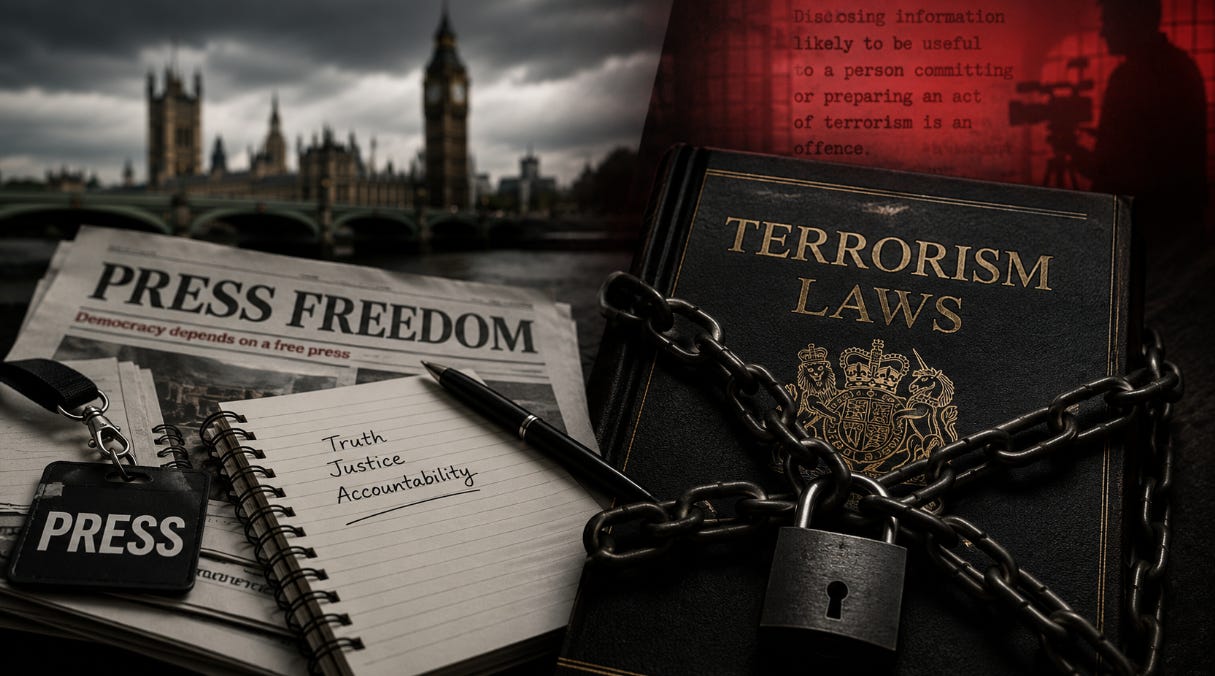
On 8 July 2026, the National Security (State Threats) Act received Royal Assent, becoming law after a legislative sprint of just 29 days from introduction to enactment. The bill was put before Parliament on 9 June and rushed through its remaining stages with what critics describe as minimal meaningful scrutiny. The government’s own collection page confirms the bill was introduced on 9 June and received Royal Assent on 8 July.
The government’s stated rationale was urgent: a growing wave of antisemitic attacks in north London that included an arson attack on Hatzola ambulances in Golders Green on 23 March 2026. The Islamic Movement of Companions of the Right (IMCR), an Iran-linked proxy group, had claimed responsibility for seven attacks on Jewish and Israeli-linked targets in the UK.
“We will never let Britain be a playground for states who want to spread fear, division and violence on our streets,” Prime Minister Keir Starmer declared on the day the Act became law.
Few would argue with the need to counter hostile state activity. But the speed of the legislation’s passage, and the breadth of the powers it confers, have alarmed press freedom organisations, human rights lawyers, and even the government’s own statutory reviewers.
The bill was introduced on 9 June 2026 and received Royal Assent on 8 July 2026 — a total of 29 days. The GOV.UK collection page tracks the bill’s progress from introduction to Royal Assent. The Wikipedia article confirms the dates: introduced 9 June, Royal Assent 8 July.
What the Act Actually Does
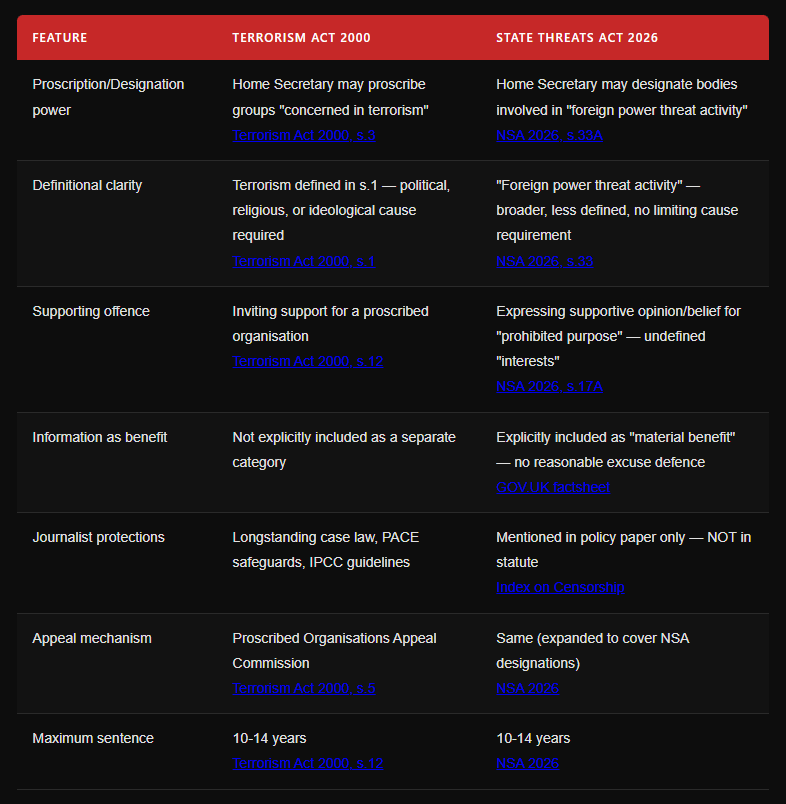
The Act inserts new sections into the National Security Act 2023, creating a designation regime that mirrors — but in key respects goes beyond — the proscription powers in the Terrorism Act 2000. The Home Secretary may designate any body they “reasonably believe” is involved in “foreign power threat activity” where designation is “necessary to protect the safety or interests of the United Kingdom.”
Once designated, three new criminal offences apply:
Supporting a designated body: It is an offence to invite support for, or express an opinion or belief supportive of, a designated body where done for a “prohibited purpose” — defined as a purpose the person “knows, or having regard to other matters known to them ought reasonably to know, is prejudicial to the safety or interests of the United Kingdom.”
Assisting a designated body: It is an offence to engage in conduct intended to materially assist a designated body in carrying out UK-related activities, or to engage in conduct likely to do so where the person knows or ought reasonably to know this.
Obtaining material benefits from a designated body: It is an offence to obtain, accept, or retain a material benefit from a designated body — or even to agree to accept one — where the person knows or ought reasonably to know its origin.
The penalties: up to 14 years in prison. The offences apply to UK persons anywhere in the world.
“Foreign correspondents could also be affected. Indeed on the face of it, they would be at risk of prosecution if they were to have contact of any kind with sources within designated bodies or their agents.” David Anderson KC, former Independent Reviewer of Terrorism Legislation, 29 June 2026
The Information Problem
The critical detail buried in the Act is the definition of “material benefit.” The government’s factsheet acknowledges that this includes information as a separate category, distinct from financial benefits. This means a journalist who receives documents, data, or even an interview from a source connected to a designated body could be committing a criminal offence.
There is no “reasonable excuse” defence for obtaining information from a designated body. The government rejected a recommendation from Jonathan Hall KC, the Independent Reviewer of State Threats Legislation, that such a defence should be included. The government’s factsheet confirms that “material benefits” includes information, and that the humanitarian activities defence (which does exist in the Act) does not cover journalism.
Ministers have argued that only information which “possesses an inherent value that enriches the recipient” would be caught. But David Anderson KC, the former Independent Reviewer, pointed out that the Act’s definition of “material benefit” categorises information separately from financial benefit — meaning the government’s reassurance rests on a distinction the legislation itself does not make.
The government’s factsheet states: “The designation offences apply in relation to designated bodies i.e. those listed in Schedule 6A to the National Security Act 2023.” It confirms that “material benefits” includes information. Jonathan Hall KC recommended extending the “reasonable excuse” defence to cover information; the government did not accept this recommendation.
The Safeguard That Wasn’t
The government’s policy paper accompanying the bill’s announcement includes “journalistic freedoms” in a list of safeguards. But this language was never included in the Act itself. As Index on Censorship noted: “It’s not in the Bill itself, where it would hold more weight.”
The distinction matters. A policy paper can be changed by the next government. A statutory defence would require Parliament to amend. Journalists covering Iran, Lebanon, or any region where designated groups operate now face a legal landscape where their protections exist only in ministerial assurances — assurances that David Anderson KC described as of uncertain value “in all possible political futures.”
The Society of Editors was blunt. Dawn Alford, its chief executive, said: “They should not be left relying on prosecutorial discretion to determine whether legitimate newsgathering is lawful. Clear legal protection is preferable to relying on assurances about how the law may be applied.”
“If there is any ambiguity, Parliament should take the opportunity to make explicit on the face of the Bill that bona fide journalistic activity carried out in the public interest is not criminalised.” Dawn Alford, Chief Executive, Society of Editors, June 2026
The Chilling Effect
The most insidious consequence of the Act may not be prosecutions but self-censorship. As Tribune Magazine’s Tom Blackburn observed: “The chances are that most journalists in these situations would never be prosecuted, but of course they wouldn’t need to be. The uncertainty and potential 14-year prison sentence encourage self-censorship.”
Lindsey Hilsum, Channel 4 News’ international editor, described this as “the law of unintended consequences.” But the risks were repeatedly highlighted to the government during the bill’s expedited passage. Ministers refused to narrow the scope of the legislation or create robust exemptions.
Index on Censorship raised fundamental questions that remain unanswered: Who qualifies as a journalist? Do you need formal qualifications? What about freelancers, stringers, bloggers? In conflict zones, where the lines between combatant, civilian, and journalist are already dangerously blurred, these are not academic questions.
The Act also criminalises “expressing an opinion or belief that is supportive of a designated body” where done for a “prohibited purpose.” The term “prohibited purpose” is defined by reference to what is “prejudicial to the safety or interests of the United Kingdom” — a phrase the Act does not define. BCL Solicitors LLP noted in their legal analysis that this “low knowledge threshold may also have a chilling effect on political commentary, journalism, academic research, and diaspora community engagement, well beyond conduct that could fairly be characterised as assisting a hostile state.”
The Designations
On 13 July 2026, just five days after Royal Assent, Home Secretary Shabana Mahmood designated the first three bodies under the new powers:
The Islamic Revolutionary Guard Corps (IRGC) — an integral part of the Iranian state, spanning military, economic, domestic security, and foreign policy. The IRGC Qods Force and Intelligence Organisation form part of Iran’s intelligence apparatus, and the IRGC has been linked to plots against Iranian dissidents, Jewish communities, and journalists in the UK.
The Islamic Movement of Companions of the Right (IMCR) — an Iran-linked proxy group that emerged in March 2026 and claimed responsibility for seven attacks on Jewish and Israeli-linked targets in the UK, including the Golders Green ambulance arson.
The GRU Volunteer Corps — a group controlled by Russia’s military intelligence agency, the GRU, which recruits volunteers online to carry out sabotage, arson, and harassment in the UK and Europe.
The designations were made under the National Security Act 2023 (Designated Bodies) Regulations 2026 and came into force on 17 July.
Home Secretary Shabana Mahmood: "Iran and Russia are using proxies and thugs to do their dirty work on our shores. I have rapidly designated 3 groups so those working for them will be tracked down and put behind bars." The designations were approved by Parliament on 17 July 2026.
Comparison: Terrorism Act 2000 vs. State Threats Act 2026
The Independent Reviewers Who Were Ignored
The Act’s intellectual foundation is the May 2025 report of Jonathan Hall KC, the Independent Reviewer of State Threats Legislation. Commissioned by then-Foreign Secretary Yvette Cooper, Hall’s report recommended creating a “classification power, equivalent to proscription under the Terrorism Act 2000.”
But Hall also warned of risks. His report noted that “roles such as journalists and lawyers, ordinarily accorded special protection in a democracy, may be deliberately exploited as cover” — and that the risk of “innocent conduct being caught” placed an onus on “investigative and prosecutorial discretion.” He recommended extending the “reasonable excuse” defence to cover information obtained from designated bodies. The government rejected this.
David Anderson KC, Hall’s predecessor as Independent Reviewer, went further. In a briefing note published on 29 June, he warned that the bill “seems to have been pulled together in a hurry, with mooted safeguards for NGOs and journalists largely absent from its text.” He said this “needs to be put right early this week, before the bill becomes law.” It was not put right.
Two independent reviewers — one current, one former — both raised red flags. Both were ignored.
“The bill seems to have been pulled together in a hurry, with mooted safeguards for NGOs and journalists largely absent from its text. That needs to be put right early this week, before the bill becomes law.” David Anderson KC, former Independent Reviewer of Terrorism Legislation, 29 June 2026
Beyond Journalism: The Wider Chill
The Act’s reach extends well beyond the newsroom. Humanitarian organisations that operate in conflict zones — where designated groups may control territory or infrastructure — face the same legal jeopardy. A de-mining charity operating in territory where the IRGC has influence could not lawfully ask for information about mine locations. Conflict resolution organisations that need to engage with designated bodies as part of their work would be at risk.
The government’s factsheet acknowledges a “specific defence for conduct carried out for the purpose of humanitarian activities in accordance with internationally recognised principles and standards” — but this defence only applies to the assisting and material benefits offences, not to the supporting offence. And it does not cover journalism.
Diaspora communities are also vulnerable. Iranian-British citizens who maintain family or business connections in Iran could find themselves caught by the Act’s broad provisions. The “low knowledge threshold” in the supporting offence — “ought reasonably to know” — creates liability for those who may not even be aware their conduct could be prejudicial to UK interests.
Middle East Eye reported that the bill’s vague wording risks criminalising journalists and NGO workers, with the Home Secretary granted sweeping powers to designate any state-backed organisation deemed prejudicial to the UK’s “safety and interests.”
What Happens Now
The Act is law. The designations are in force. The first prosecutions may be months or years away — or they may never come. But the damage is already done.
British foreign correspondents covering Iran, Lebanon, or any region where designated groups operate now work under a legal shadow. Editors will think twice before assigning stories that require engagement with designated bodies. NGOs will reconsider their operations. Academics will hesitate before researching state-linked organisations.
This is the paradox of well-intentioned but poorly drafted national security legislation: it achieves its deterrent effect not against the hostile actors it targets, but against the legitimate actors it inadvertently catches. The spies and proxies will continue their work, adapting to the new legal landscape. It is the journalists, the aid workers, and the diaspora communities who will bear the cost of compliance.
As Index on Censorship’s Nik Williams put it: “Any well-intentioned but hastily drafted law that could chill or criminalise public interest journalism, from reporters working at great risk to themselves, threatens the very foundations of British democracy, the very thing this bill is intended to protect.”
“We need scrutiny not speed when considering such significant provisions.” Nik Williams, Index on Censorship, June 2026
Timeline: How the Law Was Made
May 2025
Jonathan Hall KC publishes his report recommending a new classification power equivalent to terrorism proscription.
23 March 2026
Arson attack on Hatzola ambulances in Golders Green, London. IMCR claims responsibility.
9 June 2026
National Security (State Threats) Bill introduced in the House of Commons.
29 June 2026
The Guardian publishes David Anderson KC’s warning that journalists could face terror prosecutions.
30 June 2026
Middle East Eye reports on NGO and journalist risks. Society of Editors issues formal call for protections.
3 July 2026
Index on Censorship publishes its warning: “The UK government rushing through terror laws will stifle journalism.”
8 July 2026
Royal Assent. The National Security (State Threats) Act 2026 becomes law.
13 July 2026
Home Secretary designates IRGC, IMCR, and GRU Volunteer Corps as the first three designated bodies.
17 July 2026
Designations come into force. Supporting, assisting, or obtaining material benefits from these bodies is now a criminal offence.
Sources
Legislation.gov.uk — National Security (State Threats) Act 2026 (full text)
GOV.UK — National Security (State Threats) Act 2026: factsheet
GOV.UK — “Support for IRGC outlawed in crackdown on foreign state proxies” (13 July 2026)
GOV.UK — “UK defences strengthened against foreign state-backed groups” (8 July 2026)
GOV.UK — National Security (State Threats) Bill 2026 collection
Jonathan Hall KC — Report of the Independent Reviewer of State Threats Legislation (May 2025)
Tribune Magazine — “The National Security Bill is an Insidious Attack on Journalism”
BCL Solicitors LLP / Mondaq — Legal analysis of the Bill (26 June 2026)