The 34-Day State Rewire
Five systems. One direction. Police AI, an automated Five Eyes biometric border, a wider gateway into driver records, a national-security route around procurement rules...

Britain was not transformed by one emergency bill, one televised announcement or one vote the public could understand.
It was changed through a police press release, a procurement note, a Home Office caseworker manual, a statutory consultation, a commencement order, an energy-system roadmap and a cyber-security framework.
Between 10 June and 14 July 2026, five long-developing programmes crossed major legal, operational or regulatory thresholds. The British state launched a national centre to industrialise artificial intelligence across policing; expanded automated fingerprint checks through the Five Eyes migration network; brought into force the legal machinery for broader police access to DVLA records; opened a consultation on how far that access should reach; told departments to consider national-security procurement exemptions for artificial intelligence and energy infrastructure; and advanced the standards, licences and cyber-security rules required for companies to control large quantities of electricity flowing into and out of smart appliances.
Each measure has a respectable official explanation. Police need to process impossible volumes of digital evidence. Borders need to detect aliases and fraud. Officers searching for missing people need timely information. Britain needs secure supply chains. A grid increasingly dependent on intermittent power needs demand that can move with supply.
None of those explanations is absurd. Some of these systems could deliver real public benefit. But that is not the whole story.
No minister stood at a dispatch box and said:
We are building a state in which police intelligence, criminal evidence, immigration biometrics, driver identity records, strategic procurement and household energy demand become more centralised, interoperable and automated at the same time.
No document uncovered in this investigation proves that ministers secretly agreed to flood the public with simultaneous reforms so nobody could keep up. The evidence does not justify inventing a conspiracy memo that has not been found.
What the documents prove is more defensible and, in practical terms, nearly as serious:
The transformation has been divided across institutional silos, allowing every expansion to be presented without the public being shown the combined architecture.
Whether that fragmentation is calculated political camouflage or simply the natural language of modern bureaucracy, the democratic effect is the same. Citizens are asked to assess each mechanism in isolation. Almost nobody is asked to consider the machine they form together.
They did not present Britain with one authoritarian bill. They presented five technical programmes that almost nobody would read together.
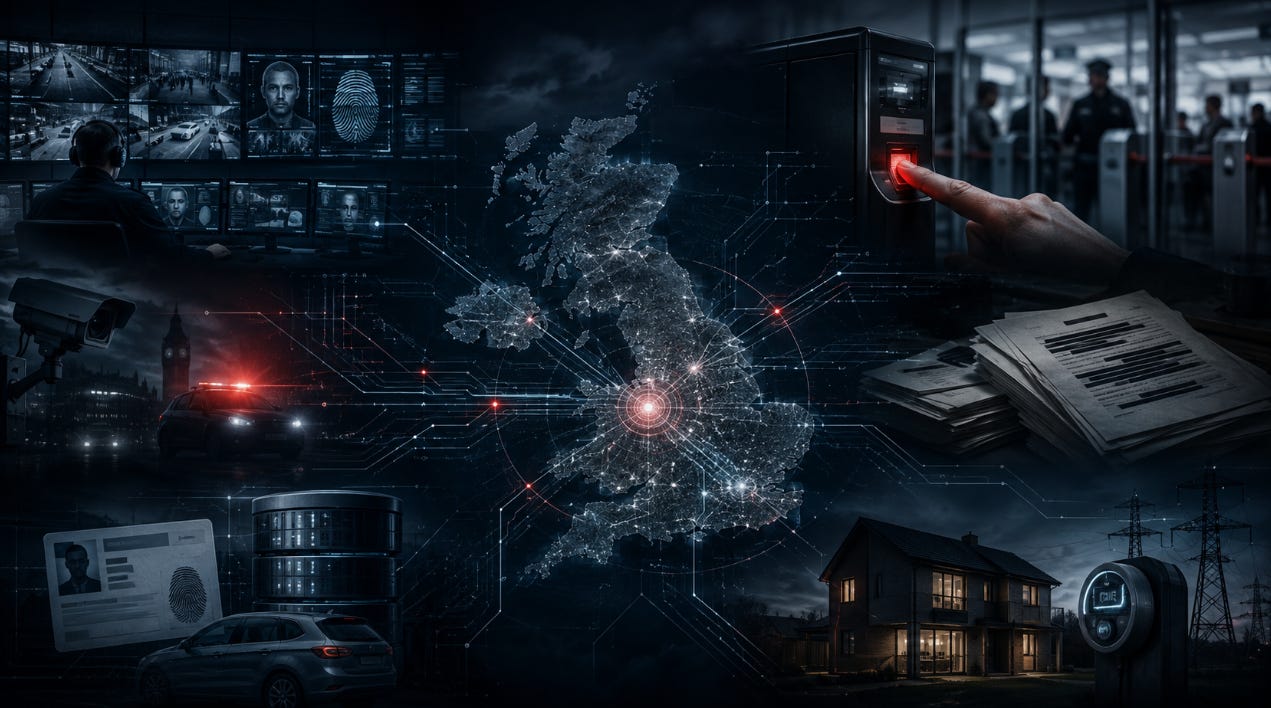
The 34 days
10 June: The Home Office formally launched PoliceAI, a national centre backed by at least £75 million over three years and intended to work across every police force in England and Wales.
19 June, updated 3 July: The Cabinet Office published Procurement Policy Note 025 and detailed guidance placing artificial intelligence and energy infrastructure inside an expanded national-security procurement framework.
22 June: The Home Office updated its Migration 5 biometric-sharing guidance, expanding automated US fingerprint checks to UK visa applications made in the United States and Jamaica.
25–29 June: The government commenced section 181 of the Crime and Policing Act 2026 and published an implementation circular explaining the new statutory route toward broader police and law-enforcement access to driver records.
30 June: The government published a large-load-controller factsheet confirming plans to treat operators capable of controlling 300 megawatts or more of smart-appliance load as providers of an essential service.
7 July: The Home Office opened its DVLA access consultation, including an option for automated access across the full range of policing purposes.
13 July: The Clean Flexibility Roadmap update recorded that roughly one-third of Britain’s electricity-metering systems were operating under half-hourly settlement and advanced smart-appliance, interoperability and load-control reforms.
14 July: The government announced that AI would be used to review and summarise police evidence, while accepting a recommendation to move towards centralised police-technology procurement.
This chronology does not prove that the five programmes are controlled by one hidden command centre. It proves that the British state is moving in one recognisable direction across several departments:
Centralise capabilities that were previously dispersed.
Connect databases, devices and institutions.
Automate searching, sorting, analysis and operational decisions.
Broaden the purposes for which existing data or infrastructure may be used.
Build the capability first, while bespoke law, public registers and oversight mechanisms follow behind.
System One: AI enters the evidential chain
The government’s own police AI factsheet says artificial intelligence could, in theory, improve almost every existing policing activity. The listed uses are not confined to rota management or filing expenses. They include triaging and analysing digital evidence; redacting text, audio and video; summarising case files; supporting disclosure obligations; identifying suspects and missing people; classifying crimes; transcribing witness statements; translating documents; managing non-emergency calls; and detecting synthetic or manipulated media.
That places AI close to the point at which raw material becomes an allegation, an evidential schedule, a prosecution file, a charging decision or information disclosed to the defence.
The government says humans will remain accountable, that deployments must be lawful and ethical, and that tools will be tested. Those safeguards matter. So does the scale of the ambition.
PoliceAI is intended to operate nationally, perform work once on behalf of many forces and eventually transition into the planned National Police Service. The Home Office says the initial consolidation can be delivered without new primary legislation. At its launch, the policing minister said the programme aimed to free at least six million hours of police time by the end of 2028, the equivalent of 3,000 full-time officers. Large-scale evidence pilots are planned in up to ten forces before national scaling in 2027.
That is not a side project. It is an operating-model change.
From administration to evidence
On 14 July, the government moved from broad ambition into the evidential pipeline. Under its disclosure reforms, AI is expected to help officers identify, sort, compile, review and summarise material from phones, emails, messages, videos and cloud storage. The same announcement accepted movement towards centralised procurement of police technology and a national governance forum for disclosure tools.
The productivity argument is powerful. An average fraud investigation can contain millions of documents. Disclosure failures can collapse prosecutions, conceal exculpatory evidence and deny justice to victims. A properly validated search, transcription or redaction system could save enormous amounts of time.
But “summarising evidence” is not a neutral mechanical act. A summary determines what is foregrounded, compressed or omitted. A ranking system influences which documents investigators see first. A graph can make one association visually dominant while burying another. A model can confidently reproduce an error at a scale no exhausted officer could match manually.
Even when a human signs the final document, automation shapes the informational environment in which human judgement is exercised.
Human oversight is not meaningful if the human cannot reconstruct how the machine selected, ranked, excluded or condensed the underlying material.
The supplier channel already exists
The Metropolitan Police’s Precise Policing 2 dynamic market shows the commercial infrastructure standing behind this policy. Its scope includes agentic AI, workflow automation, video processing, situational-awareness applications, data integration, AI object detection, intelligence scanning, graph analytics alongside the Met’s Enterprise Data Platform, public-order planning and digital asset management.
The admitted field has included Palantir, Axon, Quantexa, Deloitte, CACI, Capgemini, CGI, Veritone, Peregrine and other large and specialist suppliers. The crucial qualification is that admission to a dynamic market is not a contract award. It makes a company eligible to compete for subsequent work. It does, however, create a pre-vetted route through which operational capabilities can be purchased or prototyped more quickly through to 2030.
A separate case-file-quality procurement required prospective bidders to be members of that market. Its aims included standardising quality assurance, reducing rework and improving submissions to the Crown Prosecution Service.
None of that is automatically corrupt. The democratic question is whether technology influencing case construction can be independently examined by defendants, courts, journalists and Parliament, or whether it will be treated as reliable because the police buyer and commercial supplier say it is.
The warning arrived two days after launch
On 12 June, two days after PoliceAI formally launched, a Derbyshire police officer was reported to be under criminal investigation over allegations that artificial intelligence had been used to create evidential material in several cases. The officer was removed from frontline duties. The allegation remains under investigation and no guilt has been established.
The allegation does not prove that approved PoliceAI tools fabricate evidence. It proves something narrower and vital:
The boundary between assistance and fabrication is not theoretical.
It can be crossed deliberately by a user. It can also be crossed by a poor prompt, an unreliable model, a weak audit trail or an institution under pressure to clear impossible workloads.
Meanwhile, the public-facing register intended to show which AI systems forces are using was still in development, with an initial version expected in the autumn. The order matters: operational adoption first; consolidated public visibility later.
Searches conducted for this investigation found no published record of a comprehensive audit or FOI request sent to all 43 police forces asking which AI tools they use, who supplied them, what validation was conducted and what error rates were recorded. The NPCC register does not yet exist. FOI requests are the only way to obtain this data before the register launches.
The Copilot failure
The Derbyshire case is not the first time AI-generated material has entered the UK policing evidence chain. In October 2025, West Midlands Police used Microsoft Copilot to research Maccabi Tel Aviv’s history of fan disorder. Copilot hallucinated a match between Maccabi Tel Aviv and West Ham United that never took place. The fictional match was included in the intelligence report presented to the Safety Advisory Group, which then banned Maccabi fans from a Europa League match at Villa Park. Chief Constable Craig Guildford initially denied AI was involved, then admitted it, then retired at age 52. The Home Affairs Select Committee found he showed a “remarkable lack of professional curiosity.” Despite the scandal, at least 21 forces continued using Copilot. The NPCC has issued no ban on generative AI for intelligence-gathering.
The legal foundation: the Data Use and Access Act 2025
The legal environment surrounding PoliceAI shifted before the 34-day window. The Data (Use and Access) Act 2025 widened the circumstances in which law-enforcement bodies may make significant decisions based solely on automated processing. It received Royal Assent on 19 June 2025. Its most significant law enforcement provisions are already in force.
Section 80 creates a permissive framework for law enforcement agencies to use solely automated decision-making in wider circumstances. Under the previous law, derived from EU GDPR Article 22, significant automated decisions were heavily restricted. The DUAA removes the requirement for meaningful human involvement at the point of decision, introducing only a post-hoc safeguard: the decision must be reconsidered with human involvement “as soon as reasonably practicable.” Decisions are exempt from safeguards where necessary to safeguard national security or avoid obstruction of an inquiry.
Section 89 allows law enforcement agencies to work to intelligence services data protection rules when conducting joint operations, provided it is necessary to safeguard national security and has been approved by the Home Secretary. This effectively allows police to bypass standard data protection safeguards when working alongside MI5, MI6 or GCHQ.
Section 82 removes the statutory obligation for law enforcement agencies to record the reason or justification for accessing or disclosing personal data in automated processing systems. The requirement to log who accessed data remains; the statutory requirement to log why has been removed. (The LEDS system continues to log justifications operationally, but the legal obligation to do so no longer applies.)
The government’s own impact assessment acknowledged that “those with protected characteristics such as race, gender, and age are more likely to face discrimination from ADM due to historical biases in datasets.” A letter coordinated by Big Brother Watch and signed by 30+ civil liberties organisations warned that police could use “common law and a patchwork of laws pre-dating the technological revolution” to exploit loopholes.
Statewatch described the DUAA as representing a “systematic weakening of privacy and data protection safeguards,” warning that broad exemptions grant government and law enforcement “expansive access to personal data.” The Act contains extensive Henry VIII powers allowing ministers to rewrite data protection rules via statutory instrument with minimal parliamentary scrutiny.
The most significant law enforcement provisions commenced in September 2025 and February 2026, months before PoliceAI’s formal launch.
What is established
National AI capability is being centralised. AI is intended to enter evidence handling and disclosure. Police-technology procurement is moving towards national coordination. A broad commercial market already covers intelligence scanning, graph analytics, video search and public-order planning. The DUAA provides the legal foundation for automated decision-making. The West Midlands Copilot scandal demonstrates that AI-generated evidence can enter the chain through institutional failure, not just individual misconduct.
What is not established
Admission to a supplier market does not prove that every company has received money or deployed a live system. An allegation involving one Derbyshire officer does not prove that nationally approved tools are fabricating evidence. Searches conducted for this investigation found no published comprehensive audit of AI tools across all 43 forces. The NPCC register does not yet exist.
System Two: a procurement exemption broad enough to hide the most important contracts
While AI capability was being centralised, the Cabinet Office was changing how critical technology could be bought.
Procurement Policy Note 025 tells central government departments, executive agencies and non-departmental public bodies to identify procurement pipelines relevant to national security in four sectors: artificial intelligence, energy infrastructure, steel and shipbuilding. Authorities are instructed to engage designated sector leads and consider the Procurement Act’s national-security exemption where its use is appropriate and justified.
The accompanying Cabinet Office guidance states that “national security” is deliberately undefined. It may extend beyond defence and intelligence to economic security, public order, foreign relations, environmental security and long-term developments that gradually erode national resilience. The guidance also explains that an authority may decide whether all or only part of the Procurement Act should be disapplied, including transparency and non-discrimination provisions.
This is not an automatic secrecy order. The exemption must be justified case by case. Decisions should be evidenced, recorded, reviewed with legal advice and applied consistently with international obligations. A department cannot lawfully invoke national security merely to favour a domestic supplier for economic convenience.
But the route exists, the category is broad and two of the sectors examined in this investigation, AI and energy infrastructure, are expressly named. No evidence found for this article proves that PoliceAI, Precise Policing 2 or the smart-energy programmes described here have used PPN 025 to conceal a contract. The danger is structural:
A system can be publicly consequential while the contract that built it is legally less visible.
Britain has legitimate reasons to protect security-sensitive specifications and avoid dependence on hostile or unreliable states for critical compute, strategic software or grid components. But “national security” is also one of the most elastic phrases in government. Once it expands from war and espionage into public order, environmental security, economic resilience and gradual long-term risks, it can touch almost every major digital or infrastructure project in the country.
The question is not whether secrecy is ever justified. It is whether Parliament and the public will receive enough information to distinguish a genuinely necessary exemption from a convenient escape route around scrutiny.
Searches conducted for this investigation found no published FOI requests, parliamentary questions or media investigations examining how PPN 025 is being used. The sector leads for AI (DSIT) and energy (DESNZ) have been identified, with procurement thresholds of £5 million and above for AI hardware, critical national infrastructure or sensitive data. But no public data exists on how many contracts have invoked the exemption.
System Three: the border becomes an automated Five Eyes query
On 22 June, the Home Office published version 15 of its Migration 5 biometric-sharing guidance. The Migration 5 network links Britain, the United States, Canada, Australia and New Zealand. Its purpose is to compare immigration fingerprints and reveal identities, immigration histories, criminality, travel-document information and prior encounters with partner countries.
Automated checks against United States systems already applied to asylum claims from November 2022, in-country settlement applications from June 2023 and nationality applications from June 2024. The June 2026 update expanded automatic checks to UK visa applications made in the United States and Jamaica.
The process can apply to anyone whose fingerprints were recorded for UK immigration purposes, including children aged five or older, provided the person is not a citizen of the partner country being queried. Results are normally returned within 24 hours and often within minutes.
A confirmed match may expose aliases, identity details, immigration encounters, criminality and travel-document records. The guidance says the information can affect asylum credibility, safe-third-country inadmissibility, nationality, settlement, redocumentation and removal. It also says partner countries can submit inbound requests to Britain through automated rules without action from an ordinary UK caseworker.
Several operational passages in the public guidance are removed as “Official - sensitive”. That does not prove abuse. Governments legitimately redact security-sensitive workflow. It does mean the public can see the declared purpose while parts of the operating logic remain unavailable.
The Home Office includes real safeguards. A biometric match does not necessarily prove that a person travelled to the matching country. Children’s welfare duties apply. Information must be assessed in context. Onward disclosure is subject to domestic law and country-specific restrictions.
This is not a biometric dragnet over every British citizen. It is an immigration system. That boundary matters. So does the retention environment surrounding it. Separate Home Office guidance says immigration fingerprints are normally retained for up to 15 years from enrolment in visa, immigration-document or other immigration processes.
The architectural change is therefore larger than a quicker border check.
The border is becoming a persistent, machine-readable identity relationship across allied databases.
In political debate, immigration remains a spectacle of boats, hotels, removals and headline numbers. The operational border is moving elsewhere, into systems capable of querying identity automatically, returning information quickly and influencing life-changing decisions before the public ever sees the machinery.
Sixteen years without scrutiny
The Migration 5 programme, originally called the Five Country Conference, began in the late 2000s as a limited scheme to check fingerprints of approximately 3,000 asylum seekers per country per year. It now conducts up to 8 million checks annually across the five countries. The data shared includes fingerprints, facial images, biographic data, travel records, family members and medical history — 35 items of information in total, according to an investigation by RNZ.
The Secure Real-Time Platform enables automated fingerprint matching with the United States. Manual checks are still used for Australia, Canada and New Zealand. The United States stores biometric data for 75 years; New Zealand for 50 years. The original 10-year retention limit has been abandoned, according to the RNZ investigation.
Searches conducted for this investigation found no published record of any parliamentary committee examining the Migration 5 programme since it began. The agreements are signed by officials, not ministers, and are not debated in Parliament. As RNZ noted: “The UK exchanged notes via its embassy with the US to signal that both countries had expanded the data checks to include their countries’ citizens. There was no discussion on the move in its parliament.”
Statewatch director Chris Jones, quoted in the RNZ investigation, warned: “Biometric data is counted as a sensitive category of personal data, it merits high levels of protection... There needs to be great justification as to when organisations can collect it, and when they can share it.”
Multiple FOI requests have been submitted about M5 data-sharing. FOI 76032 (2023) confirmed the expansion timeline for automated checks. FOI 64629 (2021) obtained some 2020 statistics. But key operational data remains unpublished: the total number of automated checks, confirmed matches, refusals, inadmissibility decisions and removals resulting from the programme; the number involving children; the number of inbound automated requests from partner countries; and the number of matches later found to be inaccurate or misleading.
Searches conducted for this investigation found no published equality impact assessment for the M5 programme and no published ICO investigation into M5 data-sharing. The programme operates largely outside domestic data protection oversight mechanisms. Privacy Impact Assessments are the only public notification of the programme’s existence in some member countries.
The Biometric Update reported in June 2024 that Five Eyes biometric data-sharing had increased by over 100 times with little transparency. The maximum checks per country pair rose from 3,000 in 2010 to 30,000 and then to 400,000, as documented in the same report. Strategy documents for M5 were published in 2022 but have not been released to the public.
System Four: the driving licence becomes a general police identity node
The DVLA story is more advanced than an open consultation alone. Section 181 of the Crime and Policing Act 2026 creates a statutory route through which the Secretary of State may make driver-licensing information available to authorised persons for policing and law-enforcement purposes.
The provision was brought into force at the end of June. The Home Office’s implementation circular identifies possible authorised users including police officers, civilian police staff, designated volunteers, National Crime Agency officers, police-oversight personnel, service police and certain Crown Dependency and Gibraltar officials.
The information potentially covered by the statute includes name and address; date and country of birth; photograph and signature; driving entitlement; endorsements and convictions; and relevant medical information affecting the ability to drive.
Historically, direct automated access was largely associated with road-traffic enforcement. Wider policing uses normally relied on slower manual processes. Section 181 creates the legal gateway. The consultation opened on 7 July is determining how broad the automated operational access should become.
The options form a ladder:
P0: retain the road-traffic baseline;
P1: add serious crime and national security;
P2: permit automated access for every criminal offence;
P3: permit access across the full range of policing purposes, including non-criminal safeguarding, locating missing people, protecting life and property, preserving public order and managing public-safety risks.
The consultation does not begin from zero. Parliament has already authorised the framework. What remains is the breadth, conditions and exclusions imposed through regulations and a statutory code.
The proposed safeguards are significant: mandatory training and vetting; role-based access controls; tamper-resistant audit logs; a recorded purpose and justification for each search; annual reporting to Parliament; a public list of authorised organisations; and case-level necessity and proportionality requirements. The government says medical information would remain on a manual route. It also stresses that this measure is separate from proposals concerning facial-recognition searches of licence photographs.
Those are genuine constraints. They are also an acknowledgement of the risk. The Home Office’s own data-risks summary recognises that the policy moves from a narrower road-traffic framework towards wider policing and law-enforcement access through the Law Enforcement Data Service.
The updated LEDS data-protection assessment describes a national service through which authorised police forces and other agencies can access and update records concerning people, vehicles and property.
The DPIA that already assumes P3
The LEDS Data Protection Impact Assessment, published on 24 June 2026, contains a critical detail. Section 71A of the Criminal Justice and Court Services Act 2000, inserted by the Crime and Policing Act 2026, now allows authorised persons to access DVLA driver licence information for any policing or law enforcement purpose — not just road traffic offences as previously permitted.
The DPIA acknowledges that this expansion of access engages Article 8 of the European Convention on Human Rights (the right to private life). It identifies seven specific risks: lack of audit, disproportionate use, unlawful access, police overreach, data retention, data sharing and facial recognition (explicitly excluded from this consultation). It flags race as the clearest indirect discrimination risk.
Despite these acknowledgements, the DPIA concludes: “Following the implementation of these measures, no high residual risks have been identified.”
The contradiction is sharp. The legislation and the DPIA already anticipate access for any policing purpose. The consultation, published two weeks later, presents the operational breadth as still under public consideration.
The LEDS system itself is a cloud-based replacement for the Police National Computer, hosted on Amazon Web Services. It serves approximately 120,000 users across 150 organisations with 39 integrations migrating from the PNC. The PNC, established in 1974, held approximately 55.4 million driver records, 54.8 million vehicle records and 10.7 million criminal records, according to Liberty’s 2018 analysis. In January 2021, 150,000+ records were accidentally deleted from the PNC during routine maintenance, affecting serious crime investigations. The PND cloud migration failed in May 2026 after £35.1 million was spent with no improvements delivered.
Privacy International has raised detailed concerns about LEDS since 2018, warning that it mixes evidential and intelligence material traditionally kept separate, that intelligence material is unlikely to be scrutinised or challenged, and that there are no clear safeguards against “LOVEINT” (officers spying on partners). Liberty quit Home Office consultation meetings in protest, calling LEDS a “grave threat to privacy.”
The key phrase is purpose expansion. The state does not need to invent a new population database if it can progressively repurpose an existing one. A driving database already has national scale, verified identity fields, photographs, addresses and extensive population coverage. Change the gateway and the same data becomes a different instrument.
System Five: the grid moves inside the home
The final system appears unrelated to policing and immigration. Technically, it is. Structurally, it follows the same pattern.
The July Clean Flexibility Roadmap update says roughly one-third of Britain’s electricity-metering systems now operate under half-hourly settlement arrangements. The programme remains on track to migrate all meters by May 2027. Half-hourly settlement is not remote control. It records and settles electricity use in finer time periods, allowing suppliers to price energy more accurately and offer tariffs that reward customers for moving demand away from expensive peaks.
But it is one layer in a much wider architecture. The government and Ofgem are developing smart requirements for specified electric-heating appliances; minimum functionality, grid-stability and cyber-security standards for domestic batteries; updated rules for smart electric-vehicle chargers; standardised time-of-use tariff data; technical interoperability allowing appliances to switch flexibility providers; a licensing regime for organisations that arrange or execute load control; and enhanced cyber-security regulation for operators controlling very large aggregate loads.
The government’s own definition is clear. Load control means adjusting the immediate or future flow of electricity into or out of an energy-smart appliance. A load controller sends, configures or manages the signal that causes that adjustment.
The proposed licensing regime is intended to protect consumers, cyber security and grid stability. It includes fair-treatment requirements, clear information, restrictions on unreasonable switching barriers, complaint routes, exit protections and rules intended to prevent a control instruction from destabilising the grid. The government has aimed to open licence applications by the end of 2026 and make licensing mandatory by the end of 2027, subject to parliamentary approval and final decisions.
The architecture becomes even clearer at scale. Under the government’s large-load-controller framework, an organisation with the potential to control 300 megawatts or more of electrical load to and from relevant smart appliances would be treated as providing an essential service and brought within enhanced network and information-security regulation.
Three hundred megawatts is not a household pilot. It is industrial-scale coordination of domestic and small-business electrical demand. The fact that government is preparing special cyber-security treatment for operators at that threshold is not evidence of a secret plan to switch off homes. It is official recognition that aggregated control of smart appliances can become nationally significant infrastructure.
Power-station-scale aggregation
Octopus Energy’s Kraken platform manages approximately 2 gigawatts of domestic capacity across 500,000+ devices, according to the company’s own announcements. That is power-station-scale aggregation of household electrical demand. The government’s 300MW threshold for essential-infrastructure designation is a separate statutory measure, not directly comparable with Octopus’s commercial figures, but the scale of the aggregation already occurring is significant.
The Centre for Sustainable Energy has raised concerns that the government is considering exempting energy suppliers from load control regulations, even though they are likely to be the biggest providers of flexibility services. CSE argues this is a critical weakness: flexibility services are not the same as traditional tariffs and introduce new risks.
The regulatory gap is real. Load control contracts exist now. The licensing regime does not come into force until the end of 2027. The Energy Act 2023 provides enabling powers for enforcement, including civil penalties, compliance notices and stop orders, but the specific licence conditions have not yet been set.
This is not proof that a minister can currently press a button and switch off every heat pump, battery or electric-car charger in Britain. Participation in consumer-flexibility services is presented as contractual and consumer-led. Proposed protections include fairness, switching rights and limits on unreasonable barriers to exit.
Yet the capability being standardised is real:
Millions of connected devices, operating through common technical rules, capable of responding to external price or load-control signals and being coordinated through licensed intermediaries.
The official case is that flexibility will lower bills, integrate renewable generation and reduce the need for expensive grid reinforcement. It may achieve all three. The unresolved questions concern concentration, cyberattack, provider failure, coercive tariff design, emergency powers and whether “voluntary” remains meaningful if refusing flexibility becomes increasingly expensive.
The democratic mistake would be to wait until abuse occurs before admitting that the infrastructure creates new power relationships inside the home.
The wider operating system
Place the five systems beside one another and the shared logic becomes difficult to ignore.
1. National consolidation
PoliceAI is designed to perform work once for all forces and transition into a National Police Service. Police-technology procurement is moving towards national coordination. Migration 5 links allied immigration systems. LEDS supplies a common law-enforcement data layer. The flexibility roadmap creates national technical and market rules for smart energy.
2. Interoperability
Police data platforms are built to integrate records and expose relationships. Migration biometrics move between allied systems. Driver information becomes available through law-enforcement infrastructure. Smart appliances are being standardised so they can communicate with authorised service providers and respond to external signals.
3. Automation before public comprehension
Evidence can be searched and summarised. Fingerprints can be queried automatically. Driver information may be returned in real time. Household electrical loads can respond without a person manually adjusting every device. The systems become faster precisely because fewer humans intervene at each step.
4. Purpose expansion
An immigration fingerprint can affect nationality, asylum, criminality and removal decisions. A driving database can move from road traffic into every offence or non-criminal safeguarding. An appliance can move from consuming electricity to participating in grid operations. Artificial intelligence can move from clerical support into the evidential chain.
5. Oversight follows capability
The consolidated PoliceAI register is being developed while tools are already in use. The government is still developing bespoke legal treatment for emerging biometrics. DVLA regulations and codes follow the enabling statute. Load-control licensing is being constructed because a market capable of controlling aggregated demand is emerging. PPN 025 can reduce procurement visibility in the sectors undergoing the fastest transformation.
That does not make every system malicious. It makes cumulative scrutiny essential.
The danger is not that one database knows everything. It is that every new system is designed in a way that allows it to connect, scale and acquire a second purpose.
They will call this a conspiracy
The easiest way to dismiss this investigation is to caricature it. There is no evidence that PoliceAI controls smart meters. There is no evidence that DVLA photographs have been merged into Migration 5 fingerprint records. There is no evidence that every admitted police-technology supplier operates a live system. There is no document ordering departments to confuse the public by publishing five programmes at once.
None of those claims is necessary. A modern administrative state does not need a smoke-filled room to produce concentrated power. Departments respond to similar incentives: gather better data, remove friction, share information, automate decisions, purchase at scale and describe each expansion as an efficiency reform.
Technology suppliers favour interoperability because integrated systems are more useful and more commercially valuable. Ministers favour announcements about speed, safety and savings. Safeguards arrive in technical annexes, impact assessments, codes and consultations that almost nobody reads.
Britain’s own 2025 Data Use and Access legislation was accompanied by an official impact assessment stating that one Home Office objective was to facilitate the effective flow and use of personal data for law-enforcement and national-security purposes. That does not make data sharing unlawful or automatically abusive. It demonstrates that greater flow is an explicit policy objective, not an accidental side effect.
Whether the fragmentation described in this article is deliberate political camouflage or the normal product of bureaucracy, the democratic consequence is the same:
The citizen is invited to assess each component in isolation and denied a serious national debate about the machine the components form together.
This is how purpose creep becomes normal. Not through the theatrical abolition of rights, but through useful integrations, reasonable exceptions, temporary workarounds, efficiency reforms and narrowly framed upgrades.
The government’s strongest defence
A serious investigation must test the strongest case for these systems rather than the weakest.
PoliceAI: investigators face data volumes no human team can process efficiently. Properly validated AI could locate exculpatory as well as incriminating material, reduce disclosure failures and return officers to frontline work.
PPN 025: Britain cannot protect national security if critical AI compute, grid components or strategic software depend on hostile or unreliable suppliers. Some specifications genuinely cannot be published in full.
Migration 5: biometric matching can expose aliases, prevent fraudulent applications, identify serious offenders and establish information that would otherwise remain unavailable.
DVLA access: an officer searching for a high-risk missing person should not wait for office-hours paperwork when a lawful, audited query could save a life.
Flexible energy: shifting car charging, batteries and heating away from peak demand can lower system costs and make intermittent renewable generation easier to use.
The government’s single strongest defence to the cumulative argument is that these five systems are managed by different departments with different ministers, different statutory frameworks and different accountability structures. The fact that they crossed thresholds within 34 days, a government spokesperson might argue, is a coincidence of parliamentary timetables and administrative sequencing, not a coordinated programme. This investigation does not claim to have disproved that explanation. It documents the pattern and argues that the democratic effect is the same regardless of whether the clustering was intentional or accidental.
Those benefits are plausible and, in some cases, compelling. But benefits do not erase power. They make governance more important because systems that genuinely work are adopted more widely, relied upon more heavily and become harder to reverse.
What cannot honestly be denied
The government intends to scale AI across policing and into evidence handling.
A police-technology market already includes agentic AI, intelligence scanning, graph analytics, video search and public-order planning.
The Data Use and Access Act widened the legal framework for solely automated law-enforcement decisions, joint processing with intelligence services and reduced the statutory obligation to log the reasons for data access.
Artificial intelligence and energy infrastructure sit inside a procurement policy permitting parts of normal procurement rules to be disapplied where national security is properly invoked.
Five Eyes immigration fingerprints are increasingly queried through automated systems capable of influencing life-changing decisions. Searches conducted for this investigation found no published record of any parliamentary committee examining the M5 programme since it began.
Parliament has created a wider gateway for law-enforcement access to driver data, with the operational breadth being defined through regulations. The LEDS DPIA already assumes the broadest option.
Britain is standardising appliances and intermediaries capable of externally adjusting household electrical demand at power-station scale.
The state itself recognises that operators controlling 300MW or more of aggregated smart-appliance load may constitute essential national infrastructure.
These reforms were never presented to the public as one cumulative transfer of informational and infrastructural power.
The questions Parliament should ask now
Police AI
Which systems are operational in every force? Who supplied them? What validation has been completed? What false-positive, false-negative and omission rates were recorded? Can a defendant reconstruct the AI-assisted search, ranking, redaction or summary that affected the case? Why do 21 forces still use Microsoft Copilot for intelligence-gathering after the West Midlands scandal?
Procurement
How many AI and energy procurements use PPN 025? Which provisions have been disapplied? What minimum public information survives a national-security exemption? Who independently reviews the necessity of the exemption?
Migration 5
How many automated searches, confirmed matches, refusals, inadmissibility decisions and removals have resulted from the programme? How many involved children? How many matches were later judged inaccurate, irrelevant or misleading? Why are the 2022 strategy documents unpublished? Where is the equality impact assessment?
DVLA
Which consultation option will ministers select? Which data fields will be available for each purpose? Which bodies will qualify? Will every search be visible to an independent auditor? Will individuals ever be informed after an investigation closes? Why does the LEDS DPIA already assume the broadest access option while the consultation is still open?
Energy
What prevents future compulsory participation? What prevents punitive pricing for households that refuse load-control services? Who is liable if a mass signal causes equipment damage, heating failure or grid instability? Which emergency powers could override consumer choice?
Cumulative power
Which parliamentary committee is responsible for examining how police AI, LEDS, biometric sharing, procurement exemptions and energy-control infrastructure interact? At present, the honest answer appears to be: none.
EU adequacy
Does the cumulative effect of these changes threaten the UK’s EU data adequacy decision, which permits free flow of personal data between the UK and the European Union? The European Data Protection Board has called for close monitoring of the DUAA’s law enforcement provisions. Has the government assessed the risk?
The line Britain is crossing
This investigation is not an argument for analogue policing, publication of classified specifications, unidentified migrants, paper-only driving records or an electricity grid incapable of balancing demand. It is an argument against rebuilding the operating system of the state through disconnected technical instruments and pretending that each one is merely an upgrade.
The public is repeatedly told that nothing fundamental is changing. Police are getting better tools. Procurement is becoming more secure. Border checks are becoming faster. Databases are becoming clearer. Energy is becoming smarter.
But tools become infrastructure. Infrastructure becomes dependency. Dependency becomes power.
In 34 days, five parts of Britain’s administrative machinery moved towards greater centralisation, interoperability, automation and purpose expansion. The state published the evidence itself. It simply published every piece in a different place.
That is the fragmentation that can be proven.
The public did not fail to keep up. It was never shown the whole machine.
Accuracy boundary
This article does not claim that every admitted Precise Policing supplier has received a contract; that PPN 025 automatically makes procurements secret; that Migration 5 covers the general British population; that the broadest DVLA option has already been selected; that ministers can currently switch off every smart appliance; or that a single secret committee coordinates all five systems. The documented architecture is consequential enough without exaggeration.
Methodology note
Searches for parliamentary committee inquiries, FOI requests, ICO investigations, published audits and media investigations were conducted across the following databases: legislation.gov.uk, gov.uk publications, whatdotheyknow.com, questions-statements.parliament.uk, hansard.parliament.uk, committees.parliament.uk, ico.org.uk, and general web search via DuckDuckGo. Where searches returned no published record of a specific inquiry, audit or investigation, this is stated as “searches conducted for this investigation found no published record” rather than as an absolute claim of absence.
Support This Work
If you would like to support my work and help keep me safe, all support is greatly appreciated.
Bitcoin (BTC) - bc1qevvy4y7ph5nxhsux0j6llfjepn239r52rakgcy
Ethereum (ETH) - 0x26F16D2D4d3dE1ab332deeE9d7DECA6B90654717
XRP - r4UDiUq5U8cQv5gq2zBdimtoMVxxjqzcYH
Solana (SOL) - 22SruEARKvXAKn8TzZZ1dBogQXRYyWkuYA4KYZWa4vAS
Dogecoin (DOGE) - DBjnCWtW1r7bnTorAocE5ypsgA1h7kQ1PD
Cardano (ADA) - addr1q8u5ld73yzv0ep9vguaz2zepdlv3ldpdr23ytukpk7lt9r8ef7mazgycljz2c3e6y59jzm7er76z6x4zghevrda7k2xq43ad8d