The Alpha-Gal Transformation: How a Tick Bite Became the Gateway to Synthetic Meat Dominance
A tick-borne meat allergy is creating the perfect market for lab-grown alternatives—and Bill Gates stands to profit.

In 2009, doctors discovered something strange: people were suddenly becoming allergic to red meat, but only hours after eating it. The culprit wasn’t food poisoning—it was a sugar molecule carried by ticks. What happened next would set the stage for a dramatic transformation of the global food supply.
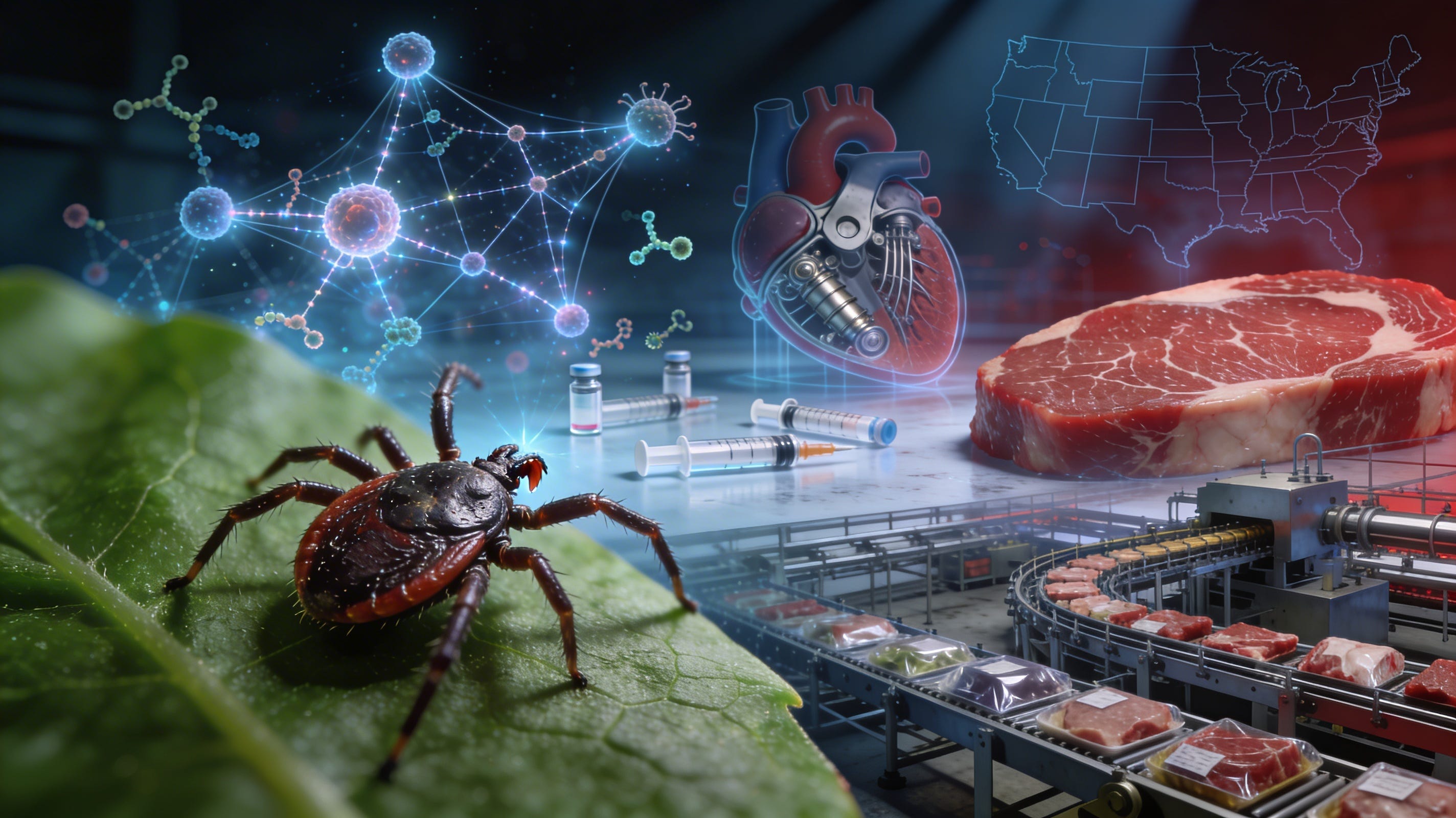
The Discovery
It started with cancer patients. In 2008, oncologists in Tennessee and North Carolina noticed that some patients were having severe allergic reactions to a drug called cetuximab, used to treat colorectal and head-and-neck cancers. Strangely, the reaction rate varied dramatically by geography: 22% of patients in Tennessee and North Carolina had severe reactions, compared to less than 1% in Boston or California. Researchers traced this to an allergy to a sugar molecule called galactose-alpha-1,3-galactose—or “alpha-gal” for short.
Alpha-gal is found in all mammalian tissues: beef, pork, lamb, venison. It’s also found in tick saliva. The connection became clear when Dr. Sheryl van Nunen and colleagues identified the first cases of what’s now called Alpha-Gal Syndrome (AGS): people who had been bitten by ticks were suddenly unable to eat red meat without suffering severe allergic reactions, including anaphylaxis—the kind of reaction that can kill you.
What makes AGS unusual is the timing. Typical food allergies cause reactions within minutes. Alpha-gal reactions take 3 to 6 hours to appear, making them difficult to diagnose. Patients would eat a steak at dinner, go to bed, and wake up at 2am unable to breathe.
How Common Is It?
According to CDC estimates, approximately 450,000 Americans are living with Alpha-Gal Syndrome as of 2022. The condition has been identified in 17 countries across all inhabited continents. Cases are concentrated in the southeastern United States—Virginia, North Carolina, Tennessee, Arkansas—but are spreading northward and westward as tick populations expand.
One group has been hit particularly hard: the military. A 2019 study by the US Army Medical Department found that service members have 7.2 times higher risk of developing AGS compared to civilians. Between 2008 and 2018, more than 4,200 cases were identified among active-duty personnel. The highest-risk locations? Training bases in tick-endemic areas: Fort Bragg (North Carolina), Fort Drum (New York), Fort Campbell (Kentucky/Tennessee). Soldiers spend more time outdoors in tick habitat, and they’re paying the price.
Not Just Ticks
Here’s where things get complicated. Alpha-gal isn’t only found in ticks and mammalian meat. It’s also found in gelatin—the stuff that makes gummy bears chewy, marshmallows fluffy, and pill capsules hold together.
Several common vaccines contain porcine (pig) gelatin as a stabilizer. FDA records show that the MMR II vaccine (measles, mumps, rubella) contains 14.5 milligrams of gelatin per dose. Varivax (chickenpox vaccine) contains 8.9 to 12.5 milligrams. ProQuad (a combination vaccine) contains 11 milligrams. For context, a single gummy bear contains roughly 1-2 milligrams of gelatin. These vaccines deliver a substantial dose.
In 1993, a 17-year-old girl in California had a severe allergic reaction to the MMR vaccine. She told doctors it felt “kind of like what happens when I eat Jell-O.” Tests confirmed she was allergic to the gelatin in the vaccine. More recently, a 2021 study showed that gelatin-containing vaccines can trigger basophil activation—the cellular mechanism behind allergic reactions—in patients with Alpha-Gal Syndrome.
The Gelatin Supply Chain
Most people don’t think about where gelatin comes from, but it’s a massive industry. Three companies dominate global production: Rousselot (owned by Darling Ingredients), GELITA (German private company), and PB Leiner (owned by Belgium’s Tessenderlo Group). Together, they control roughly 30% of the global market. Their gelatin comes from the hides, bones, and connective tissue of cows and pigs—the same mammalian sources that trigger alpha-gal reactions.
These companies serve both the pharmaceutical industry (capsule shells, medical devices) and the food industry (gummy candies, marshmallows, yogurt, processed meats). Pharmaceutical-grade gelatin has higher purity standards, but both types contain alpha-gal epitopes—the molecular structures that trigger allergic responses in sensitized individuals.
For consumers, this means gelatin is everywhere. Haribo Goldbears contain porcine gelatin. Kraft Heinz’s Jet-Puffed Marshmallows contain gelatin. Jell-O is literally gelatin. US versions of Starburst contain animal-derived gelatin, though UK versions are vegetarian. The only way to know for sure is to read labels carefully—and many products don’t specify whether their gelatin comes from cows, pigs, or fish.
The Geographic Pattern
When researchers mapped Alpha-Gal Syndrome cases, they found striking patterns. A 2018 study identified the Appalachian region—Kentucky, Tennessee, Virginia—as a hotspot with 8.7% prevalence, compared to a national average of about 0.01%. A 2021 analysis confirmed significant clustering across the entire southeastern United States.
But there were anomalies. Some high case counts appeared outside the known range of the Lone Star tick (the primary vector). CDC surveillance data showed 3,746 suspected cases in Suffolk County, New York—4% of all US suspected cases, the highest absolute numbers nationally. Minnesota and Wisconsin showed focal clusters. Twenty-three percent of Iowa patients lived outside the Lone Star tick’s known range. This suggests either range expansion, alternative tick vectors (research has implicated the blacklegged tick in some cases), or simply higher testing rates in those areas.
Enter Bill Gates
In 2017, Bill Gates made a significant investment through his personal holding company, Cascade Investment. He participated in a $17 million Series A funding round for a company called Memphis Meats, which has since rebranded as Upside Foods. Memphis Meats produces “cultured meat”—real meat grown from animal cells in laboratory bioreactors, without raising or slaughtering animals.
This wasn’t Gates’ only bet on alternative proteins. Through his foundation and personal investments, Gates has backed Impossible Foods (plant-based meat using engineered heme protein to replicate beef’s flavor) multiple times. He’s also become the largest private farmland owner in the United States, controlling approximately 242,000 to 269,000 acres across 17 states—land that produces conventional crops and livestock.
In February 2021, Gates gave an interview to MIT Technology Review to promote his book on climate change. He made a striking statement: “I do think all rich countries should move to 100% synthetic beef.”
He acknowledged that current alternatives don’t taste good enough yet, but framed the transition as essential for meeting climate goals. Agriculture accounts for roughly 10% of global greenhouse gas emissions, with livestock being a major contributor. Synthetic and plant-based alternatives could dramatically reduce that footprint.
The Financial Positioning
What makes Gates’ position unusual is that he’s positioned on both sides. He owns farmland that produces conventional agriculture—including in states like Arkansas, Florida, Georgia, and North Carolina that overlap with high Alpha-Gal Syndrome prevalence. Simultaneously, he’s invested in companies that stand to benefit if consumers shift away from conventional meat.
The farmland acquisitions accelerated around 2017-2018, according to The Land Report, which tracks large landowners. These were the same years when Alpha-Gal Syndrome was gaining recognition in medical literature and case counts were climbing. This isn’t evidence of coordination—it’s a statement of timing.
What’s clear is that Gates has strategic leverage regardless of which direction the market moves. If conventional meat continues to dominate, his farmland appreciates. If consumers shift to alternatives due to health concerns, climate pressure, or changing tastes, his synthetic meat investments appreciate. Either way, he wins.
Food Control at Scale
The global food supply is controlled by remarkably few players. Four companies—Archer Daniels Midland, Bunge, Cargill, and Louis Dreyfus Company—dominate global grain trade. Cargill alone handles about 25% of US grain exports and supplies roughly 22% of the US domestic meat market. These companies own the grain elevators, shipping fleets, and processing facilities that move food from farm to table.
Meanwhile, the Consultative Group on International Agricultural Research (CGIAR), founded in 1971, controls research on agricultural productivity with an annual portfolio of approximately $900 million. Its gene banks hold over 750,000 crop varieties. Major funders include the Gates Foundation, Rockefeller Foundation, Ford Foundation, and World Bank.
Food safety standards that govern international trade are set by the Codex Alimentarius Commission, established by the UN’s Food and Agriculture Organization and World Health Organization in 1963. Codex standards become the reference point for World Trade Organization disputes, effectively giving them the force of international law. The system has 189 member countries.
A Regulatory Divide
There’s another piece of this puzzle that few people discuss: nanotechnology in food.
Titanium dioxide (TiO2) is used as a whitening agent in candy, gum, baked goods, and sauces. In its nanoparticle form—particles between 1 and 100 nanometers—these materials behave differently than larger particles. They can cross biological barriers.
In 2021, the European Food Safety Authority concluded that titanium dioxide nanoparticles could accumulate in the body and raised genotoxicity concerns—the potential to damage DNA. The European Union banned the additive (known as E171) effective February 2022. The United Kingdom followed.
The United States, however, maintains that titanium dioxide is “Generally Recognized As Safe” (GRAS). It’s permitted up to 1% by weight in foods. The same products that had to be reformulated for European markets continue to contain TiO2 nanoparticles in American versions.
Why does this matter? Studies have shown that nanoparticles can cross the intestinal barrier and enter systemic circulation. For someone already sensitized to alpha-gal, this could theoretically deliver triggering molecules more efficiently than normal digestion. No direct research on this specific interaction exists, but the biological pathways are established.
Nanotechnology in Cultured Meat
Cultured meat production relies on scaffolds—structures that give cells something to grow on. Increasingly, these scaffolds incorporate nanomaterials. A 2025 study demonstrated that phosphatidylcholine nanoparticles can enable hormone-free cultured fat production, with cultured fat containing up to 37% polyunsaturated fatty acids compared to 17.6% in traditional fat. Another study showed that nanostarch particles enhance cell adhesion for cultured meat bioprinting.
The infrastructure for producing these nanoparticles overlaps with pharmaceutical manufacturing. Croda International, for example, supplied the lipid nanoparticles for Moderna’s COVID-19 vaccine. The same company also produces delivery systems for consumer health and nutrition products. This cross-over isn’t sinister—it’s efficient. But it demonstrates how technology platforms developed for one purpose can serve multiple markets.
Synthetic Production Capability
Alpha-gal can be produced synthetically, without any tick involvement. Patents exist for xenotransplantation methods that manipulate alpha-gal expression. Other patents cover chemoenzymatic glycoengineering—the artificial synthesis of carbohydrate molecules like alpha-gal. This isn’t theoretical; the capability exists at industrial scale.
There’s no evidence that alpha-gal has been deliberately deployed to create meat allergies. But the infrastructure for population-level sensitization exists: multiple exposure pathways (ticks, vaccines, food, pharmaceuticals), documented commercial distribution of triggering substances, and synthetic production capability.
What’s Proven and What Isn’t
Let’s be clear about what the evidence supports:
Alpha-Gal Syndrome is real. The mechanism is understood: tick saliva introduces alpha-gal, the immune system produces IgE antibodies, and subsequent mammalian meat consumption triggers delayed allergic reactions. Approximately 450,000 Americans are affected. Military personnel have 7.2 times higher risk than civilians.
Gelatin in vaccines and food contains alpha-gal epitopes. People with AGS can have reactions to gelatin-containing products, including vaccines. The major gelatin suppliers serve both pharmaceutical and food industries, with manufacturing on four continents.
Bill Gates has invested in synthetic meat companies while simultaneously becoming the largest private farmland owner in the United States. He has publicly advocated for wealthy nations to transition to synthetic beef. His financial interests align with scenarios where conventional meat consumption declines.
The regulatory landscape differs significantly between jurisdictions. The EU has banned nanoparticles (TiO2) that remain permitted in US foods. Cultured meat production uses nanomaterial scaffolds. The supply chains for lipid nanoparticles serve both vaccine manufacturers and consumer nutrition companies.
What’s not proven is intentionality. There’s no direct evidence that alpha-gal sensitization has been deliberately deployed, that Gates’ investments were timed to exploit AGS emergence, or that regulatory divergences are designed to differentially affect populations. The available evidence supports infrastructure capability, financial positioning, and coincidental timing—but not conspiracy.
The Unanswered Questions
Several questions remain that could be answered with additional research:
Why is military risk so much higher than civilian risk? Is it simply more tick exposure, or are there additional factors—dietary patterns, vaccine schedules, environmental conditions at training bases?
Why do some high-prevalence areas fall outside the Lone Star tick’s known range? Are other tick vectors involved, or is the tick’s range expanding faster than monitoring shows?
What is the actual exposure from gelatin-containing vaccines? The amounts (11-14.5 mg per dose) are substantial, but the route of administration (subcutaneous rather than intravenous) may reduce systemic absorption. More epidemiological research is needed.
What happens as cultured meat scales up? If nanomaterial scaffolds remain embedded in final products, what are the long-term exposure implications?
Can county-level AGS data be matched against Gates farmland acquisition dates to test for temporal correlation? The data exists in state health departments and county assessor records, but hasn’t been systematically compiled.
Conclusion
The conditions are present. The mechanism exists. Multiple exposure pathways deliver alpha-gal to human immune systems. Financial incentives align with population-level dietary shifts. Regulatory frameworks diverge in ways that create differential exposure. The infrastructure for synthetic production is established.
Whether this represents intentional engineering or simply opportunistic positioning is a question that available evidence cannot answer. What’s documented is that a tick-borne sugar molecule has created a population of people who cannot safely eat conventional meat—and that the financial beneficiaries of this shift include investors in synthetic alternatives who also control substantial conventional agricultural assets.
The transformation is underway. The only question is whether it’s happening to us or because of us.
Sources
Chung et al. 2008 — Geographic variation in cetuximab reactions, New England Journal of Medicine.
Commins et al. 2009 — First identification of alpha-gal syndrome, JAMA.
CDC MMWR 2023 — Alpha-gal syndrome surveillance data.
Koch et al. 2019 — Military AGS risk analysis, US Army Medical Department.
FDA Vaccine Excipient Summary — Gelatin content by vaccine.
Mullins et al. 2021 — Gelatin vaccine reactions in AGS patients, PMID: 33735861.
Erdős et al. 2018 — Geographic clustering in Appalachia.
Koch et al. 2021 — Southern US prevalence study.
Bill Gates — Farmland holdings and investments.
MIT Technology Review 2021 — Gates on synthetic beef.
EFSA 2021 — TiO2 nanoparticle assessment and EU ban.
Gu et al. 2025 — Nanoparticles in cultured fat production.
Niu et al. 2024 — Nanostarch scaffolds for cultured meat.
US11424007B2 — Xenotransplantation alpha-gal patent.
US10836805B2 — Glycoengineering patent.