The Atlantic Divide: When One Nation Arms Itself and the Other Disarms
On 11 June 2026, Britain lost its Defence Secretary over funding. Hours later, America signed a $70bn cheque for deportation forces. Two governments, two diverging futures.

They happened within hours of each other. Two governments, two fundamentally different choices about what kind of country they want to be.
In London, John Healey - the Defence Secretary appointed in July 2024 when Keir Starmer’s Labour government took power - resigned. His resignation letter, posted on social media, was devastating in its simplicity: the Prime Minister had been “unable” to force the Treasury’s hand, and Chancellor Rachel Reeves’ department had been “unwilling” to commit the resources needed to defend the nation at a time of rising threats.
Healey described the letter as something he “never expected to write” - a man who had served Labour for over 30 years, now forced out by a dispute over money.
Six thousand miles away, in Washington, President Donald Trump signed the Secure America Act - a $70 billion injection of funding for Immigration and Customs Enforcement (ICE) and Customs and Border Protection (CBP) through the end of his term in 2029.
One nation refusing to spend. One nation spending lavishly. Both choices will define their security posture for decades.
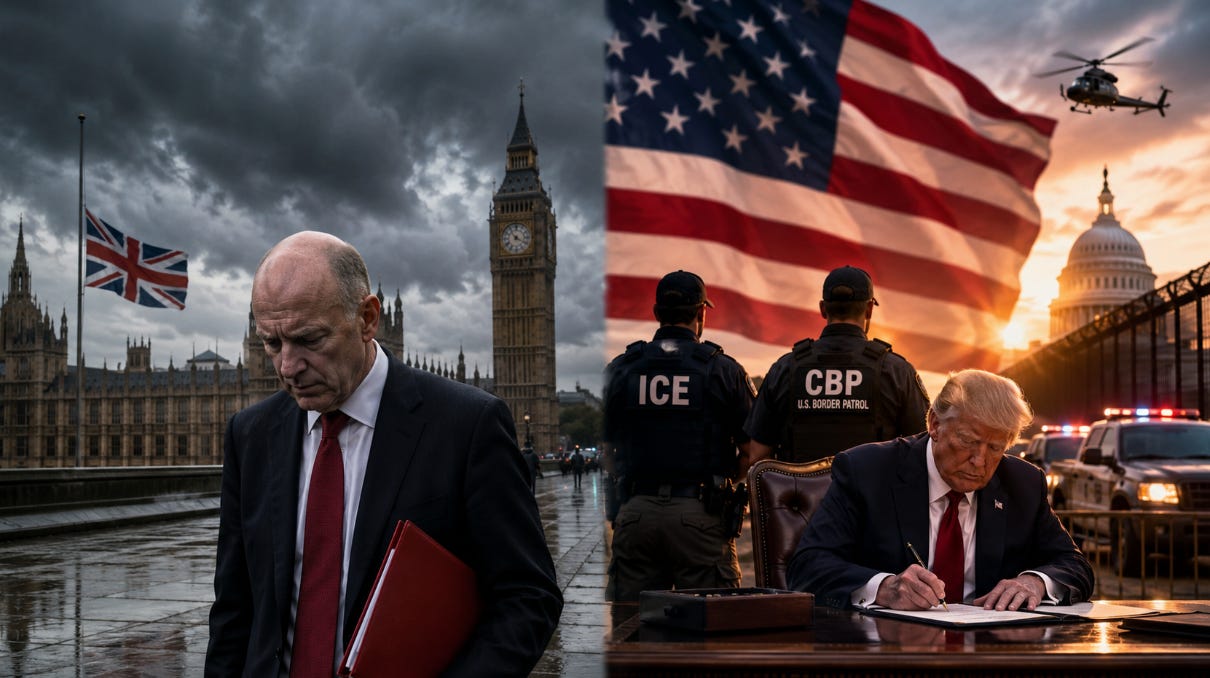
The UK: A Defence Minister Walks Away
Healey’s resignation was extraordinary. Not for what he said, but for the person saying it - a cabinet minister, quitting over money, in a government that still has three years to run until the next general election.
“You have been unable, and the Treasury has been unwilling, to commit the resources that the nation needs to defend the country at this time of rising threats.”John HealeyResignation letter to Prime Minister Keir Starmer, 11 June 2026
At the heart of the dispute was the Defence Investment Plan (DIP), a long-awaited government strategy that was expected to set out future defence spending commitments. The Treasury’s offer? Raise defence spending to just 2.68% of GDP by 2030. The UK is currently on track to reach 2.6% next year with existing investment - so the extra commitment was minimal.
Healey had been advocating for a 3% of GDP target by 2030, arguing this would have cross-party support and align with European allies who were stepping up their own defence spending in response to the Russian threat. According to NATO data, Britain spent just 2.4% of GDP on defence last year - well below the NATO average.
The Irony
Starmer himself had warned - publicly - that intelligence assessments suggested Russia could attack NATO by 2030. Then he refused to fund the defence his own intelligence was telling him was essential.
The Funding Gap
According to the Herald Scotland, Healey requested approximately £18 billion from the Treasury, but Chancellor Rachel Reeves offered just £10 billion in real cash terms - a gap of £8 billion that proved fatal to the DIP negotiations.
Healey’s letter made clear the deep MoD-Treasury divisions: “The extra support is backloaded when the pressure of operations and imperative to speed up readiness to fight is in the first two years and it rises to just 2.68% of GDP in 2030, when we will reach 2.6% next year with the investment we are already making.”
When Was This Supposed to Happen?
The timing of the funding was perhaps even more damning than the amount. Healey noted that the extra funding was “backloaded” - meaning most of it would arrive in later years, not the critical first two years when, he argued, the pressure of operations and the imperative to achieve warfighting readiness was greatest.
The Defence Secretary cited Starmer’s own words from the Munich Security Conference in February 2026, where the Prime Minister had argued powerfully for increased defence spending among European allies. Healey wrote:
“You know what defence needs. You made the argument for this powerfully in your speech at the Munich Security Conference back in February. Without a DIP that meets the moment in this way, I am being forced to make decisions that would reduce the readiness of our forces and increase the risk to personnel on operations, and could make the country less safe.”John HealeyResignation letter, 11 June 2026
Healey’s Record
Despite his resignation, Healey pointed to significant achievements during his tenure:
Led internationally for Ukraine with the coalition of the willing and Ukraine Defence Contact Group
Established Britain as a leading voice for Europe in NATO
Raised defence investment to 2.5% of GDP three years earlier than expected
Launched the deepest defence reforms in 50 years
Won the biggest UK defence export deals for decades
Published a first-of-its-kind Strategic Defence Review
Gave the Armed Forces the biggest pay rise in nearly 20 years
Fixed over 1,200 of the worst forces family homes
Reset relations with European allies and signed major defence agreements with Germany, Norway, and France
No successor has yet been announced.
The Political Fallout
This isn’t just about money. It’s about political survival:
Makerfield by-election - scheduled for next week. The timing could not be worse for Starmer, with Andy Burnham’s team reportedly receiving the news “with shock” as they sat in their campaign headquarters.
Wes Streeting - already quit as Health Secretary in May, citing disagreements with the government’s direction.
Andy Burnham - the Manchester Mayor is circling, attempting a return to frontline national politics to launch a leadership bid against Starmer.
Far-right riots - in Belfast and Southampton. The country is restless, and the government appears unable to maintain order.
Tory leader Kemi Badenoch - described Starmer’s premiership as “falling apart”
The defence industry has been saying this for months: they cannot plan, they cannot invest in long-term programmes, without clarity. According to Politico, one industry figure said: “Industry have been waiting for white smoke to signal cash is coming for over a year and it now looks like we’ll be waiting a little longer.”
Government Response
Downing Street declined to comment on the specifics of Healey’s resignation letter, but a No.10 spokesperson said the government remained “committed to the defence of the United Kingdom” and would continue to work closely with NATO allies.
A Treasury official pushed back strongly at Healey’s claims, arguing that the Chancellor had delivered “a record uplift in defence spending at the spending review, and then working alongside the PM deliver billions more to fund the Defence Investment Plan in full.” The official added: “Let’s be clear on what John is asking for: cuts to schools and hospitals.”
For the US side, the White House did not respond to requests for comment on the corporate beneficiaries of the enforcement surge. However, Senator Lindsey Graham hailed the bill as ensuring “our border has gone from its weakest point to its most secure point in less than two years.”
The UK is contending with the US pivoting away from Europe - and the US-Israeli war with Iran exposed Britain’s lack of military readiness. The Navy couldn’t immediately deploy an advanced warship to the region.
UK Defence Spending Timeline
Current: 2.4% of GDP (2025)
2027: 2.6% projected (with existing investment)
2030: Treasury offer: 2.68% | Healey request: 3.0%
NATO target: 3.5% by 2035
NATO average: 3.1% (2025)
The US: $70 Billion for Deportations
If the UK story is about refusal, America’s is about abandon. Trump signed the Secure America Act on 10 June - the largest investment in immigration enforcement in American history.
Here is how the $70 billion breaks down:
$38 billion - to Immigration and Customs Enforcement (ICE)
$26 billion - to Customs and Border Protection (CBP)
$5 billion - to Department of Homeland Security contingency fund
$3.5 billion - for technology upgrades
The funding is guaranteed through fiscal year 2029, effectively providing Trump with his signature enforcement priority fully funded for the remainder of his second term.
What Triggered This?
The bill’s passage followed months of legislative deadlock. But the trigger was the Minneapolis killings of January 2026.
On 24 January 2026, Alex Jeffrey Pretti - a 37-year-old American intensive care nurse for the United States Department of Veterans Affairs - was shot multiple times and killed by two federal agents in Minneapolis. He was pronounced dead at the scene. Renee Good, a second US citizen, was also killed in the same incident.
The killings sparked massive protests across America. According to Wikipedia, on 25 January 2026, protests erupted in Minneapolis, New York City, San Francisco, Boston, Chicago, and dozens of other cities. A “Unity Ride” in Minneapolis on 31 January drew thousands of cyclists in over 240 cities across 14 countries.
What followed was 75 days of congressional deadlock - a DHS shutdown - as Democrats refused to fund the enforcement agencies involved in the killings. According to CNBC, Democrats had refused to fund the two DHS subagencies since January, when an immigration surge in Minneapolis led to the deaths of two U.S. citizens at the hands of federal agents.
Who Were Alex Pretti and Renee Good?
Alex Pretti was an ICU nurse at the Minneapolis VA Medical Center, described by colleagues as someone who “died as he lived, taking care of other people.” He was 37 years old. According to Wikipedia, he was legally licensed to carry a handgun, and video evidence from Reuters, BBC, The New York Times, CNN, and The Guardian all concluded he was holding a cell phone, not a gun, in the moments before being tackled and killed. Renee Good was also shot in the same incident. The killings led to an FBI investigation and protests across the country.
“Despite Democrat efforts to shut down ICE and Border Patrol, Republicans have now fully funded these agencies through President Trump’s entire second term to the tune of nearly $70 billion.”Senator Lindsey GrahamSenate budget panel chairman, 10 June 2026
The vote was strictly partisan: 214-212 in the House, 52-47 in the Senate. No Democrats voted in favour. According to CNBC, Republicans used the congressional budget reconciliation process to bypass the filibuster, allowing passage with a simple majority rather than the 60 votes normally required.
At the signing ceremony, Trump said the bill would “give the heroes of ICE and border patrol... the support and resources they need to defend our borders, protect our homeland and to keep America safe.”
The Ballroom Controversy
The bill’s passage wasn’t straightforward. Earlier versions had included $1 billion for a new White House ballroom - which was removed after bipartisan opposition. An even more controversial $1.8 billion “anti-weaponization” fund to pay allies who Trump said had been “wronged by the federal government” was also removed after congressional pushback.
Who Benefits?
Beyond the agencies themselves, several corporations stand to gain from the enforcement surge:
Palantir - the data analytics company co-founded by Peter Thiel - already holds a $30 million contract for ImmigrationOS, a system that uses health records of millions of Americans to locate and deport people. The BMJ reported in January 2026 that US agents use Palantir tools that cross-reference health data for deportation hunts.
CoreCivic and GEO Group - the two largest private prison operators in America - have historically benefited from increased enforcement funding. Their stocks tend to rise when immigration detention numbers increase.
Analysis: Two Nations, Two Futures
This isn’t an abstract policy difference. It’s a fundamental choice about what governments do - and what threats they take seriously.
The contrast is even starker when placed against European allies. Germany has committed to 3.5% of GDP by 2030, Poland is spending over 4%, and France has announced a bigger defence budget than at any point since the Cold War. Britain, once NATO’s leading European voice, now finds itself outspent by allies it helped arm.
The historical parallel is instructive. After 9/11, America chose to spend heavily on counterterrorism - creating the Department of Homeland Security, expanding TSA, and building the surveillance architecture that persists today. The $70bn bill follows that same logic: treat the threat as existential, fund the response accordingly. Britain, meanwhile, faces a Russian threat that its own intelligence services have quantified - yet can’t commit an extra 0.3% of GDP to counter it.
The political economy tells a story too. Labour’s problem isn’t just fiscal - it’s credibility. Starmer campaigned on economic competence, on “stability.” Raising taxes to fund defence would undermine that brand. The Conservatives, meanwhile, can attack from the left (Starmer is soft on defence) and right (he’s soft on migration) simultaneously. It’s an impossible position - and Healey’s resignation exposes it.
In America, the calculation is simpler but no less troubling. The $70bn bet is that enforcement, not reform, is the answer to border challenges. But history suggests otherwise. The Secure Fence Act of 2006 promised 700 miles of barriers. Net migration hit record highs anyway. The pattern is clear: more enforcement without pathway reform produces more detention, more spending, and the same number of crossings.
Both situations raise profound questions about governmental priorities - and the capacity of democratic systems to respond to what leaders claim are existential threats. When Britain can’t find money for defence and America can only find money for deportation, something is broken in how we decide what matters.
The next six months will be revealing. Will Starmer cave to pressure and bump defence spending? Will Congress exercise oversight over how ICE spends its new billions? Or will these become the defining failures of both administrations - the moment when the gap between rhetoric and reality became simply too large to bridge?
Domestic controversy over the Minneapolis killings
Democratic opposition spanning the entire party
Questions about civil liberties and due process
Historical evidence that enforcement-only approaches don’t reduce migration
The UK faces a credible military threat from Russia - one its own intelligence services have quantified. America faces a genuine challenge at its southern border - but the $70 billion bet is that enforcement, not reform, is the answer.
Both situations raise profound questions about governmental priorities - and the capacity of democratic systems to respond to what leaders claim are existential threats. When Britain can’t find money for defence and America can only find money for deportation, something is broken in how we decide what matters.
Sources
All links verified working on 11 June 2026. 17 sources total.
[1] Reuters - UK defence minister Healey quits, says PM Starmer’s plans fail to keep country safe
[2] Politico - UK Defense Secretary John Healey quits with blast at Keir Starmer
[3] Herald Scotland - John Healey resigns as defence secretary in funding row
[4] Guido Fawkes - Defence Secretary John Healey Resigns
[5] CNBC - Trump signs $70 billion immigration funding bill after months of delay
[6] Wikipedia - Killing of Alex Pretti
[7] NATO Defence Expenditures 2025 - Table of defence spending as percentage of GDP
[8] CNBC - Congress passes $70bn immigration funding bill
[9] CNBC - Senate passes $70bn funding for ICE and Border Patrol
[10] CNBC - Alex Pretti killed in Minneapolis shooting
[11] CNBC - Democrats block DHS funding over Minneapolis killings
[12] CNBC - Senate Republicans pursue budget reconciliation for immigration funding
[13] CNBC - $1.8bn anti-weaponization fund removed from bill
[14] CNBC - Acting Attorney General says anti-weaponization fund is dead
[16] BMJ — US agents using Palantir tools that cross-reference health data for deportation hunts