The Great Invention Heist
History is written by the winners. But in the world of invention, the winners were often the ones with the best lawyers, the deepest pockets, and the most powerful friends.

There is a story we tell ourselves about invention. A lone genius, struck by a bolt of inspiration, builds a prototype in a workshop, and the world is transformed. The story is comforting. It is also, in case after case, a lie.
The real story is not about theft by individuals. It is about capture by systems. The question of who gets credit for an invention is decided not by who had the idea first, but by who controlled the patents, the capital, the litigation, and the institutions that confer recognition. The distinction matters. Outright appropriation happened, certainly. But so did disputed priority, simultaneous invention, overlooked precursors, and later commercial improvement that eclipsed the original. These are not the same thing, and lumping them together as “theft” weakens the argument. What unites them is the mechanism: the person or corporation with the resources to patent, litigate, commercialise, and write the history books is the one who gets remembered.
This is the story of that mechanism in action, across two centuries and two dozen technologies. It is not a conspiracy. It is a pattern, repeated so often that it becomes a law of technological history.
What you will find in this article:
Over 20 major inventions where the person credited was not the first inventor. A clear taxonomy of how credit is captured: outright appropriation, disputed priority, simultaneous invention, overlooked precursors, and commercial improvement that rewrites history. And a look at the modern-day secrecy order system that continues to suppress breakthrough technologies.
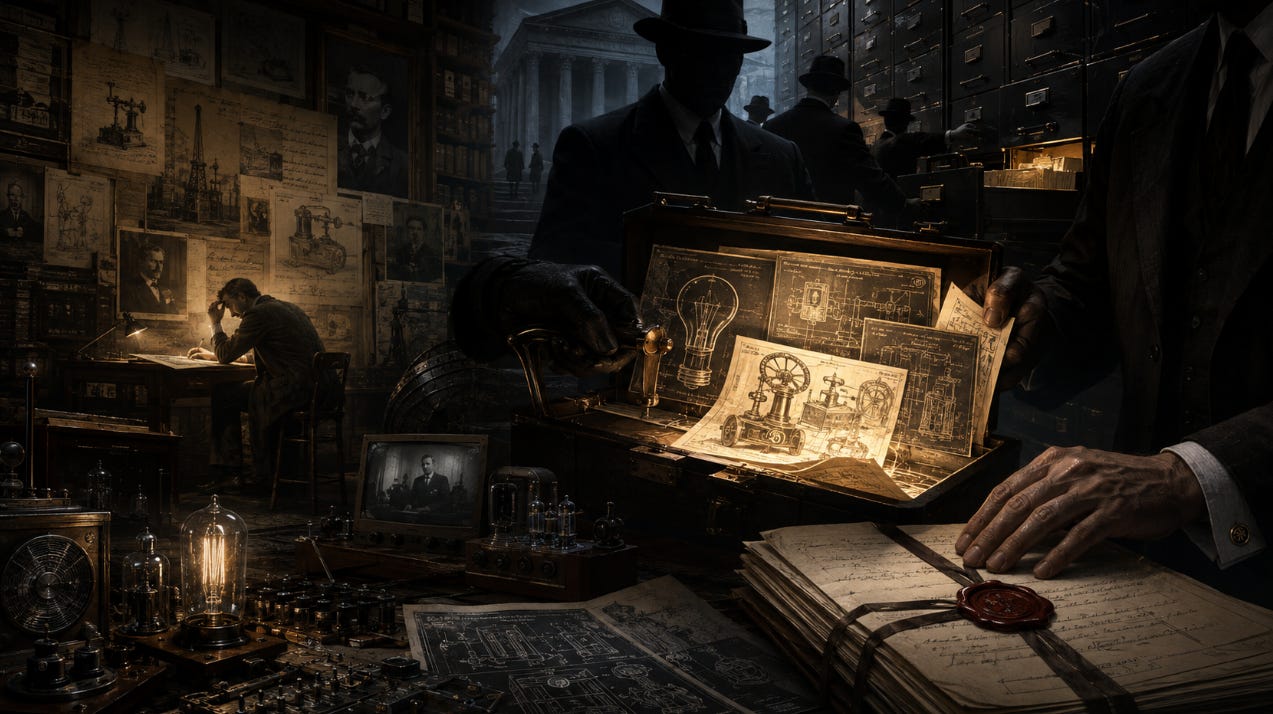
The Edison Machine
Thomas Edison holds 1,093 US patents and a place in the American pantheon that borders on sainthood. But the closer you look at his record, the more it resembles a pattern of institutional capture rather than individual genius. The solitary-genius version of Edison does not survive scrutiny. He perfected, commercialised, and in several cases took credit for the work of others who lacked his resources, his legal team, and his access to capital.
Take the incandescent light bulb. Edison demonstrated a working version on October 21, 1879. But the British physicist Joseph Swan had demonstrated a functional incandescent lamp on February 3, 1879 — eight months earlier. Swan had been working on carbon-filament bulbs since 1850. When Edison sued Swan for patent infringement in British courts, Swan won. The two eventually merged their companies as the Edison & Swan United Electric Light Company. Swan is the defensible precursor: his priority is established by contemporary records and a successful patent challenge.
The motion picture camera is another Edison credit that belongs elsewhere. Louis Le Prince, a French inventor working in Leeds, England, shot the first motion picture film in October 1888 — three years before Edison filed his patent for the Kinetograph. The film, known as “Roundhay Garden Scene,” is eleven frames and lasts about two seconds. In September 1890, Le Prince boarded a train in Dijon, France, and vanished without a trace. His luggage was searched. His body was never found. Edison’s motion picture patent was granted the following year. The circumstances of Le Prince’s disappearance have never been satisfactorily explained.
Edison’s motion-picture operation also depended heavily on William Kennedy Laurie Dickson, the engineer tasked with turning the laboratory’s ambitions into working machinery. The Kinetograph and Kinetoscope emerged from a team, but the public brand absorbed the achievement into a single name: Edison. The mechanism was not merely theft from outside the laboratory. It was ownership converting the labour of employees into the mythology of one inventor.
The movie projector tells a similar story. Charles Francis Jenkins and Thomas Armat developed the Phantoscope projector in 1895. They sold the manufacturing rights to Edison, who rebranded it as the “Edison Vitascope” and took full public credit. The projector that launched the American film industry was not Edison’s invention.
Even the phonograph — one of Edison’s most celebrated creations — had a predecessor. In 1857, the French printer and typesetter Édouard-Léon Scott de Martinville invented the phonautograph, a device that recorded sound waves visually onto lampblack-coated paper. It could record, but not play back. In 2008, scientists at Lawrence Berkeley National Laboratory used optical scanning and digital processing to play back Scott’s recordings, including a ten-second clip of “Au Clair de la Lune” from 1860. It is the oldest recorded sound in human history, made seventeen years before Edison’s phonograph. The New York Times reported the story under the headline “Researchers Play Tune Recorded Before Edison.”
And then there is the War of the Currents. Edison’s employees, as part of a propaganda campaign against Nikola Tesla’s alternating current (AC) system, conducted a series of public animal electrocutions using AC power. The goal was to associate AC with death and danger. The campaign included the electrocution of dogs and cats in 1888, and a horse in 1889. The electric chair was designed to run on AC, and Edison’s associates suggested calling it “Westinghousing” after his rival George Westinghouse. The campaign worked: AC was stigmatised in the public mind, even though it was the superior technology for long-distance power transmission. The IEEE’s history of the War of the Currents documents these events.
Tesla’s AC system won the contract to light the Chicago World’s Fair of 1893, proving its superiority. It was then used to harness the power of Niagara Falls in 1895, becoming the standard for electrical power distribution worldwide. But Tesla died in poverty in 1943 in Room 3327 of the New Yorker Hotel, while Edison’s name is on schools, hospitals, and companies around the world. The man who gave the world the technology that powers every building on the planet died alone and broke. The man who tried to destroy his technology became a folk hero.
The Telephone
Alexander Graham Bell is credited with inventing the telephone in 1876. The reality is more complicated, and less flattering to Bell.
Antonio Meucci, an Italian immigrant living in Staten Island, had been developing a “telettrofono” (talking telegraph) since the 1850s. He filed a patent caveat — a preliminary notice of invention — in December 1871, but could not afford the $10 renewal fee in 1874. His caveat lapsed. In 1876, Bell filed his patent for the telephone. In 2002, the US House of Representatives passed H.Res.269, formally recognising Meucci’s contributions to the invention of the telephone. The resolution did not declare Meucci the inventor — it recognised his role in the telephone’s development and noted that his work had been overlooked.
Even more revealing is the story of Elisha Gray. On February 14, 1876 — the same day Bell filed his patent application — Gray filed a caveat for a telephone design. Bell’s application was the fifth entry that day. Gray’s was the thirty-ninth. Bell’s patent was granted. Gray’s caveat was noted and shelved. The timing has been the subject of controversy for over a century, with allegations that Bell or his lawyers may have seen Gray’s caveat before filing. The US Patent Office later acknowledged the closeness of the filings, but Bell’s patent stood.
The Radio
Guglielmo Marconi won the Nobel Prize in Physics in 1909 for his work on wireless telegraphy. He is widely credited as the inventor of radio. But the patent history tells a different story.
Nikola Tesla had been working on wireless transmission since 1891. He demonstrated a radio-controlled boat in 1898 at Madison Square Garden and held fundamental patents for radio technology dating to 1897. Marconi, backed by a powerful network including Andrew Carnegie, Thomas Edison, and J.P. Morgan, built on Tesla’s work and secured patents. In 1943, the US Supreme Court ruled in Marconi Wireless Telegraph Co. of America v. United States, 320 U.S. 1, that certain contested Marconi patent claims were invalid because they had been anticipated by earlier work, including Tesla’s. The Court did not declare Tesla the sole inventor of radio. It invalidated Marconi’s claims on the basis of prior art — a narrower but still significant legal finding that acknowledged Tesla’s priority on key elements.
Meanwhile, the Russian physicist Aleksandr Popov had demonstrated a wireless receiver on May 7, 1895 — months before Marconi’s first public demonstration. Popov is celebrated as the inventor of radio in Russia and Eastern Europe. The patent belonged to the inventor. The industry belonged to RCA.
The Frequency RCA Could Not Control
Edwin Howard Armstrong developed wide-band frequency modulation, which offered clearer sound and greater resistance to static than AM broadcasting. RCA had examined Armstrong’s system, but its commercial empire, transmitter infrastructure, and NBC network were built around AM.
Armstrong later accused RCA of infringing fundamental FM patents and obstructing FM’s development. He did not merely invent a better way to transmit sound. He invented a technology that threatened an existing industrial order. RCA had built its empire around AM. FM promised greater clarity, less interference, and a new technical standard that RCA did not fully control. Armstrong’s subsequent legal campaign accused the company of infringing his patents and deliberately slowing FM’s development. Whatever judgment is made about motive, the structural imbalance is beyond dispute: Armstrong owned patents; RCA owned an industry.
The Television War
Television was not the invention of a single person, but the man who built the first fully electronic television system was Philo Farnsworth — and he was systematically outmanoeuvred by corporate power.
Farnsworth, a self-taught prodigy from a rural Idaho farm, conceived the idea of electronic television at age fourteen. He transmitted the first electronic television image — a straight line — in September 1927. In 1930, Vladimir Zworykin, an engineer working for RCA, visited Farnsworth’s lab. RCA offered to buy Farnsworth’s patents. He refused. RCA then claimed Zworykin had invented television first. The US Patent Office ruled in Farnsworth’s favour in 1935, finding that his priority predated Zworykin’s work. But RCA tied Farnsworth in litigation for years, outspending him at every turn. By the time Farnsworth’s fundamental patents expired, RCA had already built the television industry — and written Zworykin into the history books. Farnsworth died in 1971, largely forgotten, his name absent from the industry he created. The patent belonged to the inventor. The industry belonged to RCA.
Two Generations of Stolen Visibility
Mary Anderson patented an effective windshield-clearing device in 1903. The automotive industry did not adopt such systems at scale while her patent still held meaningful commercial value. Standard adoption came later, after her protection had expired.
Decades afterwards, Robert Kearns invented the intermittent wiper in 1963 and entered a prolonged patent war against major car manufacturers. He represented himself in court, turning down multi-million-dollar settlement offers because he wanted justice, not money. He eventually won $10.2 million from Ford and $18.7 million from Chrysler. But the legal battle destroyed his marriage, his health, and his sanity. His story was turned into the 2008 film “Flash of Genius.” The Hustle covered his epic battle in detail. Kearns won in court, but the system was designed to break him. Most independent inventors do not have the resources to fight a decade-long patent war against a multinational corporation. Kearns was the exception, and it cost him everything.
Mary Anderson and Robert Kearns were separated by six decades, but they encountered opposite ends of the same system. Anderson arrived too early to profit. Kearns arrived on time to be crushed.
The Woman Who Had to Prove She Built It
Margaret Knight designed machinery that automatically cut, folded, and glued flat-bottomed paper bags. Charles Annan encountered the machine and sought a patent for the design.
Knight challenged him in a patent interference proceeding and produced drawings, development records, testimony, witnesses, and physical evidence of her work. She won.
Knight’s case was not a vague argument over influence or simultaneous invention. A man saw her machine and attempted to patent the design. Knight fought back with notebooks, drawings, witnesses, and physical evidence showing how the mechanism had been developed. She won the interference proceeding, but the case exposed the burden placed on excluded inventors: Knight did not merely have to build the machine. She had to prove that a woman was capable of having built it. Knight won the patent fight. History still made her fight for the footnote.
The Sewing Machine Wars
The sewing machine was not invented by Isaac Singer, though his name became synonymous with it. Walter Hunt built the first functional sewing machine in 1834, but refused to patent it, fearing it would put seamstresses out of work. Elias Howe independently invented a sewing machine in 1846 and received a patent. Isaac Singer copied Howe’s design, added a foot treadle and other improvements, and built a business empire. Howe sued Singer and won, forcing Singer to pay royalties of $25 per machine. But it is Singer’s name that lives on — because Singer built the company, the brand, and the distribution network. The legal victory gave Howe money, but Singer got history.
The Monopoly That Wasn’t
Monopoly is the best-selling board game in history, credited to Charles Darrow, who supposedly invented it during the Great Depression and sold it to Parker Brothers in 1935. The story is a fabrication.
The game was actually invented by Elizabeth Magie, a progressive feminist who created “The Landlord’s Game” in 1903 to demonstrate the economic principles of Henry George — specifically, the evils of land monopolies. She received US patent 748,626 in 1904. The game was played in college towns for decades, evolving through various homemade versions. Charles Darrow played a version, copied it, and sold it to Parker Brothers as his own. Magie sold her patent to Parker Brothers in 1936 for $500 — with no royalties. The New York Times finally told her story in 2015, more than a century after she invented the game. Parker Brothers promoted Darrow as the game’s inventor while Magie’s earlier patent and political purpose receded from public memory.
The Whiskey That Wasn’t Jack’s
Jack Daniel’s is one of the most famous whiskey brands in the world, named after its founder Jasper Newton “Jack” Daniel. But the man who taught Jack Daniel how to make whiskey was Nathan “Nearest” Green, an enslaved master distiller who taught Daniel the distilling trade, including charcoal mellowing. The origins of the Lincoln County Process — the charcoal filtering method that defines Tennessee whiskey — remain disputed among whiskey historians, but Green’s role in teaching Daniel the craft is well documented.
Green was enslaved by a Lutheran minister named Dan Call, who ran a distillery. Jack Daniel worked for Call as a boy and learned the distilling trade from Green. When Call sold the distillery to Daniel in 1875, Green stayed on as the first master distiller — the first freedman to hold that title in the United States. For over a century, Green’s role was erased from the company’s history. Jack Daniel’s eventually incorporated Nearest Green into its official company history and visitor narrative. Entrepreneur Fawn Weaver independently founded Uncle Nearest Premium Whiskey to restore Green’s name and legacy. Jack Daniel’s and Uncle Nearest later collaborated through industry initiatives. The erasure was not a single act of theft but a systemic one: an enslaved man could not hold a patent, could not own a business, and could not write himself into the historical record.
The Technology the Navy Ignored
Hedy Lamarr was one of Hollywood’s most glamorous stars. She was also a brilliant inventor. During World War II, Lamarr and composer George Antheil developed a “frequency-hopping” spread-spectrum communication system designed to prevent radio-guided torpedoes from being jammed. They received US patent 2,292,387 in 1942.
The Navy declined to adopt the proposal at the time. Lamarr was encouraged to support the war effort through fundraising and war-bond promotion. The patent expired before the Navy ever used it. Lamarr and Antheil’s patent did not directly create every wireless technology that followed, but it anticipated a central principle of secure spread-spectrum communication: rapidly changing transmission frequencies to resist interception and jamming. Lamarr and Antheil were posthumously inducted into the National Inventors Hall of Fame in 2014, but they never saw a penny from the technologies that now connect the world.
The Laser
The laser was not invented by Charles Townes or Arthur Schawlow, who won the Nobel Prize in Physics in 1964 for their work on the maser and laser. The real priority belongs to Gordon Gould.
Gould conceived the idea of the laser in November 1957 and coined the term “laser” — Light Amplification by Stimulated Emission of Radiation. He had his notebook notarised and filed for a patent. Townes and Schawlow developed the optical-maser framework. Gould independently developed key concepts, coined the term “laser,” documented his work, and later secured important patents. He spent the next thirty years in legal battles and eventually won forty-eight patents for laser technology, so fundamental that every laser manufacturer in the world had to license them. But the Nobel Prize had already been awarded to Townes and Schawlow. Gould was inducted into the National Inventors Hall of Fame in 1991, but he never received the scientific recognition that the Nobel confers. Scientific prestige, patent priority, and commercial control were distributed differently among the contributors. The point is not that one side invented everything. It is that institutional recognition and patent ownership did not reflect the full pattern of contribution. The invention was cumulative. The credit was not.
The Airplane
The Wright brothers made their famous flight at Kitty Hawk on December 17, 1903. But Gustave Whitehead claimed to have flown a powered aircraft on August 14, 1901 — more than two years earlier — in Bridgeport, Connecticut. The flight was reported by the Bridgeport Sunday Herald with eyewitness accounts.
Whitehead’s claim is disputed. Aviation historians remain divided on whether his flight was conclusively proven. The alleged flight photograph has not survived, and the Smithsonian disputes the supporting evidence. What is not disputed is that the Smithsonian Institution had a contractual agreement with the Wright estate: the Smithsonian would recognise the Wrights as the first to fly, and in return, the Wrights’ original Flyer would be displayed at the museum. This agreement created an obvious institutional conflict of interest — the Smithsonian had a financial and reputational stake in maintaining the Wrights’ priority. The agreement was only revealed in the 1970s. In 2013, the authoritative Jane’s All the World’s Aircraft published an editorial stating that Whitehead likely flew first. The Smithsonian continues to maintain that the Wrights were first. The conflict of interest is clear; the evidence for Whitehead’s flight remains contested.
The Computer
The ENIAC, completed in 1945 at the University of Pennsylvania, is often called the first electronic general-purpose computer. But the real priority belongs to the Atanasoff-Berry Computer (ABC), built by John Atanasoff and his graduate student Clifford Berry at Iowa State College between 1939 and 1942.
The ABC was an earlier electronic digital computer, but it was NOT programmable or general-purpose. John Mauchly, one of the ENIAC’s creators, visited Atanasoff in June 1941 and spent several days examining the ABC before ENIAC was completed. In 1973, the landmark case Honeywell, Inc. v. Sperry Rand Corp. invalidated the ENIAC patent, ruling that Mauchly and his co-inventor J. Presper Eckert had derived their ideas from Atanasoff. The court declared Atanasoff the inventor of the electronic digital computer. ENIAC still retained major significance as an electronic general-purpose machine. The scandal is not that ENIAC was meaningless. It is that its patent attempted to claim a field built partly on earlier work.
Tommy Flowers and his team built Colossus at Bletchley Park to assist in decrypting high-level German communications. After the war, the project remained classified, machines were dismantled, records and technical material were restricted or destroyed, and Flowers could not openly explain the scale of what he had built. The British contribution was excluded from public computer history for decades.
Colossus did not lose its place in history because another inventor reached the patent office first. It disappeared because the state ordered it to disappear. Tommy Flowers and his team had built one of the defining machines of the electronic age, yet secrecy prevented them from explaining what they had achieved. Equipment was dismantled, records vanished behind classification, and the public history of computing developed without them. Here, erasure was not an accidental consequence of the system. It was government policy. Colossus worked. That was precisely why the public was not allowed to know it existed.
The computer had many parents. Charles Babbage designed the Analytical Engine in 1837. Ada Lovelace wrote the first algorithm for it. Konrad Zuse built the Z3 in Germany in 1941. Alan Turing conceived the universal Turing machine in 1936. The point is not that any one of them was the sole inventor. The point is that the ones who got the credit were not always the ones who did the work — they were the ones who had the institutional backing to claim it.
The Digital Music Player
Before the iPod, there was the IXI. British inventor Kane Kramer designed a portable digital music player in 1979 — twenty-two years before the iPod. He filed a UK patent in 1981. The device had a 3.5-inch screen, a four-button interface, and could store about three and a half minutes of audio.
Kramer could not afford to renew his international patents, and they lapsed. When Apple launched the iPod in 2001, they used Kramer’s design as prior art — meaning they acknowledged his invention existed before theirs. But Kramer never received any compensation. Apple’s lawyers successfully argued that since the patents had expired, the design was in the public domain. The inventor who cannot afford to maintain patent protection loses not only the financial reward but the historical credit.
The Computer Mouse
Douglas Engelbart invented the computer mouse in 1963 — a wooden shell with two metal wheels that he built by hand. He demonstrated it at the “Mother of All Demos” in 1968, where he also showed hypertext, video conferencing, and collaborative editing in real time. The audience of a thousand computer scientists sat in stunned silence.
Engelbart’s employer, SRI International, held the patent. In 1980, SRI licensed the mouse technology to Apple for $40,000. Apple used it in the Lisa (1983) and the Macintosh (1984), changing computing forever. Engelbart saw almost none of that money. He spent his later years in relative obscurity, while Apple became the most valuable company in the world on the back of a graphical user interface that Engelbart had pioneered. The patent system rewarded the institution that held the rights, not the individual who had the idea.
The Telescope
Galileo Galilei is often credited with inventing the telescope in 1609. But the first telescope was built by Hans Lippershey, a German-Dutch spectacle maker, in 1608. Lippershey applied for a patent, but it was rejected because the design was too easy to copy. Galileo heard about the device, built his own improved version with higher magnification, and turned it to the heavens — discovering the moons of Jupiter, the phases of Venus, and the craters of the Moon. He became famous. Lippershey was forgotten. The case is a textbook example of commercial improvement eclipsing original invention.
The Steam Engine
James Watt is celebrated as the inventor of the steam engine, with his name on the unit of power. But the first practical steam engine was built by Thomas Newcomen in 1712 — fifty-seven years before Watt’s patent.
Newcomen’s atmospheric engine pumped water out of coal mines and was used across Britain for decades. Watt’s improvements — a separate condenser, double-acting cylinders, and a centrifugal governor — made the steam engine far more efficient. Watt secured a twenty-five-year extension on his patent through an Act of Parliament in 1775. Whether this delayed industrialisation is disputed: recent scholarship from Oxford University Press argues that Watt’s patent did not significantly impede innovation, and that the narrative of suppression has been overstated. The point is not that Watt suppressed progress. It is that parliamentary legislation — the highest form of institutional power — was required to secure his credit in the first place.
The Cotton Gin
Eli Whitney is credited with inventing the cotton gin in 1793, a device that revolutionised the American cotton industry. But the real story is darker and more systemic. Whitney’s gin was a simple design that was easily copied, and he spent years in court trying to enforce his patent.
What is less known is that enslaved Black inventors could not hold patents under the legal framework of the time. The US Patent Act of 1793 did not explicitly say “enslaved people cannot patent” — it required patent applicants to be citizens and to swear an inventor’s oath. These requirements, later interpreted through the lens of slavery law, effectively excluded enslaved people from the patent system. Any invention by an enslaved person was legally the property of their owner. The true number of inventions lost to this systemic exclusion will never be known. The cotton gin is not a story of a single stolen invention. It is a story of a system designed to ensure that certain people could never be recognised as inventors at all.
The Invention Secrecy Act
The capture of invention is not just a historical curiosity. It is still happening today, under the authority of the Invention Secrecy Act of 1951.
This law allows the US government to issue secrecy orders on patent applications, preventing the inventor from disclosing or commercialising their invention. As of FY2025, there were 6,543 active secrecy orders in effect — the highest number ever recorded. In FY2025, 102 new secrecy orders were issued. Of those, 18 were against private inventors — individuals who had their inventions classified without compensation, in what critics call constitutionally questionable “John Doe” orders. The figures fluctuate by financial year; the Federation of American Scientists maintains the most current data.
It is important to distinguish between two separate phenomena. The secrecy order system suppresses patent applications from public view entirely. Separately, there are extraordinary patents that were granted and published publicly — and are therefore not evidence of currently suppressed inventions. These are included here as a matter of record, with the explicit caveat that a granted patent does not constitute independent scientific validation:
Extraordinary patents that remain scientifically unverified
US 10,144,532 B2 — Dr. Salvatore Pais (US Navy): A “craft using an inertial mass reduction device.” View on Google Patents
US 10,322,827 B2 — Dr. Salvatore Pais (US Navy): A “gravitational wave generator.” View on Google Patents
US 6,960,975 B1 — Boris Volfson: A “space vehicle propelled by a pulsed inertial mass.” View on Google Patents
US 6,362,718 B1 — Thomas Bearden: A “motionless electromagnetic generator.” View on Google Patents
US 5,088,272 — Stanley Meyer: A “water fuel cell.” View on Google Patents
US 5,018,180 — James W. Barrett: An “electrostatic propulsion system.” View on Google Patents
These patents exist in the public record. They were granted by the USPTO. But a patent is not a proof of concept. The USPTO does not ordinarily construct each invention or independently reproduce every claimed performance. Patent issuance therefore cannot substitute for external experimental validation. Claims of antigravity, free energy, water-fuel, or reactionless propulsion should be evaluated on their scientific merits, not on the fact of patent grant. These are not evidence of currently suppressed inventions; they are publicly available patents whose scientific claims remain unverified.
As Bloomberg reported in 2019, the secrecy order system has expanded dramatically since 9/11, and inventors have little recourse. The Slate investigation in 2014 revealed that the government has suppressed everything from advanced battery technology to cold fusion devices. The system is the modern incarnation of the same mechanism that has always governed who gets to invent: the power to suppress is the power to control.
The Network
Look closely at the pattern, and a network emerges. The men who captured the credit — Bell, Edison, Marconi, Singer — were not necessarily more brilliant than the people they displaced. They were better connected.
J.P. Morgan funded Edison’s laboratory, Marconi’s wireless company, and Andrew Carnegie’s steel empire. He also funded Tesla’s Wardenclyffe project — a global wireless transmission tower. Tesla radically expanded the scope of the project, requiring substantially more funding than originally agreed. Morgan refused further advances. Meanwhile, Marconi’s cheaper and more immediately practical wireless telegraphy technology attracted investors. Wardenclyffe was never completed. Tesla died broke. Morgan’s banks became the most powerful financial institutions in the world. The Money Trust, as congressional investigators called it, controlled the flow of capital to inventors. If Morgan did not fund you, you did not get built.
The Royal Society served as a gatekeeper for scientific legitimacy in Britain. Isaac Newton was its president. James Watt was a fellow. The Society’s endorsement could make or break a scientific career — and it was reserved for the well-connected. The Society’s history of patronage shows how institutional recognition has always favoured the connected over the isolated.
The Smithsonian Institution had a contractual agreement with the Wright estate that required the Smithsonian to recognise the Wrights as the first to fly in order to retain the Wright Flyer exhibit. This created an obvious institutional conflict of interest. The Smithsonian’s own archives document this agreement.
This was not a conspiracy in the sense of a secret meeting where they planned it all. It was a system — a network of privilege, money, and institutional power that naturally favoured the connected over the isolated, the wealthy over the poor, the established over the unknown. The real network was not secret societies. It was the openly visible network of capital, institutional gatekeeping, and legal power.
George Selden obtained a broad patent associated with the automobile despite not building the commercially dominant system later used by manufacturers. An industry licensing association attempted to collect royalties until Henry Ford successfully challenged the scope of the claim. Patent capture does not only erase earlier inventors. It can also allow a broad legal claim to be positioned over an industry built by other engineers.
The Pattern
Across all these stories, the same mechanism repeats. It is not a single theft but a four-step process of credit capture:
An earlier inventor creates. A brilliant but often isolated individual — an immigrant, a woman, a self-taught prodigy, an enslaved person — has the original idea and builds a working prototype. They lack the resources to patent, litigate, and commercialise.
A connected person or corporation captures. Someone with money, social connections, or institutional backing learns about the invention and files a patent, often with minor improvements. The capture may be outright appropriation, disputed priority, or legitimate commercial improvement that nonetheless eclipses the earlier contributor.
The market commercialises. The connected person’s version is manufactured, marketed, and sold. The earlier inventor lacks the resources to compete or to litigate. If they do litigate, they face a system designed to exhaust them.
History erases the earlier contributor. Textbooks, museums, and encyclopedias credit the connected person. The earlier inventor is forgotten, or reduced to a footnote. The institutions that could correct the record — courts, patent offices, museums — have already moved on.
This is not a conspiracy theory. It is documented history, confirmed by:
The US Supreme Court in 1943, invalidating Marconi’s patents on the basis of Tesla’s prior art
The US Congress in 2002, formally recognising Meucci’s contributions to the telephone
The Federal Court in 1973, declaring Atanasoff the inventor of the electronic computer
The Patent Office in 1935, ruling for Farnsworth over RCA
The British courts in the 1880s, ruling for Swan over Edison
The pattern continues today. The Invention Secrecy Act suppresses breakthrough technologies. Corporate patent strategies bury independent inventors in litigation. And the same institutions that once erased Tesla and Meucci are still writing the history books.
The question is not whether the pattern exists. It is whether we have the courage to look at it — and to ask who is being erased right now.
Sources
US Supreme Court: Marconi Wireless Telegraph Co. of America v. United States, 320 U.S. 1 (1943)
US House Resolution 269 (2002) — Recognising Antonio Meucci’s contributions to the telephone
Honeywell, Inc. v. Sperry Rand Corp. (1973) — Invalidating the ENIAC patent
Federation of American Scientists: Invention Secrecy Act of 1951
Google Patents: US 748,626 — Elizabeth Magie, The Landlord’s Game (1904)
Google Patents: US 2,292,387 — Lamarr/Antheil, Frequency-Hopping Spread Spectrum (1942)
Google Patents: US 10,144,532 B2 — Pais, Inertial Mass Reduction Device
Google Patents: US 10,322,827 B2 — Pais, Gravitational Wave Generator
Google Patents: US 6,960,975 B1 — Volfson, Pulsed Inertial Mass Space Vehicle
Google Patents: US 6,362,718 B1 — Bearden, Motionless Electromagnetic Generator
Google Patents: US 5,018,180 — Barrett, Electrostatic Propulsion System
New York Times: “Researchers Play Tune Recorded Before Edison” (2008)
New York Times: “Monopoly’s Inventor: The Progressive Who Didn’t Pass ‘Go’” (2015)
MIT Technology Review: “Who Really Invented Television?” (2009)
Bloomberg: “Congratulations, Your Genius Patent is Now a Military Secret” (2019)
The Hustle: “The Epic, Decades-Long Battle Between Ford and a Small-Time Inventor”
FirstSounds.org — Scott de Martinville’s Phonautograph Recordings
Smithsonian Institution Archives: The Wright Brothers and the Smithsonian
Smithsonian Magazine: Philo Farnsworth — The Farm Boy Who Invented TV
Computer History Museum: From ENIAC to ABC — The Court Case That Changed Computing
Computer History Museum: Douglas Engelbart — The Mother of All Demos
Library of Congress: The Telephone — Who Really Invented It?
BBC: Kane Kramer — The Man Who Invented the Digital Music Player Before the iPod
IEEE Engineering and Technology History Wiki: Edwin H. Armstrong
Google Patents: US 743,801 — Mary Anderson, Window-Cleaning Device (1903)
Google Patents: US 549,160 — George Selden, Road Engine (1895)