The Great Multicultural Experiment: A European Investigation
An investigative analysis of European multiculturalism policies - tracking five decades of promises, the events that exposed the gap between policy and reality.

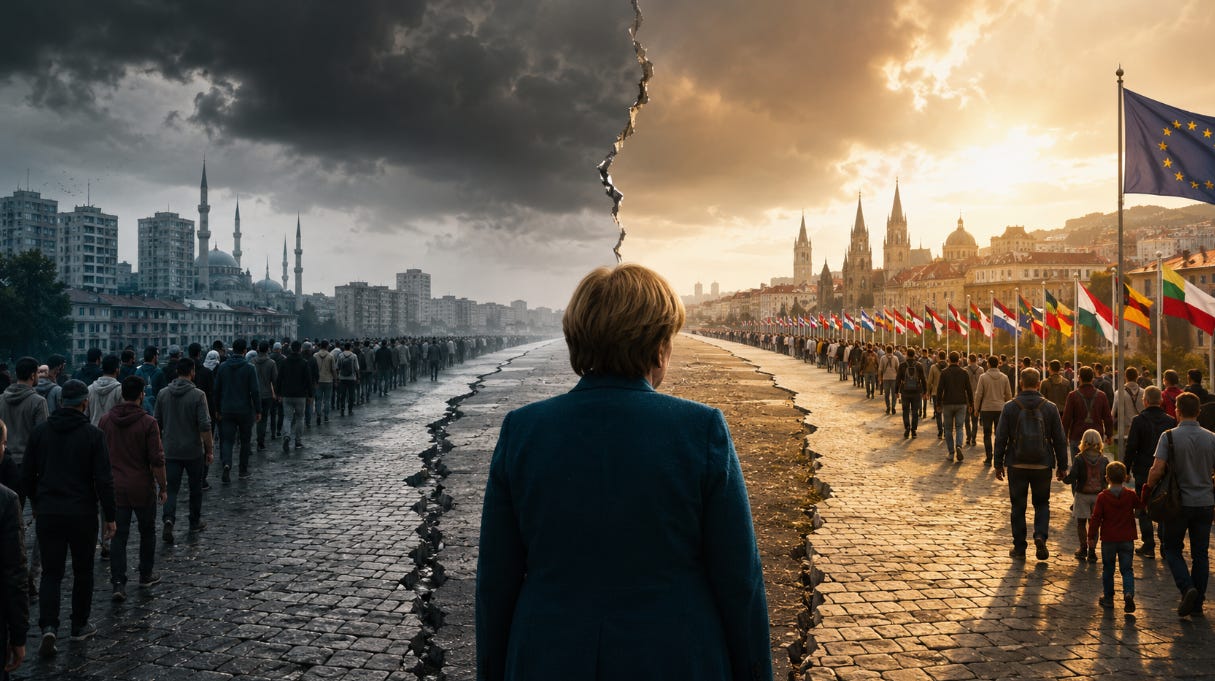
It was October 2010 when German Chancellor Angela Merkel stood before her party’s youth wing in Potsdam and delivered a sentence that would echo across Europe. “Multiculturalism has failed, absolutely failed,” she told the audience. “The approach has failed, and it has failed utterly.”
The statement made headlines worldwide. Here was Germany’s leader - the woman who had guided Europe through the financial crisis, the de facto head of the European Union - publicly acknowledging that one of the continent’s defining social experiments had not worked.
But what received far less attention was the timeline. Merkel’s declaration came thirty-five years after West Germany first began recruiting Turkish “guest workers” in 1961 under the Gastarbeiter (guest worker) program. It came fifteen years after German reunification and the economic disruptions that followed. It came several years after the London bombings, which had exposed the existence of parallel communities in Britain’s major cities. It came during a period of rising populist sentiment across Europe.
The question this investigation examines is not simply whether multiculturalism failed - the data on that point is substantial. The question is why European leaders celebrated multiculturalist policies for decades while the evidence of failure accumulated, and then suddenly pivoted to acknowledge that failure in a coordinated fashion between 2010 and 2011.
More specifically: what did leaders know or should have known, when did they know it, and what does their pattern of delayed acknowledgment reveal about political messaging versus actual governance?
The Origins: How It Began
To understand what failed, one must first understand how it began. The European multicultural experiment did not start with celebrations of diversity. It started with labor shortages - and the assumption that workers would go home.
The German Gastarbeiter Program
West Germany’s guest worker program, formally known as the Gastarbeiter programme, began with bilateral recruitment agreements signed with multiple countries. The first agreement was with Italy on November 22, 1955, followed by Spain, Greece, Turkey, Morocco, South Korea, Portugal, Tunisia, and Yugoslavia.
The agreement with Turkey, signed on October 30, 1961, would prove the most significant. By the 1970s, approximately 2.5 million foreigners were laboring in Germany across manufacturing and services. The program officially ran from 1955 until 1973, when recruitment stopped following the oil crisis.
But there was a fundamental assumption baked into the policy: these workers were temporary. Work permits were issued for two-year periods, with the expectation that workers would return home. That assumption proved spectacularly wrong.
Three factors changed everything. First, family reunification - starting in the 1970s, workers brought their families. Second, the 1973 recruitment halt - after the oil crisis, Germany stopped recruiting but workers already there stayed. Third, permanent settlement - many decided to remain rather than return.
By 2024, Germany recorded 17.4 million first-generation immigrants, representing 20.9% of the population. Including those with migration background, the figure reaches 25.2 million - 30.2% of the population.
The shift from “temporary workers” to permanent settlement was not a single policy decision but a gradual realization. Germany did not formally acknowledge this as a new immigration policy until later decades.
The Netherlands: Ethnic Minorities Policy
The Netherlands adopted its “Ethnic Minorities Policy” in 1983, explicitly embracing multiculturalism as the guiding framework. The policy was designed to ensure equal opportunities for ethnic minorities while allowing them to maintain their cultural identities.
The Netherlands marketed itself as uniquely tolerant. The message to the world was clear: the Netherlands had solved the integration question through enlightened policy.
By the 1990s, the country’s self-image was so closely tied to its multiculturalist policies that any challenge to those policies was treated as an attack on Dutch identity itself.
Sweden’s Free Choice Model
Sweden adopted what became known as the “free choice” model in 1975 - preserving minority cultures through voluntarism rather than mandating integration. The country took pride in its enlightened approach, becoming the first European country to adopt an official multiculturalism policy.
In 1970, immigrants were below 7% of the Swedish population. By 2024, those with foreign backgrounds reached 35.4%.
The pattern was consistent across Europe: policies designed for temporary workers became permanent population settlements, with integration frameworks that assumed those populations would eventually return home.
Leaders Speak: What They Said
The public statements of European leaders on multiculturalism tell a story of gradual celebration followed by coordinated reversal. The quotes are well-documented.
Angela Merkel, Germany - October 2010
“Multiculturalism has failed, absolutely failed.”
Merkel made this statement at a meeting of her Christian Democratic Union (CDU) youth wing in Potsdam, Germany. This was not a slip or an offhand comment - it was a deliberate repositioning of her party’s stance on integration.
David Cameron, United Kingdom - February 5, 2011
“Under the doctrine of state multiculturalism, we have encouraged different cultures to live separate lives.”
Cameron delivered this major speech on counter-terrorism and community cohesion at the Munich Security Conference. The speech was widely documented as a key turning point in British multiculturalism policy.
Nicolas Sarkozy, France - February 2011
“The multiculturalist temptation is finished. We have been wrong to believe that one could simply live next to one another.”
French President Sarkozy delivered this speech on national identity, explicitly criticizing France’s multiculturalist approach. The timing - just weeks after Cameron’s Munich speech - suggests a pattern of political repositioning that merits examination.
Tony Blair, United Kingdom - Multiple Statements
Blair’s statements on multiculturalism evolved over time. In March 2000, he delivered a major speech on British identity at City Hall in London, stating: “we celebrate the diversity in our country, get strength from the cultures and races that go to make up Britain today.”
Following the 7/7 London bombings, Blair gave a December 2006 speech on integration: “If you come here lawfully, we welcome you. If you are permitted to stay here permanently, you become an equal member of our community and become one of us.”
The contrast between Blair’s celebratory 2000 messaging and the acknowledgment of integration challenges in 2006 illustrates the evolution - but the coordinated pivot came only after years of evidence accumulating.
Key Events: When Reality Interrupted
The gap between stated policy and actual outcomes became impossible to ignore through a series of events that shook European confidence in multiculturalism.
2001 England Riots: Bradford, Oldham, Burnley
In July 2001, a series of ethnic riots exploded across northern England. In Bradford, the riots lasted from July 7-9, resulting in over 300 police officers injured and 297 arrests. The riots occurred as a result of heightened tension between British Asian communities and the confrontation between far-right groups and anti-fascist movements. Similar riots had already occurred in Oldham in May 2001 and would occur in Burnley in June 2001. The Cantle Report, commissioned by the UK government following these riots, documented what became known as “parallel communities” - ethnic groups living side by side with minimal interaction.
7/7 London Bombings
On July 7, 2005, Islamist terrorists carried out four coordinated suicide bombings targeting commuters on London’s public transport during morning rush hour. The attacks killed 56 people (including the four bombers) and injured 784. The bombings exposed what the Cantle Report had identified years earlier: parallel communities. (BBC: 7/7 London bombings) that existed side by side but did not integrate. The bombers were British citizens - young men born and raised in the UK who nonetheless sought to kill their fellow citizens in the name of Islamic extremism.
Pim Fortuyn Assassination - 2002
Dutch politician Pim Fortuyn was assassinated during the 2002 Dutch national election campaign by Volkert van der Graaf, a left-wing environmentalist. Fortuyn had explicitly criticized multiculturalism and called Islam “a backward culture.” Fortuyn was assassinated during the campaign.
Fortuyn was not merely a politician but a trained sociologist with a PhD from the University of Groningen. His academic work, including “The Orphaned Society” (1995) and “Against the Islamisation of Our Culture” (1997), had analyzed the failures of Dutch multiculturalism in rigorous terms.
His assassination - by a left-wing activist - shocked the Netherlands and forced a reckoning with the country’s multicultural policies.
Theo van Gogh Murder - 2004
In November 2004, Dutch film director Theo van Gogh was murdered by Mohammed Bouyeri, a Dutch-Moroccan Islamist who objected to the film’s message. Van Gogh had directed “Submission: Part 1,” a short film written by Somali writer and politician Ayaan Hirsi Ali, which criticized the treatment of women in Islam.
Van Gogh was a well-known critic of Islam and used his columns to express harsh criticism of multicultural society. His murder, like Fortuyn’s assassination, forced the Netherlands to confront the dark side of its multicultural experiment.
France 2005 Suburban Riots
In October-November 2005, France experienced three weeks of civil disturbances in the suburbs of Paris and other cities. The riots were triggered by the deaths of two teenagers, Zyed Benna and Bouna Traoré, who were electrocuted while hiding from police in Clichy-sous-Bois. The riots spread across 274 towns, with 8,973 vehicles burned, 2,888 arrests, and an estimated €200 million in damage. President Jacques Chirac declared a state of emergency.
The causes were documented as: youth unemployment (often 40-50% in suburban housing estates), police harassment and brutality, housing segregation in the “banlieues,” and social discrimination against immigrants, particularly those of North African and Sub-Saharan African origin.
Sweden 2015 Asylum Crisis
In 2015, Sweden took in 156,000 asylum applications - 1.6% of the population - the highest per capita in Europe. An estimated 1.3 million people came to Europe to request asylum in 2015, the most in a single year since World War II. Sweden ranked third in total asylum applications received in Europe that year.
The integration challenges that followed strained social services and exposed the limits of voluntarist approaches. Sweden dramatically reversed its open border policy, reintroducing border controls and expanding integration programs - but struggled to meet demand.
Municipalities like Botkyrka (58.6% foreign background), Södertälje (53.0%), and Haparanda (51.7%) documented significant residential segregation.
Migration Numbers: What the Data Shows
The statistics tell a consistent story across European nations - population transformation on a scale not previously experienced.
United Kingdom
2021 Census: 10.7 million foreign-born residents (16% of UK population)
2023: Net migration peaked at 944,000
2025: Net migration 171,000 (immigration 813,000, emigration 642,000)
Primary immigration reasons (2025): Study (47%), Work (23%), Asylum (14%), Family (7%), Humanitarian (6%)
Post-Brexit: EU net migration has been negative since 2022
Germany
2024: 17.4 million first-generation immigrants (20.9% of population)
2024: 25.2 million with migration background (30.2%)
2015: 1.1 million asylum seekers (highest in Europe during crisis)
Peak guest worker era: 2.5 million foreigners in manufacturing/services
Ethnic German repatriates (1990-2007): 4.5 million
France
2024: 9.2 million immigrants (13.8% of population)
2022: 320,000+ new foreigners arriving (first time above 300,000)
Origins: 48.2% Africa, 32.3% Europe, 13.5% Asia, 6% Americas/Oceania
Paris region: ~40% of immigrants live in Greater Paris
Employment rate for non-EU citizens: below 50% in some regions
Netherlands
2024 Population: 18 million
Immigrant groups: Turks/Kurds 2.44%, Moroccans 2.38%, Surinamese 2.05%, Germans 1.95%, Poles 1.26%, Syrians 0.72%
2022: ~250,000+ immigrants
Amsterdam: 55% of young people of non-Western origin
Sweden
2024: 35.4% of population with foreign background
2015: 162,877 asylum applications (highest per capita in Europe)
2015: 163,000 immigrants (peak year)
Municipalities with majority foreign background: Botkyrka 58.6%, Södertälje 53.0%
The UN Documents: What Was Projected
There is a document that most European leaders have never publicly referenced in their discussions of multiculturalism. It was published in 2001 by the United Nations Population Division. The document’s formal designation is ST/ESA/SER. A/206, and its title is Replacement Migration: Is It a Solution to Declining and Ageing Populations?
The document opens with a definition that should send a chill through anyone who has followed the European multiculturalism debate:
“Replacement migration refers to the international migration that would be needed to offset declines in the size of population and declines in the population of working age, as well as to offset the overall ageing of a population.”
The UN authors were not engaging in speculation. They were presenting projections based on the 1998 Revision of World Population Prospects. Their conclusions were stark: developed countries faced population decline and ageing that could only be offset through massive immigration.
The numbers were extraordinary. To maintain working-age populations between 2000 and 2050, the UN projected that Germany would need 24.3 million net migrants (approximately 487,000 per year), Italy would need 18.6 million (372,000 per year), and the European Union as a whole would require 79.4 million migrants (roughly 1.6 million annually). [UN Replacement Migration, Executive Summary, pp. 1-4]
The UN’s own conclusion was damning: “The levels of migration needed to offset population ageing... are extremely high, and in all cases entail vastly more immigration than has occurred in the past.” The report added that maintaining current support ratios “seems out of reach, because of the extraordinarily large numbers of migrants that would be required.”
Here is the question that nobody in the European leadership has adequately answered: Did they know this document existed?
The timeline is damning. The UN paper was published in 2001. It received significant media coverage at the time. European governments had representatives at the UN Population Division. The document was not hidden. It was not classified. It was a public UN publication, available in multiple languages.
If European leaders knew about this document, they faced a choice. They could pursue multiculturalist policies while publicly acknowledging that the demographic projections required massive immigration - immigration levels that would fundamentally transform their societies. Or they could promote multiculturalism while omitting the demographic context that made it seem necessary.
Analysis: The pattern suggests many leaders chose the latter.
For nearly a decade, European leaders celebrated diversity, promoted multiculturalism, and framed immigration as cultural enrichment - while a UN document sat in their archives projecting that Europe would need nearly 80 million immigrants by 2050 simply to maintain its workforce.
The 2018 Global Compact
The 2018 Global Compact for Safe, Orderly and Regular Migration revisited these themes. The compact, adopted by the UN General Assembly in July 2018 in Marrakech, Morocco, acknowledged “demographic imbalances” as a driver of migration and framed immigration as providing “immense opportunity and benefits for the host communities.”
Notably, the document did not use the term “replacement migration” - perhaps because of the political connotations the 2001 document had exposed.
Academic Critiques: What Scholars Found
The academic literature on multiculturalism failures is extensive. While some scholars defended the approach, others documented significant concerns.
Paul Scheffer - Netherlands
Paul Scheffer, a Labour Party member and professor of urban studies at the University of Amsterdam, published the influential essay “The multicultural tragedy” in 2000. His core argument was that multicultural policies resulted in spontaneous ethnic segregation and that the Netherlands had exceeded its “absorptive capacity” for immigrants.
Scheffer’s key claim: “Immigrants must always lose their own culture - that is the price of immigration.” This provocative statement crystallized the debate: was multiculturalism a genuine alternative to assimilation, or a way of avoiding the hard question of integration?
His subsequent book “Immigrant Nations” argued that the ability to cope with immigration challenges requires moving beyond multiculturalism.
Ted Cantle - United Kingdom
Ted Cantle chaired the independent review following the 2001 UK riots, producing what became known as the Cantle Report. His work documented “parallel communities” with minimal interaction across ethnic lines.
In his 2012 chapter “The ‘failure’ of multiculturalism” published in “Interculturalism: The New Era of Cohesion and Diversity,” Cantle argued that multicultural policies failed to deliver social cohesion and needed to be replaced with a more “outward focused” approach.
His 2008 follow-up report “Parallel lives” examined integration failures in detail, finding that little had changed since the 2001 riots.
Brian Barry - Academic Critique
Brian Barry, in his influential 2001 article “Muddles of multiculturalism” published in the New Left Review, provided a systematic critique of the Parekh Report and multiculturalist policies more broadly. His core argument was that not concealing what one believes is the academic duty.
Barry’s book “Theories of multiculturalism: An introduction” provided a critical analysis of multiculturalism theory including the work of Will Kymlicka, Chandran Kukathas, and Susan Moller Okin.
Will Kymlicka - Defense
Will Kymlicka represented the defense of multiculturalism. In his 2012 work “Multiculturalism: Success, failure, and the future,” he acknowledged critiques while arguing that multicultural policies had genuine successes. His work is essential for understanding the academic debate, even if his conclusions are disputed.
Government Reviews: What Official Reports Found
Government-commissioned reviews across Europe documented what academics had been saying for years.
The Casey Review (2016)
The Casey Review, officially “The Casey Review: A report into community cohesion and integration,” was commissioned by the UK government and led by Dame Louise Casey. Published in December 2016, it found “deep-seated” segregation in some areas of England.
The review documented parallel communities that had not integrated despite decades of policy. It recommended stronger integration requirements for immigrants and highlighted the failures of multicultural policies over decades.
The key finding: little had changed in the fifteen years since the Cantle Report - the evidence of failure had been visible for decades.
The Cantle Report (2001)
The Cantle Report, formally “Community Cohesion: A Report of the Independent Review Team,” was commissioned following the 2001 riots in Bradford, Oldham, and Burnley. It was the first official acknowledgment of “parallel communities” in Britain.
The report found that residential segregation was increasing, not decreasing. Communities were living parallel lives with minimal interaction. The report recommended a more proactive approach to integration.
Unfortunately, the recommendations were not fully implemented. The 2016 Casey Review found that the same problems persisted.
The European Commission: Diversity at the EU Level
While individual European nations pursued their own multiculturalist policies, the European Commission itself promoted diversity as a core value. Under Presidents Romano Prodi (1999-2004) and Jose Manuel Barroso (2004-2014), the Commission issued statements celebrating Europe’s cultural diversity.
The Prodi Commission, which took office in 1999 following the Amsterdam Treaty, oversaw the expansion of EU powers into social and cultural domains. While not issuing direct multiculturalism mandates, the Commission’s rhetoric increasingly emphasized diversity as a European strength.
The Barroso Commission continued this trajectory, with Commissioners regularly stating that Europe’s diversity was its competitive advantage in a globalized world. The formal EU position was that cultural diversity was a fundamental value, enshrined in the European Union’s legal framework.
This top-down emphasis on diversity created a tension: national governments pursuing integration policies were implicitly challenging the EU’s celebratory narrative. The coordinated policy reversal of 2010-2011 can be read as national leaders pushing back against this EU-level messaging.
The France Assimilation Model
France has historically pursued a different approach to immigration than its European neighbors. Rather than multiculturalism, France has emphasized assimilation - the integration of immigrants into French culture, language, and values.
Key Components of the French Model
Laïcité: The principle of secularism, separating religion from public life
Republican ideal: Citizenship based on adherence to French values, not ethnic or cultural origin
Language requirement: French as the common public language
Integration contracts: Required for long-term residency
The Pasqua Laws and Méhaignerie Law
France’s assimilationist approach was reinforced through legislation in the 1980s and 1990s. The Pasqua Laws (1993) and the Méhaignerie Law (1993) introduced stricter requirements for family reunification and naturalization, emphasizing the primacy of French identity.
These laws required immigrants to demonstrate knowledge of French language and culture before obtaining long-term residency or citizenship. They represented a rejection of the multiculturalist approach in favor of assimilation - the expectation that immigrants would adopt French customs, language, and values.
The Shift Away from Assimilation
Despite these assimilationist laws, France struggled with integration challenges similar to other European nations. The 2005 suburban riots exposed the limits of the French model - even in a country that had explicitly rejected multiculturalism.
The riots demonstrated that assimilation requires economic opportunity and social mobility. Without jobs, education, and pathways to advancement, the French model failed as spectacularly as the multiculturalist approaches of neighbors.
Under President Nicolas Sarkozy, France shifted toward what some called “national identity” politics - a tough stance on immigration combined with explicit statements that multiculturalism had failed. This positioned France alongside Germany and Britain in the 2011 coordinated reversal.
The Brexit Connection
The question of immigration was central to the United Kingdom’s decision to leave the European Union. The 2016 Brexit referendum - and the campaign that preceded it - brought immigration to the forefront of British political debate.
Immigration as Campaign Issue
Throughout the EU referendum campaign, immigration was consistently ranked as the number one issue by voters. Polls showed that concerns about immigration - particularly immigration from the European Union - drove much of the support for leaving the EU.
The “Take Back Control” message resonated because it connected to a broader sense that Britain had lost control of its borders, its laws, and its destiny. Immigration was not just an abstract policy concern; it was a symbol of larger grievances about globalization, sovereignty, and identity.
Post-Brexit Realities
The Brexit vote represented a rejection of the EU’s free movement principles - the idea that citizens of member states could move freely between countries. For many Leave voters, this was about more than economics; it was about restoring a sense of national sovereignty.
After Brexit, the UK implemented a points-based immigration system that treats EU and non-EU citizens equally. The result has been a significant shift in migration patterns: EU net migration has been negative since 2022, while non-EU migration has increased.
The data suggests that Brexit did not reduce overall immigration - it reshaped it. The promise of “taking back control” has been partially fulfilled in terms of policy, though the underlying debates about immigration and identity continue to shape British politics.
The Rise of Right-Wing Parties
The failure of multiculturalist policies - and the subsequent political reversals - created space for populist and right-wing parties across Europe. These parties capitalized on public concerns about immigration, integration, and national identity.
Timeline: The Rise of Anti-Establishment Parties
2002National Front (France) - Under Jean-Marie Le Pen, reached the second round of the presidential election, shocking the political establishment.
2013Alternative for Germany (AfD) - Founded as a Euro-skeptic party, later shifted toward anti-immigration politics following the 2015 migrant crisis.
2014UK Independence Party (UKIP) - Won the European Parliament elections, becoming the first UK party to win a national election since 1900.
2014Party for Freedom (PVV, Netherlands) - Under Geert Wilders, became the second-largest party in Dutch politics.
2015Sweden Democrats - Emerged as a significant political force, capitalizing on concerns about immigration and integration.
2017National Front rebrands as National Rally - Marine Le Pen takes over, attempting to detoxify the party’s image while maintaining hardline immigration positions.
2024AfD becomes second-largest party in Germany - Polling showed AfD as the second-largest party, driven by immigration and identity concerns.
Common Themes
Despite different national contexts, these parties share common themes:
Immigration as central issue: All these parties prioritize immigration in their platforms
Critique of elites: They position themselves as anti-establishment, contrasting “the people” against “the elite”
National identity: Emphasis on protecting national culture, traditions, and sovereignty
Skepticism of EU: Many are Euro-skeptic, viewing EU integration as undermining national sovereignty
The Policy Response
The rise of these parties has forced mainstream parties to respond. In some cases, mainstream parties have adopted harder immigration stances to compete for voters. In other cases, these parties have entered coalition governments or exercised significant influence as opposition parties.
The long-term impact on European politics remains uncertain. What is clear is that the multiculturalist consensus that dominated European politics for decades has been replaced by a more contested landscape - one in which immigration and identity are central political questions.
This investigation has documented a consistent pattern across European nations: political leaders promoted multiculturalist policies while evidence of failure accumulated, then pivoted to acknowledge failure in a coordinated fashion between 2010 and 2011.
The evidence shows:
First, the demographic case for immigration was clear from at least 2001. The UN Population Division projected that Europe would need nearly 80 million migrants by 2050 simply to maintain workforce levels. Leaders either knew about this document or should have known. They chose not to connect the demographic case to their multiculturalist messaging.
Second, the evidence of integration failure was visible for years before leaders acknowledged it. The 2001 UK riots, the 2005 7/7 bombings, the 2005 French riots, the Pim Fortuyn and Theo van Gogh murders - all provided evidence that multiculturalist policies were not achieving their stated goals.
Third, academic critics documented these failures years before political acknowledgment. Paul Scheffer’s 2000 essay, the Cantle Report in 2001, Brian Barry’s 2001 critique - all identified problems that became impossible to ignore only after political leaders chose to acknowledge them.
Fourth, the timeline of acknowledgment - coordinated between 2010 and 2011 - suggests political calculation rather than spontaneous recognition. Leaders waited until the evidence was overwhelming, then pivoted together to position themselves as solvers rather than creators of the problem.
Fifth, the political space created by this failure has been filled by populist and right-wing parties. From France’s National Rally to Germany’s AfD to the UKIP-driven Brexit, the failure of multiculturalism has reshaped European politics in ways that continue to unfold.
The question is not whether multiculturalism failed - the evidence on that point is substantial. The question is why European leaders celebrated multiculturalist policies for decades while the evidence of failure accumulated, and what their pattern of delayed acknowledgment reveals about political messaging versus actual governance.
The UN document was there all along. The academic critiques were there. The government reports were there. The events that exposed the gap between policy and reality were there.
What was missing was political will to connect the dots - until the accumulated evidence made acknowledgment unavoidable.
Excellent breakdown of (uncomfortable for some?) realities.
I particularly like the distinctions shown where people have accepted
the idea of integration but are now confronted by separatist patterns. (I speak from very personal experience which I won't elucidate here)