The Remote Control Question: What the NICE Patent Reveals About the Future of Human Neurological Control
An investigation into the technology that could allow remote control of human neural activity — and why there's no policy stopping it

It started with a patent.
In September 2018, the United States Patent and Trademark Office granted US10064941B2 to Rockefeller University. The invention, developed by Jeffrey Friedman and Sarah Stanley, described “compositions and methods to modulate cell activity” using radiofrequency waves to excite nanoparticles targeted to specific cell types [1].
The stated purpose was medical: treating diabetes by remotely triggering insulin release. But the underlying technology — using external radio signals to control biological processes at the cellular level — has significant implications for oversight.
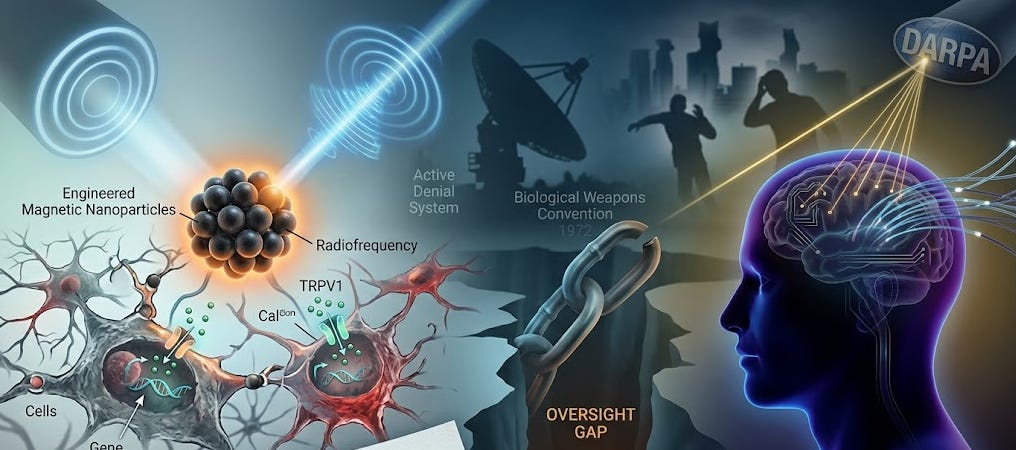
The Technology: How It Works
The patent describes what the inventors call NICE — Nanoparticle Induced Circuit Excitation. Here’s the basic mechanism:
Nanoparticles (specifically iron oxide ferritin) are engineered to attach to specific cells
These cells are genetically modified to express TRPV1 — a temperature-sensitive ion channel
When a radiofrequency field is applied, the nanoparticles heat up
The heat opens the TRPV1 channel, allowing calcium to enter the cell
That calcium influx triggers gene expression — essentially programming the cell to do something it wouldn’t normally do
Key point: The technology requires two things that don’t exist in nature — genetic modification of target cells, and nanoparticles that can be remotely heated. It’s not something that could happen to you spontaneously.
In mouse studies, this has worked. A 2015 paper published in Nature Medicine showed that mice could have their glucose regulation controlled remotely using radiogenetics [2]. A 2024 paper from Jinwoo Cheon’s group demonstrated remote control of feeding behavior, social interaction, and long-term obesity control in freely moving mice [3].
But what concerns researchers and policymakers alike is this: the technology exists in the academic literature. And it’s being funded by institutions that also develop weapons.
Who Funded This?
The NICE patent didn’t emerge from a black budget. It was funded by the National Institutes of Health — specifically a $1.26 million BRAIN Initiative grant awarded to Sarah Stanley’s lab at Rockefeller University in 2014 [4].
The BRAIN Initiative was launched in 2013 by President Obama, with the goal of “revolutionizing our understanding of the human brain.” But alongside the medical research, it funded exactly the kind of technology that could be adapted for neural control.
This is where it gets interesting.
DARPA Enters the Picture
While NIH was funding academic research, DARPA — the Defense Advanced Research Projects Agency [5] — was pursuing its own agenda.
In 2022, DARPA announced the MOANA project: Magnetic, Optical, and Acoustic Neural Access. The goal: wireless, non-invasive brain-to-brain communication headsets. From the DARPA description:
“Using light to decode neural activity. Using electromagnetic energy to encode activity into another brain. Target: sub-50 millisecond latency. Applications: Communication for paralysis patients, neural interfaces.”
Let me be clear: MOANA is described as a medical technology. But it’s using the same fundamental principles as the NICE patent — using external fields to affect neural activity.
And MOANA isn’t alone. DARPA’s Biological Technologies Office (BTO) has a portfolio including:
Safe Genes — $100 million program for gene drive control
Insect Allies — $27 million program (2017-2021) using insects to disperse genetically modified viruses to crops
PREEMPT — Preventing Emerging Pathogenic Threats
None of these are explicitly weapons. But they all involve the kind of biological manipulation that could be adapted.
The Military Side: Active Denial System
The most direct military application of radiofrequency technology is the Active Denial System — a US military weapon developed by Raytheon and the Air Force Research Laboratory that operates at 95 GHz [6].
Here’s how it works: the 95 GHz frequency penetrates less than 0.4mm into human skin, heating the water molecules and causing intense, unbearable pain. It doesn’t cause lasting damage under normal operation — the idea is crowd control without lethal force.
It was developed under the sponsorship of the Department of Defense Non-Lethal Weapons Program, and was deployed in 2010 with the United States military in the Afghanistan War, but was eventually withdrawn without seeing combat.
Key distinction: The Active Denial System causes pain. It doesn’t control behavior. But it demonstrates that the US military has invested in the capability to affect human physiology using radiofrequency energy.
Havana Syndrome: The Unexplained Incidents
Starting in 2016, US and Canadian diplomatic personnel in Havana began reporting unusual symptoms: dizziness, cognitive impairment, tinnitus, visual disturbances, balance problems. By 2024, according to government reports, 334 people had qualified for care in the military health system after experiencing similar symptoms in locations around the world [7].
The US intelligence community has not concluded what causes Havana Syndrome. Theories include:
Directed energy weapons — specifically, radiofrequency or microwave radiation
Mass psychogenic illness — the symptoms are stress-related
Toxic chemicals — exposure to some unknown substance
No weapon has been confirmed. But the incidents are real. And they remain unexplained.
What we don’t know: If Havana Syndrome is caused by directed energy, we don’t know who deployed it, what technology they used, or whether it’s still being used. The US government has not confirmed a cause after eight years of investigation.
The Policy Gap: Why There’s Nothing Stopping This
This is where it gets really concerning.
The primary international treaty governing biological weapons is the Biological Weapons Convention, signed in 1972. It prohibits the development, production, and use of biological weapons [8].
But the BWC has a critical gap: it doesn’t mention neural control, radiofrequency effects on the brain, or neurotechnology weapons.
The convention was written before magnetogenetics existed, before optogenetics, before brain-computer interfaces. It bans “biological agents or toxins” — but neural manipulation using radiofrequency signals falls into a regulatory void.
In the United States, there’s no specific law prohibiting remote neural control. The FDA approves neural implants as medical devices, but there’s no regulatory pathway for — and no explicit ban on — technology that could control human behavior remotely.
The gap isn’t capability — it’s oversight. The technology to affect neural activity remotely exists in academic literature. DARPA is funding neural research. There’s an unexplained syndrome affecting hundreds of government personnel. But there’s no treaty, no law, no international body specifically addressing the threat.
The GAO Investigation: What Happened 1945-1972?
In 2025, Congress passed Section 1068 of the FY26 National Defense Authorization Act, directing the Government Accountability Office to investigate whether the US Department of Defense weaponized ticks and other insects as part of a Cold War bioweapons program [6].
The investigation covers the period from January 1, 1945 to December 31, 1972 — and is reviewing records from Fort Detrick, Plum Island, and other military research facilities.
What were they doing in those years? We don’t know yet. The GAO is scheduled to deliver its report by December 2027.
But the fact that Congress felt the need to investigate suggests that there are questions about past US government activities that remain unanswered.
The Evidence Assessment
Here’s what the evidence actually shows:
What’s confirmed:
Academic magnetogenetics works in mice (published, peer-reviewed)
NIH funded $1.26M for radiogenetics research
DARPA is developing MOANA brain-to-brain communication
Active Denial System exists (causes pain, not control)
334+ Havana Syndrome cases remain unexplained
What’s NOT proven:
Remote control weapon — no confirmed capability
Human trials — none conducted
Intent — no documented plan for human control
The honest assessment: the building blocks exist in open literature. The policy framework hasn’t caught up. And there’s an unexplained syndrome that may — or may not — be related.
What Comes Next
The GAO investigation will deliver its report in 2027. The BWC hasn’t been updated since 1972. DARPA continues to fund neural research. And the technology will only improve.
What’s needed is oversight that matches the capability. But given the interests involved — defense agencies, pharmaceutical companies, academic institutions — that’s easier said than done.
For now, what we have is questions. And the uncomfortable possibility that the technology for remote neural control exists before the guardrails do.
Sources
US Patent US10064941B2 — “Compositions and methods to modulate cell activity” (USPTO, 2018)
Stanley et al., Nature Medicine 21, 92-98 (2015) — Remote regulation of glucose homeostasis using radiogenetics and magnetogenetics in mice
Choi et al., Nature Nanotechnology 19, 1333-1343 (2024) — In vivo magnetogenetics for cell-type-specific targeting and modulation of brain circuits
Rockefeller University News (2014) — $1.26 million NIH BRAIN Initiative grant awarded to Sarah Stanley’s laboratory
DARPA Official Website — Defense Advanced Research Projects Agency overview ($4.122B FY2024 budget)
Stars and Stripes (January 23, 2026) — Congress calls on GAO to look for origin of Lyme disease in Cold War military programs
CBS News (2024) — 334 veterans enrolled in Havana syndrome health program
United Nations Office for Disarmament Affairs — Biological Weapons Convention (1972)
DARPA have developed a lot of stuff that is not openly known about and they have some of the most sinister technologies.
Excellent assessment