
They were told to give up their way of life. Their children would be taken if they refused. The housing? Nissen huts with no electricity, no running water, no hot water. Some lived like this for over 60 years.
This wasn’t a prison. It was the Tinker Experiment — a UK government policy that lasted 40 years, backed by Parliament, supported by the Church of Scotland, and implemented by 27 of Scotland’s 32 local authorities.
This is not ancient history. Some victims are still alive today. Some still live on the same sites where they were forcibly settled.
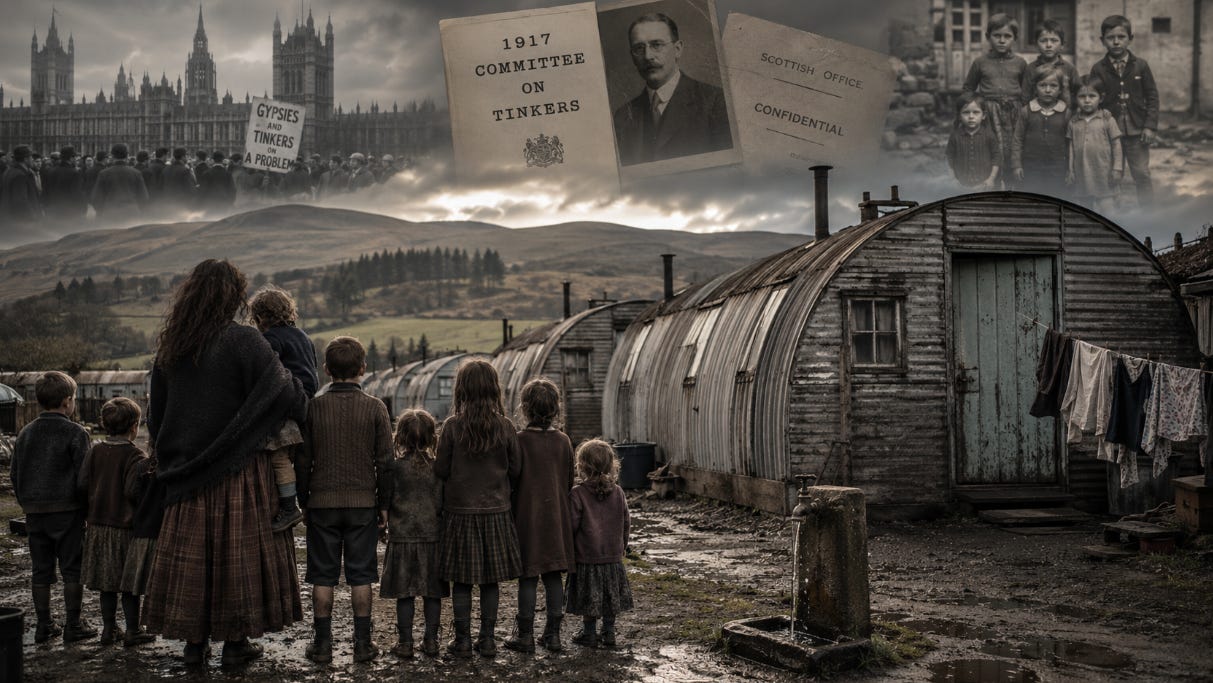
What Was the Tinker Experiment?
Between 1940 and 1980, the British government, through the Scottish Office, conducted a systematic programme to forcibly assimilate Scotland’s Gypsy Traveller community. The policy had three aims:
Destroy the nomadic lifestyle — by making it illegal to travel
Remove children from families — to “erase” the culture
House people in substandard accommodation — deliberately
Victims were threatened: stop travelling, or lose your children. Families were torn apart. An entire culture was targeted for eradication.
“Like Staying Inside a Fridge-Freezer”
The accommodation was deliberately, intentionally substandard. This was not negligence — it was policy (BBC, January 2026).
At Bobbin Mill in Pitlochry, where the McPhee family was settled in 1946 (ACERT):
No running water
No electricity — for over 60 years (not installed until the 2010s)
No hot water — not installed until 2010
No bath or shower
Single cold water tap for entire buildings, which froze in winter
Coal fires for heating
Asbestos in the walls — not removed until the 1980s
“It was horrendous. No hot water, no bath, no shower, no electricity, it was like staying inside a fridge-freezer. There was only one cold water tap in the whole building and during the winter months it froze solid.”— Anonymous resident, Bobbin Mill (1965-1980) (BBC)
The McPhee family — nine children plus parents — were housed in a single bedroom. For a family of eleven (ACERT).
“While authorities took action to roll out electricity to the majority population and put in place laws to ensure housing was up to an adequate standard, hutted accommodation without electricity for Gypsy Travellers was still being proposed by Perth County Council up to 1961.”— Scottish Human Rights Commission, “No Man’s Land” Report (BBC, January 2026)
When the rest of Scotland got electricity, Gypsy Travellers were deliberately excluded.
How Parliament Enabled the Experiment
The Tinker Experiment was not a secret. MPs debated it in both Houses of Parliament (University of St Andrews).
Research by the University of St Andrews found evidence that Gypsy Travellers were referred to as “a problem” during debates in the House of Commons and House of Lords (St Andrews, June 2025).
Key Legislation
Vagrancy Act 1824 (Scotland 1912) — Made it a criminal offence to sleep rough or beg. Used to target nomadic Travellers (Scottish Government).
Education (Scotland) Act 1908 — Required school attendance. Children could be taken if families continued to travel (gov.scot).
1895 Committee on Habitual Offenders — Labelled Travellers as a “problem class” (Travellers Times).
1917 Committee on Tinkers — Proposed forced settlement (gov.scot).
The Church of Scotland’s Role
The Church of Scotland was deeply complicit. In June 2025, it issued an apology (The Independent):
“On behalf of the Church of Scotland, we offer a heartfelt and genuine apology for these historic wrongs... We wish to say we stand in solidarity with those who suffered, and deeply regret the harm that came to them as a result of actions by the Church in the past.”— Reverend Tommy MacNeil and Dr Mike Cantlay, Church of Scotland (The Independent, June 2025)
The Nazi Connection
In February 2025, a leaked report revealed the Scottish Government colluded with the Nazis: German eugenicist Wolfgang Abel was allowed to study Scottish Gypsy Travellers in 1938 — just before World War II (Travellers Times).
The 2025 Apology — And Why It’s Not Enough
On 25th June 2025, First Minister John Swinney apologised in the Scottish Parliament (BBC):
“The Tinker Experiments should not have happened. Those policies were wrong... on behalf of Scotland, we are sorry.”— John Swinney, First Minister of Scotland (BBC, June 2025)
But he rejected calls for a compensation scheme (BBC).
The 2026 Verdict: “Continuing Human Rights Issue”
On 30th January 2026, the Scottish Human Rights Commission (SHRC) published its “No Man’s Land” report, finding violations of (BBC):
Article 11 of ICESCR — Right to adequate housing
Article 8 of the ECHR — Right to family life
Article 9 of the UNCRC — Rights of children
The SHRC called for financial compensation and “transformative reparations” (BBC, January 2026).
“While it is true that overt policy and practice designed to forcibly assimilate Gypsy Travellers took place in the 19th and 20th century, we cannot be clearer that the harms of the Tinker Experiment have not been addressed, are ongoing, and amount to a continuing human rights issue.”— Professor Angela O’Hagan, SHRC Chair (BBC)
Victim Testimonies
Roseanna McPhee grew up at Bobbin Mill in the 1970s and still lives there (BBC):
“We had to study by candlelight and wash clothes in a tub outside, boiling water on a small stove or outside stick fire, even in the winter. We only got hot water and electricity in 2010. We were bullied at school and discriminated against all our lives.”
Shamus McPhee was born at Bobbin Mill in the early 1970s:
“Growing up, we often wondered if this was just indicative of the level of treatment afforded to Gypsy Travellers. But when they actually stumbled upon the highly sensitive and deeply offensive paperwork pertaining to the Tinker Experiments, we were absolutely staggered.”
Roseanna on the lack of compensation:
“Redress and Reparations which have been stalled until after the Election — some 15 months after the Apology — is a cynical tactic.”
Key Facts at a Glance
The Tinker Experiment by Numbers
1940–1980 — Duration
27 of 32 — Scottish councils that implemented the policy
2010 — Year electricity finally installed at Bobbin Mill
2,728 — Scottish Travellers counted in 1917
June 2025 — Scottish Government apology
January 2026 — SHRC calls for compensation
Who Was Responsible
UK Government — Primary funder
Scottish Office — Policy architect
27 Scottish councils — Implementation
Church of Scotland — Complicit
Parliament — Debated Travellers as “a problem”
Sources
BBC News - ‘Tinker Experiment’ victims back call for reparations (January 2026)
BBC News - John Swinney apologises to travellers (June 2025)
Scottish Government Response (June 2025)
University of St Andrews Report (June 2025)
The Independent - Church of Scotland Apology (June 2025)
Travellers Times - Leaked Report (February 2025)
Governments...so stellar in their purposes. Why do they even exist?