The UK's Largest Facial Recognition Rollout: The Story The Media Ignored
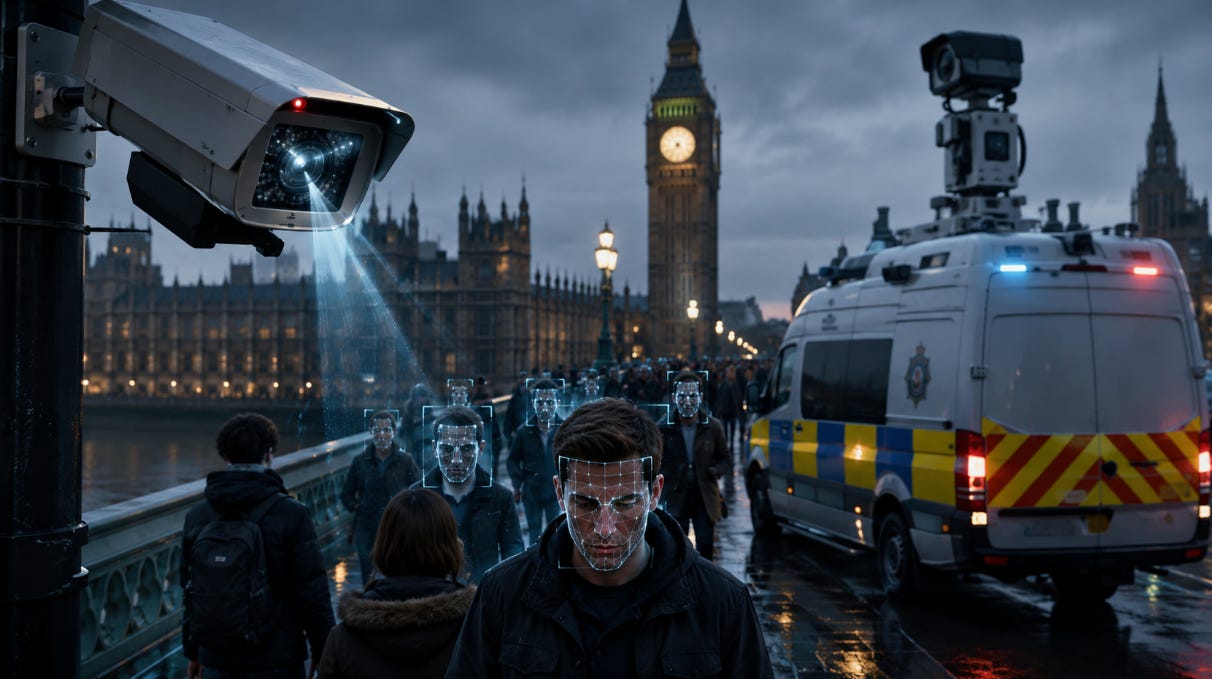
50 LFR vans. £115m for AI policing. Live facial recognition deployed to knife crime hotspots across 27 forces. The largest surveillance expansion in British history - and almost no one noticed.

In April 2026, the UK government launched what is quite probably the largest facial recognition programme in British history. It announced a £26.25 million Knife Crime Concentrations Fund and a strategy titled “Protecting Lives, Building Hope” - with the explicit goal of halving knife crime within a decade.
Buried in the announcement was a commitment to deploy Live Facial Recognition (LFR) technology across the country. The mainstream media covered the funding. They did not cover the surveillance implications.
The announcement made clear that the technology would be deployed alongside increased police patrols, new CCTV cameras, and knife detection arches in the identified hotspots. What was not spelled out was that this represented a fundamental shift in how British citizens are watched in public spaces - a shift that happened with minimal parliamentary debate, almost no media scrutiny, and no public consultation.
The Strategy: “Protecting Lives, Building Hope”
The “Protecting Lives, Building Hope” strategy represents the government’s flagship approach to tackling knife crime. The document pinpoints what it calls “the tiny fraction of streets (under 2.5%) that account for the vast majority of offences.” New national mapping technology is being shared with 27 police forces, identifying high-risk hotspots with micro-geographic precision down to 0.1 square kilometres.
This “Hex mapping” technology, as it’s been called, allows police to pinpoint specific streets and times when knife crime is most likely to occur. According to the government announcement, this represents a data-driven approach that will allow forces to “target them with police patrols, Live Facial Recognition and knife arches to catch these criminals.”
The strategy encompasses far more than law enforcement. It includes plans to launch 50 “Young Futures Hubs” by the end of this Parliament in areas impacted by knife crime, with the first eight opening in Birmingham, Brighton and Hove, Bristol, County Durham, Leeds, Manchester, Nottingham, and Tower Hamlets. There is also £66.6 million committed to the Serious Violence Reduction Programme and £15 million for the Ministry of Justice’s Turnaround Programme aimed at children on the cusp of the youth justice system.
But it is the surveillance infrastructure that will outlast any particular policy initiative. Once the LFR vans are deployed, once the camera networks are expanded, once the data collection systems are operational - they become permanent. The technology does not expire when knife crime declines.
The Funding: More Than Meets the Eye
The Knife Crime Concentrations Fund provides £26.25 million for the year, with £1.75 million confirmed for 2026/27. This funding is being allocated to the 27 police force areas where 90% of knife crime occurs in England and Wales. The GOV.UK announcement explicitly confirmed this figure and the geographic distribution.
But this is just the most visible funding stream. The government has committed to significant investment in AI policing capabilities beyond the knife crime fund. The direction of travel is clear: the state is building the infrastructure for mass surveillance, and it is doing so with minimal public scrutiny.
Additional funding streams include more than £34 million for the County Lines Programme this year (including more than £28 million for policing), £5.5 million for technological solutions to knife crime funded through UK Research and Innovation, and £1.2 million for the Safety In & Around Schools Partnership.
The total investment in this programme runs into the hundreds of millions of pounds - making it one of the largest civilian surveillance deployments in British history.
The Technology: What Is Live Facial Recognition?
Live Facial Recognition represents a significant escalation from existing CCTV and automated number plate recognition systems. Where those technologies identify vehicles, LFR identifies people - in real time, without their knowledge or consent.
The system works by capturing faces in public spaces, comparing them against watchlists of suspects or persons of interest, and alerting police when a match is found. Unlike passport checks or police databases where individuals present themselves, LFR operates on anyone who walks past a camera - including those with no criminal involvement whatsoever.
The technology raises profound questions about the nature of consent in public spaces. When you walk down a street in London, Manchester, or Birmingham, you have not consented to being identified, scanned, and compared against a database. You have not agreed to have your face stored, analysed, or retained. Yet that is exactly what LFR does.
Civil liberties organisations have warned that LFR represents a fundamental departure from the presumption of innocence. Rather than investigating specific individuals based on reasonable suspicion, the technology treats everyone in a defined area as a potential suspect. Your face becomes evidence by default.
The Bias Problem: Documented Inaccuracies
UK facial recognition has faced documented challenges with accuracy across different demographic groups. Multiple studies have shown that algorithmic bias exists in facial recognition systems, with higher false positive rates for people with darker skin tones and women.
Research has consistently demonstrated that facial recognition algorithms perform differently across demographic groups. Studies have found error rates can be significantly higher for women, older adults, and people with darker skin tones. This is not unique to any particular system - it reflects fundamental challenges in how these algorithms are trained on data sets that underrepresent certain populations.
Academic researchers have documented these disparities in multiple studies. The implications for law enforcement are severe: when an LFR system generates a false positive, it means an innocent person - disproportionately someone from a minority demographic group - gets flagged, stopped, and potentially detained based on faulty technology.
When you walk past an LFR van, the system is making a decision about you - whether to flag you as a match to a watchlist, whether to trigger police attention. If the algorithm is more likely to make errors for certain groups, those groups will bear the cost of those errors. This is not theoretical. It is a documented empirical reality.
The government’s own trials have documented these accuracy disparities, yet the technology continues to be deployed. There is no mandatory bias audit requirement before deployment, no published accuracy figures broken down by demographic group, and no independent oversight of how these systems perform in the field.
Privacy Concerns: The Erosion of Anonymity
The expansion of LFR represents a fundamental transformation in the relationship between the state and its citizens. For the first time in British history, the state has the technical capability to identify any individual in public spaces - automatically, instantly, and at scale.
This goes far beyond catching knife offenders. The infrastructure being built has no inherent limitation on its use. Once the LFR vans are deployed, once the AI hub is operational, once the watchlist databases are populated - the technology will be there. And the uses will expand.
Consider the possibilities: football matches and political protests, shopping centres and train stations, anywhere the government decides there is a “public safety” justification. The same infrastructure used to catch knife offenders could equally be used to monitor political dissent, track protesters, or build a comprehensive record of who attended what event.
Privacy International and other civil liberties groups have warned that LFR creates the infrastructure for a surveillance state where anonymity in public becomes impossible. The chilling effect on free expression and association is well documented - people change their behaviour when they know they are being watched.
Legal Challenges: The Regulatory Gap
The legal framework governing LFR in the UK remains inadequate. While the Surveillance Camera Code of Practice provides some guidance, it is not legally binding in the same way as primary legislation. There is no specific law governing when, where, and how LFR can be deployed.
The Information Commissioner’s Office has raised concerns about the lack of clear legal basis for LFR deployments. The European Court of Human Rights has found that blanket surveillance violates the right to privacy under Article 8 of the European Convention on Human Rights. While the UK remains technically bound by the Convention, the enforcement mechanism is weak.
The lack of a statutory code of practice means each police force can develop its own policies, its own watchlists, its own thresholds for alerts. Some forces may be more careful than others. There is no national standard, no minimum accuracy requirement, no mandatory transparency about how the technology is being used.
Legal challenges are already working their way through the courts. The case of R (Bridges) v South Wales Police (2020) established that the use of LFR required a lawful basis beyond general police powers. But the government has not passed new legislation to address the court’s concerns - it has simply continued deploying the technology.
International Comparisons: A Global Trend
The UK’s LFR deployment is not happening in isolation. Governments around the world are racing to deploy facial recognition technology, often with limited democratic oversight.
In China, facial recognition is deployed extensively for social credit scoring and mass surveillance, particularly in the Xinjiang region. The technology has been linked to human rights abuses against Uyghur Muslims. While the UK would not go as far as China’s most extreme applications, the technological infrastructure is fundamentally similar.
The United States has seen a patchwork of regulations, with some cities (including San Francisco and Portland) banning facial recognition outright, while federal agencies continue to expand its use. The US Department of Homeland Security has deployed facial recognition at airports across the country.
European Union member states are subject to the General Data Protection Regulation (GDPR), which provides stronger privacy protections than UK law. The EU’s proposed AI Act would further restrict high-risk AI applications including facial recognition. Yet the UK, post-Brexit, is not bound by these protections.
Australia has deployed facial recognition for identity verification and law enforcement, while India has built the world’s largest facial recognition system for policing and national ID. The direction of global travel is clear: towards more surveillance, not less.
What distinguishes democracies from authoritarian states is not the technology itself - it is the legal frameworks, oversight mechanisms, and democratic accountability that constrain how that technology is used. The UK is currently failing to build those frameworks before deploying the technology.
The Consolidation: A “British FBI”
The surveillance expansion is happening alongside a parallel consolidation of police forces. The government is merging England’s 43 police forces down to approximately 12, creating what has been dubbed a “British FBI.”
This matters because larger forces have larger surveillance capacities. A merged force covering multiple former force areas will have access to more data, more cameras, more AI systems - and less local accountability. The consolidation is happening alongside the surveillance expansion, creating a police architecture that is simultaneously more powerful and less accessible to public scrutiny.
Police and Crime Commissioners, already criticised for lacking real power, will have even less oversight over forces covering multiple counties. Local communities will have virtually no say in how surveillance technology is deployed in their areas.
The combination of force consolidation and surveillance expansion represents the most significant restructuring of British policing in a generation. It is happening almost entirely without public attention.
The Question
The question is not whether this technology works. The question is whether we want to live in a society where the state can identify us - instantly, automatically, without suspicion - wherever we go.
The government says this is about knife crime. But the infrastructure being built has no such limitation. Once the LFR vans are deployed, once the AI hub is operational, once the force merger is complete - the technology will be there. And the uses will expand.
This is what creep looks like. Not a dramatic authoritarian moment, but a gradual normalisation. We are being watched. And we’re not even being told about it.
The mainstream media should have made this the story of the month. Instead, they covered the funding announcement and moved on. The surveillance implications - the ones that will shape what it means to be a free citizen in Britain for decades to come - received almost no coverage.
That tells you everything you need to know about whose interests the media serves - and whose interests are served by keeping the public in the dark.
I. Believe that yes 🙌