THE WATER WAR HAS BEGUN
Hormuz is no longer merely an oil crisis. The infrastructure sustaining entire cities—and feeding much of the world—is now inside the battlefield.

On 17 July, an Iranian strike hit Kuwait’s power and water infrastructure.
The fire was contained.
Emergency procedures were activated.
Engineers began assessing the damage.
The international conversation returned almost immediately to oil.
That may prove to be one of the most dangerous misunderstandings of this war.
The facility was not merely another industrial target.
It was part of the machinery that manufactures drinking water for a country where rainfall cannot remotely sustain the population.
Kuwait obtains more than 90% of its drinking water from desalination.
Saudi Arabia, Bahrain, Qatar, the United Arab Emirates and Oman also depend heavily upon coastal plants that convert seawater into the water used by cities, hospitals, homes, businesses and power systems.
These plants are not optional utilities.
They are artificial rivers.
They make modern life in the Gulf possible.
And they are now inside an active military theatre.
At the same time:
shipping through the Strait of Hormuz remains severely disrupted;
US forces are striking Iranian military infrastructure connected with control of the strait;
Iran is attacking American forces and allied infrastructure across the region;
oil and liquefied-natural-gas flows remain under pressure;
the Gulf’s fertiliser exports have been severely obstructed;
global farmers are already paying more for agricultural inputs;
and the United Nations is warning that the disruption could lower harvests during the second half of 2026 and into 2027.
These are not separate stories.
Energy sustains desalination.
Natural gas sustains fertiliser.
Fertiliser sustains crop yields.
Shipping sustains all three.
The public is being shown the explosions.
It is not being shown the complete system behind them.
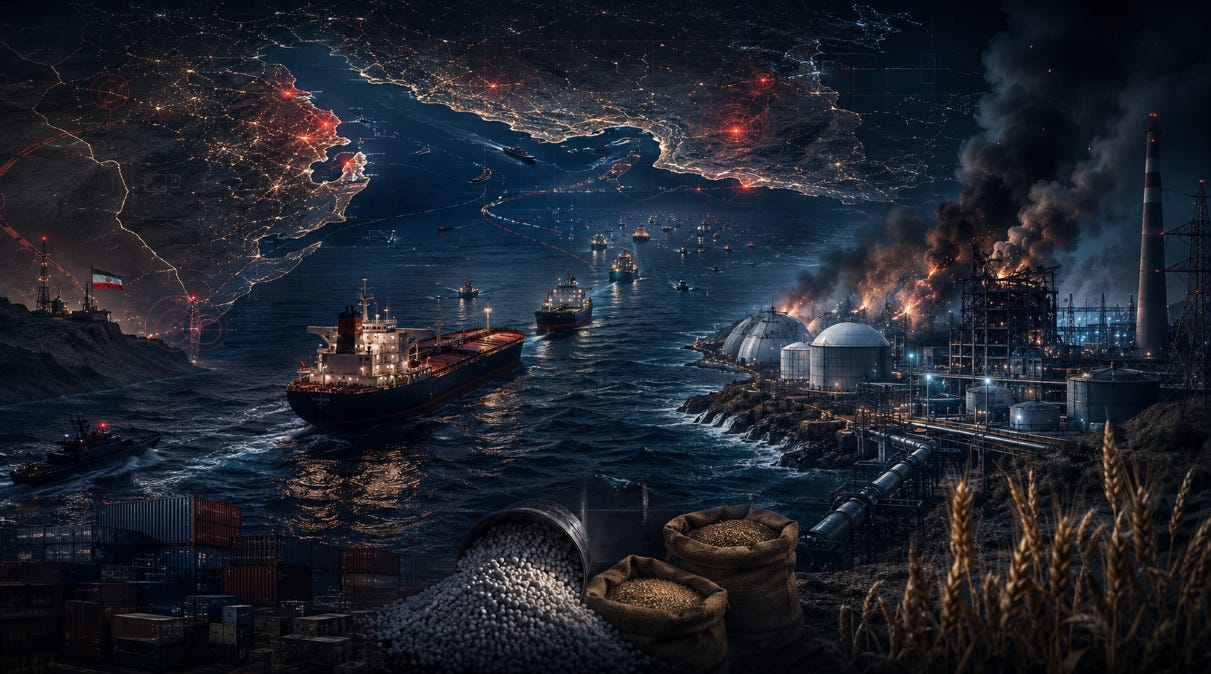
The Strike That Changed the War
The Iranian attack on Kuwait’s desalination and power infrastructure crossed a threshold.
Water infrastructure in the Gulf has long been recognised as vulnerable.
Governments have modelled attacks.
Intelligence agencies have warned about them.
Military planners have understood the implications for decades.
Now the threat is no longer contained inside a risk assessment.
The infrastructure has been hit.
According to Kuwait, the strike damaged a major complex responsible for electricity generation and desalinated-water production. A fire broke out, generating units were affected and contingency arrangements were activated.
The attack did not instantly deprive Kuwait of drinking water.
That is not the claim.
Kuwait possesses storage, redundancy and emergency plans.
The important fact is that a functioning war has reached the physical infrastructure upon which an overwhelmingly desalination-dependent population relies.
A missile does not need to flatten an entire plant.
It only needs to disable the right component.
A seawater intake.
A pumping station.
A transformer.
A control system.
A chemical-treatment unit.
A high-pressure membrane system.
A power-generation block.
A replacement part that cannot be delivered while ports and airspace are under attack.
The plant can remain visibly standing while its output collapses.
That is the nature of modern infrastructure warfare.
The target is not always the building.
The target is the dependency.
Oil Built the Gulf. Desalinated Water Keeps It Alive.
The Gulf states are among the driest countries on Earth.
Their modern populations, industries and cities exceed what naturally available freshwater could support.
Desalination closes that gap.
Seawater is drawn through coastal intake systems, filtered, treated and processed through thermal or membrane-based technology. The resulting freshwater is then pumped into municipal distribution networks or stored for later use.
Every stage requires infrastructure.
Every stage requires energy.
Many desalination facilities are integrated directly with power stations because the production of electricity and water developed together.
That creates efficiency.
It also creates one large target.
Damage the power station and the desalination system may stop.
Disrupt the fuel supply and output may fall.
Contaminate the seawater intake and the plant may need to shut down.
Attack the control network and operators may lose confidence that the process is safe.
The same complex can sustain the lights, cooling systems and drinking-water supply of millions of people.
This is why the Associated Press described Gulf desalination facilities as lifelines vulnerable to missiles, drones, contamination and cyberattack.
The Gulf has hundreds of desalination sites, but much of its total production is concentrated in several dozen major plants.
Concentration reduces cost.
It also means that a relatively small number of successful attacks could remove a disproportionate share of regional capacity.
The Gulf’s cities are not simply beside the battlefield.
Their water source is physically located on its coastline.
Drinking Water Does Not Behave Like Oil
Governments maintain strategic petroleum reserves because oil can be stored for long periods and released when normal supply is interrupted.
Drinking water is different.
It is heavy.
It is consumed continuously.
It is required immediately.
It cannot be transported across continents at the scale needed to replace national desalination systems.
A country can release oil from underground caverns.
It cannot replace hundreds of millions of litres of daily urban water demand with bottled-water deliveries.
Hospitals require water.
Sanitation requires water.
Food preparation requires water.
Cooling systems require water.
Firefighting requires water.
Electricity generation may require water.
Industry requires water.
People require it every day.
This means the emergency clock operates differently.
An oil shortage first appears as a market and transport problem.
A water shortage becomes a public-health and survival problem.
Gulf countries maintain emergency storage, but storage only buys time.
The decisive measurement is not simply how much water exists in reserve.
It is how many days the reserve can sustain the population if major production is interrupted.
That figure can change rapidly during extreme heat, population movement, panic consumption or damage to distribution networks.
The essential questions are therefore straightforward:
How much operational capacity can each country lose before rationing begins?
How many days of usable water are held in reserve?
Can neighbouring systems transfer meaningful quantities across borders?
Which facilities depend on the same electricity, pipeline or control network?
Which replacement components must come through threatened ports?
Who receives priority during prolonged disruption?
Military facilities?
Hospitals?
Citizens?
Industry?
Foreign workers?
Agriculture?
Those are not technical questions alone.
They are political decisions about who continues to receive the infrastructure of life.
Hormuz Is Not Merely an Oil Route
The Strait of Hormuz connects the Persian Gulf with the Gulf of Oman and the wider Indian Ocean.
At its narrowest point, the shipping corridor sits between Iran and Oman.
There is no equivalent maritime exit from the Persian Gulf.
Approximately one-fifth of global petroleum consumption has historically passed through it.
A similarly consequential share of global liquefied-natural-gas trade uses the same route, particularly exports from Qatar to Asian markets.
China, India, Japan and South Korea are heavily exposed.
European buyers are exposed indirectly because they compete for the same replacement cargoes.
The obstruction of Hormuz does not simply cause traders to charge more.
It can physically trap exports inside the Gulf.
Tankers may refuse to enter.
Insurers may withdraw cover or demand prohibitive premiums.
Crews may refuse assignments.
Ports may close.
Storage facilities may fill.
Producers may then be forced to reduce output because the product has nowhere to go.
Alternative pipelines exist.
Saudi Arabia and the United Arab Emirates possess routes capable of moving some oil toward terminals outside Hormuz.
They cannot replace the strait’s full capacity.
Qatar’s LNG is even more constrained.
Gas cannot be redirected through an oil pipeline.
A prolonged Hormuz disruption therefore affects:
oil;
LNG;
petrochemicals;
fertiliser;
shipping;
insurance;
electricity prices;
manufacturing;
aviation;
and household inflation.
The war does not remain in the Gulf.
The chokepoint transmits it into every economy dependent upon global energy and trade.
The Second Chokepoint Is Waiting
Hormuz is not the only route under threat.
Bab el-Mandeb connects the Red Sea with the Gulf of Aden.
Ships travelling between Asia and Europe through the Suez Canal must pass through it.
During earlier Houthi attacks on Red Sea shipping, vessels were diverted around the Cape of Good Hope.
That added thousands of miles to voyages.
It increased fuel consumption.
It tied up ships for longer.
It raised freight and insurance costs.
It delayed cargo.
The present risk is more serious because Hormuz is already obstructed.
Saudi Arabia can use east-to-west pipelines to move part of its oil production toward the Red Sea port of Yanbu, reducing its dependence on Hormuz.
But those exports then rely upon secure passage through the Red Sea system.
Reuters has reported that Iran instructed Houthi forces to prepare for action against the Bab el-Mandeb route if American forces attacked Iranian power infrastructure.
That instruction does not prove Bab el-Mandeb will be closed.
It proves the second chokepoint is part of the escalation ladder.
If Hormuz and Bab el-Mandeb were heavily disrupted at the same time, the crisis would affect both the primary export route and one of the principal alternatives used to mitigate its closure.
Ships would not simply encounter a blocked door.
They would encounter a blocked door and a threatened emergency exit.
The Fertiliser Shock Is Already Moving
Oil dominates the headlines because its price changes immediately.
Fertiliser moves more slowly.
That makes it more dangerous.
A rise in oil prices appears on trading screens and petrol-station signs.
A shortage of fertiliser first appears in wholesale contracts, import tenders, subsidy budgets and farmers’ purchasing decisions.
The public may not see the effect until months later.
By then the next harvest may already have been weakened.
The Gulf is one of the world’s most important sources of nitrogen fertiliser and the natural gas required to manufacture it.
Urea production depends heavily upon natural gas both as an energy source and as a chemical feedstock.
The Strait of Hormuz is also a major route for traded urea, ammonia, sulphur and phosphate products.
Its analysis identifies countries in Africa and Asia as especially vulnerable to shortages and price increases.
It warns there are no viable land routes capable of replacing that lost maritime capacity at the required scale.
This is the sequence now developing:
Gas production and shipping are disrupted.
Fertiliser supply falls.
Prices rise.
Governments spend more to maintain farmer subsidies.
Farmers without protection purchase less.
Less fertiliser is applied.
Crop yields weaken.
Food-exporting countries protect domestic supply.
Import-dependent countries pay more or receive less.
Hunger and instability increase.
The process does not require every fertiliser shipment to stop.
Agriculture is sensitive to timing.
A shipment arriving after the planting or application window may be economically available but agriculturally useless.
The crop calendar does not wait for diplomacy.
The Warning Is No Longer Theoretical
In April, the FAO warned that a prolonged Hormuz crisis could become a global agrifood catastrophe.
In May, it warned that fertiliser scarcity would affect harvests during the second half of 2026 and into 2027.
It later stated that the window for preventing a global food-security crisis was closing.
Its technical assessment describes the conflict as a threat to energy, fertiliser and agrifood systems simultaneously.
This matters because agricultural damage is delayed.
Farmers make input decisions now.
Harvests reflect those decisions later.
Food markets reflect the harvests later still.
A government can therefore claim that supermarket shelves remain full while the conditions for a future price shock are already embedded.
The food crisis does not begin when bread becomes unaffordable.
It begins when farmers cannot obtain the inputs required to produce the grain.
The Countries Most Exposed Are Not the Countries Fighting
The countries firing missiles are not necessarily those that will suffer the most severe food consequences.
Wealthy states can outbid poorer countries for replacement energy and fertiliser.
They can subsidise farmers.
They can release reserves.
They can finance alternative shipping routes.
They can absorb higher insurance costs.
Poorer import-dependent states cannot.
India
India is a major fertiliser consumer with significant import dependence.
The government can protect farmers through subsidies, but higher global prices transfer the cost to the public budget.
A prolonged shortage forces a choice between spending more, rationing imports or allowing farmers to absorb the increase.
Pakistan and Bangladesh
Both remain highly sensitive to energy prices, currency pressure and agricultural-input costs.
Higher fuel and fertiliser bills can quickly become electricity shortages, fiscal stress and more expensive food.
Brazil
Brazil is one of the world’s largest agricultural exporters and relies heavily upon imported fertiliser.
A disruption affecting Brazilian farms does not remain a Brazilian issue.
It can alter exports of maize, soybeans, meat and other products consumed around the world.
East Africa
Countries including Kenya and Ethiopia use less fertiliser per hectare than many major agricultural exporters, but the inputs are often supported through state programmes.
Price increases therefore create both a farming problem and a fiscal problem.
East Asia
China, Japan and South Korea depend heavily upon Gulf energy.
They possess financial resources and purchasing power, but replacement LNG cargoes are finite.
When wealthy Asian and European buyers compete, poorer importers lose.
Britain and Europe
Britain does not need to import every affected commodity directly from the Gulf to suffer the consequences.
The costs travel through global markets.
Higher oil prices affect transport.
Higher gas prices affect electricity and fertiliser production.
Higher freight costs affect imports.
Lower harvests affect food prices.
Persistent inflation affects interest-rate decisions, household debt and public expenditure.
A war thousands of miles away enters British homes through the energy bill and the supermarket receipt.
Iran Is Also Fighting a Water Crisis
Iran can threaten Gulf desalination infrastructure.
It is not immune to the same vulnerability.
Iran has endured years of drought, reservoir depletion, groundwater overuse and deteriorating water infrastructure.
Tehran’s supply has repeatedly reached dangerous levels.
Iran has pursued desalination projects and water-transfer schemes from its southern coast, but sanctions, cost and energy constraints have limited what can be delivered inland.
This creates a deeply unstable balance.
American and allied forces can threaten Iranian power, ports, fuel systems and coastal infrastructure.
Iran can threaten the desalination and energy systems of American partners across the Gulf.
Both sides can impose civilian suffering.
Neither side can reliably control the cascade after critical water infrastructure is attacked.
The military logic is obvious.
Power plants, ports and water facilities sustain national operations.
The humanitarian logic is equally obvious.
They also sustain civilians.
Once both sides classify life-support infrastructure as strategically relevant, almost every system required for civilian survival can be placed on the target list.
That is how escalation consumes the distinction between war and society.
The Buffers Are Hiding the Damage
The global economy has not collapsed.
That is true.
It is also misleading.
Resilience is not the absence of damage.
It can be the consumption of reserves built to delay the damage.
Governments have released emergency stocks.
Importers have redirected cargoes.
Alternative producers have increased output where possible.
China and other major economies have drawn upon stored energy supplies.
Shipping companies have changed routes.
Public budgets have absorbed costs.
Markets have repeatedly priced in the possibility of ceasefires and reopening.
These measures matter.
They have prevented the first shock from becoming an immediate global breakdown.
But each buffer has a limit.
Oil reserves are finite.
Tankers are finite.
Pipeline capacity is finite.
Replacement LNG cargoes are finite.
Port capacity is finite.
Subsidy budgets are finite.
The question is not whether the system has survived until now.
The question is how much resilience has already been spent.
A system can appear stable while its emergency margin is disappearing.
The Obfuscation Is the Separation
There does not need to be a secret instruction ordering the media to suppress this story.
The structure of modern reporting fragments it automatically.
Energy journalists cover oil.
Trade journalists cover shipping.
Agricultural publications cover fertiliser.
Defence reporters cover missile strikes.
Water specialists cover desalination.
Economists cover inflation.
Humanitarian agencies cover food insecurity.
Each report can be factually correct.
The public can still be left with a false picture.
The full story only appears when the systems are placed together:
One regional war is disrupting the route carrying a substantial share of the world’s energy and fertiliser while bringing the coastal infrastructure manufacturing drinking water for entire countries into the active battlefield.
That is the story.
Not the price of one barrel.
Not one damaged plant.
Not one delayed fertiliser shipment.
The system connecting them.
VERIFIED FACT
An Iranian strike damaged Kuwaiti power and desalination infrastructure.
Shipping through Hormuz has been severely disrupted.
The strait carries globally significant oil, LNG and fertiliser flows.
Fertiliser trade has been obstructed.
The WTO confirms severe disruption to urea and phosphate commerce.
The FAO warns that shortages may reduce yields in late 2026 and 2027.
Iranian and US attacks have intensified after the collapse of the ceasefire.
Water infrastructure is now demonstrably inside the conflict.
SUPPORTED INFERENCE
A prolonged conflict increases the risk of a combined energy, water and food-security crisis.
Several damaged desalination facilities could force rationing and industrial shutdowns in Gulf countries.
Simultaneous pressure on Hormuz and Bab el-Mandeb could sharply increase shipping and energy costs.
Fertiliser disruption today can produce lower yields and higher food prices months later.
Poorer import-dependent countries would probably be affected first and most severely.
NOT YET PROVED
The Gulf is not certain to lose its drinking-water supply.
Bab el-Mandeb has not been permanently closed.
Global famine is not inevitable.
Hormuz may reopen through diplomacy or military agreement.
Damage to Kuwait’s plant does not prove a plan to destroy the region’s entire water system.
Every fertiliser shortage will not automatically become a failed harvest.
There is still time for intervention.
That is why the warning matters now.
A warning issued after the crop fails is not a warning.
It is an obituary.
What Governments Should Publish Immediately
Governments should disclose their exposure before the crisis is used to justify policy behind closed doors.
Every major importing state should publish:
its dependence on Gulf oil and LNG;
its current emergency-stock position;
the estimated duration of those reserves;
its fertiliser needs for the next two growing seasons;
replacement contracts already secured;
agricultural sectors most exposed to shortage;
expected food-price effects;
and measures protecting low-income households.
Gulf governments should publish:
operating desalination capacity;
reserve-water duration;
redundancy between facilities;
cross-border or domestic transfer capability;
dependence on shared electricity infrastructure;
cyber-protection arrangements;
emergency-rationing plans;
and the number of civilians dependent upon each major plant.
The FAO, WTO and development banks should coordinate fertiliser access before richer states absorb the remaining supply.
Governments should resist export bans that protect one country by worsening the shortage elsewhere.
Farmers should receive support before they reduce application or planting.
Shipping routes should be protected without turning every civilian port into a military target.
Diplomacy should focus not only on oil exports but upon explicit protection for water, food and agricultural infrastructure.
The objective should not be to manage the headlines.
It should be to stop the delayed cascade.
The War Has Entered the Machinery of Life
For decades, governments and corporations optimised the global economy for efficiency.
Energy moved through the narrowest practical routes.
Fertiliser production concentrated where gas was abundant.
Water production concentrated in enormous coastal plants.
Food systems depended upon international inputs.
Inventories were reduced.
Just-in-time logistics replaced redundancy.
Every decision appeared rational alone.
Together, they created a system in which one regional war can place pressure on:
fuel;
electricity;
water;
fertiliser;
shipping;
food;
inflation;
and political stability.
The system does not need to collapse completely to harm billions of people.
It only needs to become more expensive, less reliable and less accessible.
A farmer in Brazil may pay more for fertiliser.
A family in Britain may pay more for food and electricity.
A factory in Europe may reduce production because of gas prices.
A government in South Asia may spend scarce currency protecting fuel imports.
A Gulf city may begin rationing water because one facility lost power.
The consequences appear local.
The mechanism is global.
The attack on Kuwait’s desalination infrastructure was not the beginning of every risk described in this investigation.
It was the moment those risks became impossible to dismiss as theory.
The world has been told to watch the oil price.
Watch the water plants.
Watch the fertiliser ships.
Watch Bab el-Mandeb.
Watch the emergency reserves.
Watch the next planting season.
The most serious consequences may not arrive with the next explosion.
They may arrive months later through weak harvests, higher prices, exhausted public budgets and cities discovering that their most essential infrastructure was never designed for a sustained war.
The water war has begun.
The food shock is already moving.
And the world is still reporting them as separate stories.
Sources
Associated Press — Iranian strike damages a Kuwaiti desalination plant
Associated Press — Oil built the Persian Gulf; desalinated water keeps it alive
Associated Press — Threats against Iranian desalination and energy infrastructure
US Energy Information Administration — World oil-transit chokepoints
US Energy Information Administration — One-fifth of global LNG trade passes through Hormuz
US Energy Information Administration — LNG prices during the Hormuz closure
US Energy Information Administration — Hormuz closure and production outages
Reuters — Iran reportedly tells Houthis to prepare to close Bab el-Mandeb
Reuters — Iran turns toward the Red Sea as a second pressure point
Food and Agriculture Organization — Global agrifood implications of the 2026 conflict
Food and Agriculture Organization — Hormuz conflict threatens global food prices
Food and Agriculture Organization — Risks and policy responses
Carnegie Endowment — Fertiliser is not getting through Hormuz
Reuters — The Hormuz closure could cause a severe food-price crisis
Associated Press — The Iran war sparks a global fertiliser shortage
holy moly dude, i am capable of reading a whole paragraph of text. you know like 2 sentences stuck together without a blank line in between them. great article. too long. too much like a bullet point powerpoint slide. but great info all the same!