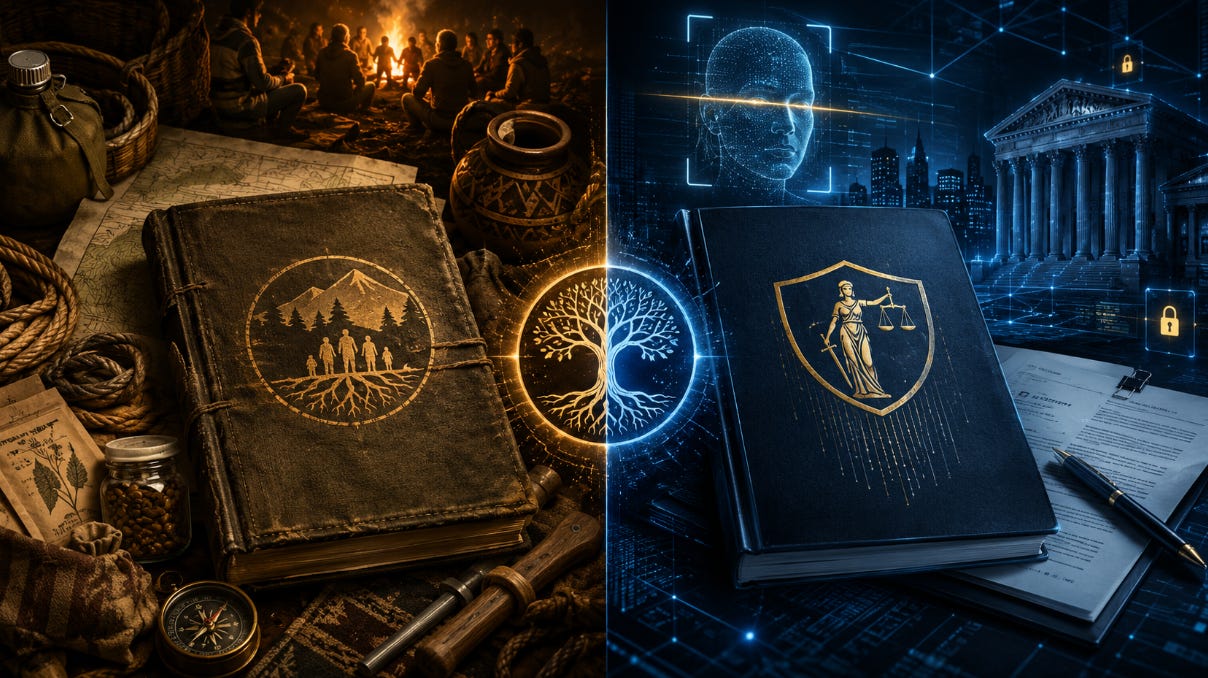
Two Manuals. One Purpose: Preserve Life, Memory and Liberty.
Nearly 700 pages of practical survival, cultural continuity and lawful civil-liberties defence—released completely free

Modern resilience requires more than emergency food, bottled water and a charged phone.
A community can survive physically while losing its memory, practical knowledge, customs and social cohesion.
A population can also remain materially comfortable while gradually surrendering privacy, autonomy and meaningful access to essential services.
That is why I am releasing two complete manuals together:
The Tribal Bible 2026 — First Public Edition
The Global Civil-Liberties Defence Manual — First Public Edition
Together, they contain 687 pages of practical, searchable and offline-accessible material.
Both are free to read, download, print and redistribute in their original, unaltered form.
No subscription gate. No email gate. No £100 price tag.
The Tribal Bible 2026
Cultural continuity, community survival and civilisational renewal
The Tribal Bible 2026 is a 473-page practical reference for communities facing severe disruption, institutional failure, supply-chain collapse, prolonged isolation or the loss of services modern society has been conditioned to take for granted.
It is not merely a list of equipment to purchase.
It is concerned with preserving the things that make a community recognisably human:
Life.
Memory.
Language.
Skills.
Customs.
Land stewardship.
Accountable order.
Care for children, elders and vulnerable people.
The transfer of knowledge from one generation to the next.
The central principle is straightforward:
A culture survives by being lived, taught, recorded and renewed.
The manual covers immediate survival requirements while also addressing the longer-term problem that most preparedness books neglect: what happens after the emergency becomes the new normal?
What it covers
The manual includes extensive material on water, sanitation, food production, shelter, livestock, communications, evacuation, low-resource medicine, disease control, chemical and radiation hazards, fieldcraft, transport, community security, governance, education, craft skills, archives, seed banks, remembrance and rebuilding.
It also contains operational records, checklists and forms designed to be printed and used by real communities rather than merely read once and forgotten.
Its purpose is not to romanticise collapse.
Its purpose is to ensure that, should systems become unreliable or inaccessible, people are not forced to begin again from ignorance.

Download and preserve a copy
Save it locally.
Keep an offline copy.
Store it on more than one device.
Print the pages most relevant to your household or community.
A survival manual stored only in the cloud may not exist when it is actually needed.
The Global Civil-Liberties Defence Manual
A worldwide guide to defending rights in an increasingly automated society
The Global Civil-Liberties Defence Manual is a 214-page worldwide operational reference for challenging intrusive digital systems through evidence, procedure and lawful action.
Digital identity, biometric recognition, automated decisions, facial-recognition watchlists and networked public infrastructure are often presented as isolated conveniences.
The real civil-liberties consequences appear when these systems begin connecting.
Identity can become connected to employment.
Employment can become connected to biometrics.
Biometrics can become connected to payment, transport, healthcare, education or access to public services.
An incorrect automated decision can then become more than a technical error.
It can become exclusion.
Loss of income.
Denial of treatment.
Restriction of travel.
Loss of access to essential services.
A false suspicion attached to a person’s identity may be repeated across multiple institutions before that person even knows the original record exists.
Anger is not a defence strategy
The manual does not encourage sabotage, unauthorised access, obstruction or reckless confrontation.
Those actions often give the institution an avoidable distraction while weakening the legitimate complaint.
The operating principle is:
Force the system to state its authority. Preserve the evidence. Demand the alternative. Use the correct remedy.
The manual helps readers identify:
Who is making the demand or decision.
What authority they claim to possess.
What information has been collected.
Whether meaningful consent exists.
Whether a less intrusive alternative is available.
Whether a human reviewed the decision.
Which regulator, court or complaint route applies.
What evidence must be preserved.
Which deadlines could determine whether a challenge succeeds.
What it covers
The manual includes worldwide jurisdiction routing, civil-liberties and privacy frameworks, operational scenario cards, evidence-preservation procedures, case studies, procedural guidance and reusable templates.
It addresses issues including:
Mandatory digital identity.
Workplace biometric systems.
School and college biometrics.
Facial recognition and private watchlists.
Police surveillance.
Automated eligibility and risk scoring.
AI-assisted healthcare decisions.
Digital wallets and compulsory applications.
Smart infrastructure and connected sensors.
Data breaches and identity takeover.
Border and airport biometric gates.
SIM registration and network restrictions.
Peaceful public campaigns.
Procurement and economic pressure.
Complaints, appeals and litigation preparation.
Why this manual is crucial
Most people do not discover the importance of procedure until they are already facing a deadline.
They object verbally but fail to obtain the demand in writing.
They collect screenshots but lose the original files and metadata.
They complain publicly before preserving the evidence.
They contact the wrong regulator.
They miss an internal appeal.
They assume that an automated decision cannot be challenged.
They accept a biometric or digital route because nobody clearly disclosed that an alternative existed.
The difference between justified anger and an effective defence is often documentation.
A written notice.
A preserved email.
An exact chronology.
A copy of the applicable policy.
A request for the legal basis.
A demand for human review.
An appeal submitted before the deadline.
The purpose of this manual is to help ordinary people create that record before it is too late.
Download and preserve a copy
Keep it searchable.
Store it offline.
Share it with civil-liberties groups, researchers, campaigners, journalists, lawyers and anyone confronting compulsory digital systems.
Why these manuals belong together
The Tribal Bible asks:
How do people preserve life, knowledge, memory and social order when modern systems fail?
The Global Civil-Liberties Defence Manual asks:
How do people preserve privacy, autonomy, evidence and lawful alternatives when modern systems become too powerful?
One prepares for the absence of functioning systems.
The other prepares for their overreach.
These are not opposing concerns.
A resilient community must be capable of functioning independently—but it must also understand how to defend itself lawfully while institutions still exist.
Practical continuity without liberty can become managed dependency.
Liberty without practical competence can disappear during the first serious disruption.
A population capable of preserving both is far harder to control, deceive or render helpless.
Why they are free
An older and unrelated publication using the title The Tribal Bible has appeared through specialist sellers at three-figure prices.
This publication is not that book.
Neither of these manuals has been produced to become a luxury object available only to those who can afford it.
Their value comes from being:
Downloaded.
Read.
Printed.
Tested.
Shared.
Challenged.
Corrected.
Preserved.
Knowledge that could protect a family, preserve a community or prevent an unlawful denial of rights should not be restricted to paying subscribers.
Both manuals may therefore be redistributed completely free, provided they remain unaltered, complete and clearly attributed.
Do not remove the title, author, warnings, sources or edition information.
Do not sell modified copies under the original name.
Do not present altered material as an official Thom Aster edition.
What to do now
Download both documents.
Store copies offline.
Send them to someone who will actually read them.
Print the emergency pages, procedural cards and operational forms most relevant to your circumstances.
Use the Tribal Bible to identify weaknesses in your household or community preparedness.
Use the Civil-Liberties Defence Manual to understand what evidence and procedures may matter before agreeing to intrusive digital requirements.
Do not wait for a crisis before discovering what you should have recorded, learned or preserved.
Thank you so much for all your hard work and effort in putting together these two documents!